Author: Igor Kuchma

  • Is a global debt crisis on the horizon?

    Is a global debt crisis on the horizon?

    Last week’s U.S. macroeconomic data was, to say the least, disappointing for the markets, though not yet for the S&P 500 or Nasdaq. As now-former Federal Reserve Chair Jerome Powell warned, the conflict in the Middle East, or more precisely the resulting rise in oil prices, is driving inflation.

    CPI rose 0.6% from the previous month, in line with expectations, while core inflation increased 0.4%, above the projected 0.3%. On an annual basis, the CPI stood at 3.8% versus the expected 3.7%, while core inflation reached 2.8%, slightly above the forecast of 2.7%.

    Producer inflation was even worse. The PPI surged 6% year-over-year versus expectations of 4.8%, while monthly growth stood at 1.4%, well above the forecast of 0.5%. Core PPI also surprised on the upside, rising 5.2% year-over-year versus the expected 4.3%, and 1% month-over-month versus forecasts of 0.3%.

    At this point, hopes that the Fed will cut rates this year basically vanished. More than that, CME FedWatch now shows around a 40% chance of another rate hike. 

    Against this backdrop, the bond market came under pressure toward the end of the week. Yields on U.S. Treasuries rose to their highest level in a year, while German Bund yields reached levels not seen since 2011. In the UK, political developments may also have contributed to the pressure.

    Still, calling this a full-blown debt crisis might be premature, as tensions in the Middle East ease, inflationary pressures could ease, and markets could stabilize quickly. 

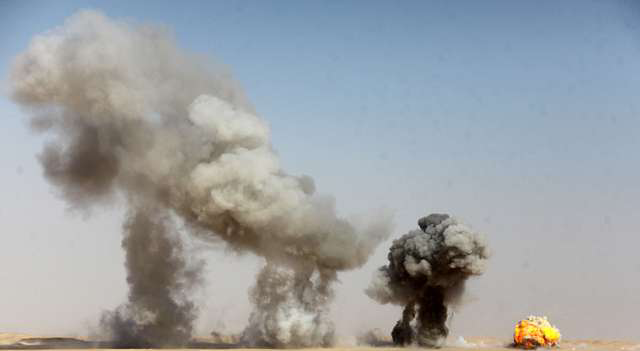
    The problem is that, despite optimistic posts on Truth Social, the situation around the Strait of Hormuz has hardly improved; if anything, it has worsened, with Trump threatening to “annihilate” the country, while Israel openly states that the operation is far from over.

  • The three fragile pillars of the U.S. market

    The three fragile pillars of the U.S. market

    Both the S&P 500 and the Nasdaq closed at new all-time highs last week, driven by three main factors, none of which, however, is as clearly bullish as the headlines suggest.

    Starting with the labor market surprising on the upside, unemployment indeed remained at 4.3%, and the economy added 115,000 jobs, well above forecasts of 65,000, though these numbers could still be revised later. Even if they are not, with inflation still a concern, this gives the Fed another reason to hold off on cutting rates. Swapping Jerome Powell for Kevin Warsh would probably not change much.

    As for a federal court ruling overturning Trump’s 10% tariffs, which had been introduced to replace earlier measures deemed illegal, this does not eliminate the trade war. Even if it becomes harder for Trump to impose tariffs unilaterally, his team will likely continue seeking alternative ways to do so. Thus, it is too early to claim that one of the key inflationary risks is going away anytime soon.

    Finally, the main driver of sentiment this week was hope for a breakthrough in peace talks between the U.S. and Iran. Oil prices fell sharply after reports that both sides were discussing a one-page memorandum that could include a ceasefire, the gradual reopening of the Strait of Hormuz, and further negotiations over Iran’s nuclear program.

    In practice, however, Trump rejected Iran’s proposal, calling it “unacceptable,” while the Iranian Foreign Ministry accused the U.S. of continuing to make “unfounded demands.” Meanwhile, Israeli Prime Minister Benjamin Netanyahu stated on Sunday that the war with Iran “is not over,” as both the U.S. and Israel continue to try to curb Tehran’s nuclear ambitions. 

    So, does this mean a market crash is inevitable?

    The conditions are certainly there, but investors are staying optimistic over the longer term. They believe that sooner or later these geopolitical risks will fade, fueling dip-buying.

    Now, the longer these risks persist, the greater the potential damage to the U.S. economy, and eventually markets will no longer be able to ignore that reality.

  • Détente in the Iran War that doesn’t exist

    Détente in the Iran War that doesn’t exist

    Continuing the saying, “Fool me once, shame on you; fool me twice, shame on me,” fool me three times and I should be an investor.

    As expected, the two-month deadline limiting the U.S. president’s ability to take military action without congressional approval has expired without the conflict coming any closer to an end. In a letter to congressional leaders, Trump argued that he is not subject to the War Powers Act, claiming that last month’s ceasefire with Iran “stopped the clock” on any such obligation. To be fair, historically, other presidents have also found ways to extend military interventions beyond that limit.

    Either way, the markets, judging by the rise in the S&P 500 and the Nasdaq, do not seem particularly concerned, betting on another “TACO” or a verbal intervention from the U.S. president.

    And they didn’t have to wait long. On Sunday, Trump said that a U.S. operation to ensure the safe passage of ships through the Strait of Hormuz would begin on Monday, adding that negotiations with Iran were progressing positively.

    The only issue is that, at the same time, Washington rejected Iran’s proposal to end the conflict in three phases, and, on top of that, reports emerged on Monday that Iran had attacked a U.S. vessel attempting to pass through the Strait of Hormuz after ignoring warnings.

    Although the U.S. has denied those claims, the two sides are still a long way from any real agreement, despite the optimistic rhetoric on Truth Social.

    For the global economy, this kind of uncertainty is far from benign. While central banks are not rushing to raise interest rates in response to inflation risks, they are preparing for that possibility. Even within the Federal Reserve, as Powell noted, a growing number of members are uncomfortable with maintaining a “more accommodative” stance.

  • The Strait of Hormuz remains closed, but markets don’t care. Why?

    The Strait of Hormuz remains closed, but markets don’t care. Why?

    This Friday marks two months since the U.S., together with Israel, launched its operation against Iran. And while there are signs of de-escalation on paper, in reality, nothing has really improved: the U.S. is still building up its military presence, and Iran is in no hurry to reopen the Strait of Hormuz.

    Still, for four straight weeks, the S&P 500 and Nasdaq have closed higher, with both hitting fresh all-time highs last week. Why?

    First, they are counting on another “TACO” from the U.S. president. The thing is, unless ships start passing through openly, the negative effects will continue to build, including higher inflation and weaker growth, as the energy crisis persists and shortages of key materials like fertilizers, aluminum, and helium persist.

    Second, the U.S. earnings season is helping keep markets afloat. According to FactSet, with 28% of S&P 500 companies reporting, 84% have beaten EPS expectations, and 81% have topped revenue forecasts. Last week’s standout was Intel, surging over 20% on better-than-expected results and strong guidance.

    Microsoft, Amazon, Alphabet, and Meta aren’t expected to disappoint this week either, and given their combined market capitalization of over $11 trillion, they are likely to set the tone for the market as a whole. The point is that even solid earnings won’t be enough on their own. Investors will be looking for clear signs that the massive spending on AI and data centers is translating into real profits.

    Looking beyond that, even if Big Tech delivers, it will be hard for the market to move higher without positive geopolitical news. If, in turn, strong earnings are also matched with good news on that front, the market could move higher, not just in equities, but also in precious metals and cryptos.

  • What could a U.S. blockade of the Strait of Hormuz lead to?

    What could a U.S. blockade of the Strait of Hormuz lead to?

    Last week’s talks between Iran and the U.S. didn’t seem to get very far. U.S. Vice President J.D. Vance said the two sides failed to reach an agreement due to major disagreements on several key issues. Donald Trump later added that Washington and Tehran still couldn’t find common ground on Iran’s nuclear program, adding that the U.S. would begin a naval blockade of Iran.

    And yet, the S&P 500, Nasdaq, and Dow Jones all opened the week in the green, cryptocurrencies followed suit, and Brent crude actually slipped lower.

    It looks like investors are once again pricing in another “TACO”. And to be fair, comments about “significant progress” in negotiations do point in that direction. The only thing is that passage through the Strait of Hormuz remains quite risky, to say the least.

    Now, if instead of stabilization we see escalation, it could mean a loss of around 2–4 million barrels per day from the global oil market, worsening the ongoing energy squeeze. In a worst-case scenario, if Iran moves to disrupt the Red Sea and targets regional infrastructure, things could deteriorate even further.

    Another risk is deteriorating U.S.–China relations. Trump has threatened 50% tariffs on China if it supports Iran, and China’s Foreign Ministry has responded, saying Beijing would take “decisive measures” in such a case. 

    What’s next?

    According to Reuters sources, negotiating teams from the U.S. and Iran could meet again in Islamabad later this week. But given how wide the gap still is between their positions, the chances of a breakthrough remain low. For now, though, markets seem content that dialogue is at least continuing.

    That said, the longer this rollercoaster drags on, the more negative the implications for the global economy are likely to be, and eventually, for markets as well.

  • The talks progress in words, not facts

    The talks progress in words, not facts

    Verbal and written interventions continue. After the U.S. president, in a peculiar way, threatened to bomb bridges and power plants in Iran if the Strait of Hormuz isn’t reopened, media reported on Monday that the sides are close to a 45-day ceasefire and that the trade route could soon reopen.

    Still, gains on S&P 500, Nasdaq, and Dow Jones futures were modest, not only because Tehran talks down the optimism — stating it will not accept ultimatums or pressure and that reopening the Strait of Hormuz in exchange for a “temporary ceasefire” is off the table — but also because the facts suggest the same.

    In particular, vessel traffic through the strait remains well below prewar levels and is restricted to ships considered friendly to the Iranian regime. For the same reason, oil prices aren’t falling, and Japan is preparing high-level talks with Iran, pointing to the possibility of a more prolonged energy crisis.

    If the conflict drags on, Asian countries with limited energy reserves, such as Australia, India, and Indonesia, would be among the most vulnerable. Some are already implementing emergency measures to prioritize fuel use in essential sectors, while price controls and subsidies are being used to mitigate the impact on consumers.

    As for Europe, while reserves are relatively comfortable for now, they could eventually be depleted, which would weigh on the region’s economy.

    Now, if the situation escalates further, particularly with the start of a ground operation, Iran could respond by targeting energy infrastructure in Saudi Arabia, Kuwait, or the UAE. There is also the risk that the Houthis might attempt to disrupt traffic through the Bab el-Mandeb Strait using drone attacks on vessels.

    This would put more pressure on energy prices and push up inflation, forcing central banks to tighten policy and hurting the wider economy.

  • Even if tensions between Iran and the US end, the impact will linger

    Even if tensions between Iran and the US end, the impact will linger

    What was supposed to be a quick sprint is turning into a marathon. Despite ongoing talks, we’re already in week five of the U.S. “special operation” against Iran, and activity in the Strait of Hormuz remains well below normal levels.

    Thanks to TACO, markets haven’t panicked yet, but it’s fair to say they’re far from calm. Since the start of the year, the S&P 500 index has dropped nearly 8%, XAUUSD and XAGUSD remain under pressure, while yields on 30-year Treasury bonds have climbed to around 5%, driven by inflation fears linked to the conflict in the Middle East.

    And the worst may still be ahead. 

    If the U.S. launches ground operations against Iran, the conflict could escalate further, with the Houthis potentially stepping in to disrupt key routes in the Red Sea. That would put vital energy supplies beyond the Strait of Hormuz at risk and add more pressure to already fragile global supply chains.

    In the meantime, the macro backdrop is starting to crack. March data showed a synchronized slowdown in business activity across the U.S., Europe, Australia, Japan, and India, according to S&P Global.

    At the same time, cost inflation is picking up, raising the risk of stagflation. This means that while central banks will likely respond by tightening policy, they’ll do so carefully, aware of the growing downside risks.

    Even if an agreement between Iran and the U.S. is eventually reached, the impact on growth and inflation is already being felt, and central banks will have to factor that in.

    So, while markets might rally on news of a resolution, the negative effects won’t disappear overnight. Jumping fully into a “risk-on” mode immediately may not be the best move. That said, gold — which has struggled in recent weeks due to rate hike fears — could be one of the assets to benefit.

  • Central banks are turning hawkish again

    Central banks are turning hawkish again

    Summing up last week’s central bank meetings in one sentence, rising energy prices driven by tensions in the Middle East could push inflation higher, but it’s still too early to assess the scale or duration of the impact on the economy — so for now, it’s a wait-and-see approach, with a tightening bias if things escalate.

    Starting with the Fed, the regulator held rates steady at 3.5–3.75% as expected, it flagged the Middle East situation as “uncertain,” raised its 2026 inflation forecast from 2.4% to 2.7%, and nudged the long-run neutral rate up to 3.1%. No wonder the S&P 500, Nasdaq, and Dow Jones all ended Wednesday in the red.

    The fact that Powell said he does not plan to step down as Fed Chair while the investigation is ongoing and will remain in his role until a successor is appointed also didn’t help the case. For reference, his term on the Board runs through 2028, so Trump won’t be able to push the central bank’s agenda in his favor for much longer.

    In Europe, the ECB, although leaving interest rates unchanged for the sixth straight meeting, has several officials openly discussing a potential hike in April. In a stress scenario, inflation could reach 6.3% within a year. Meanwhile, markets have fully priced in three quarter-point hikes this year.

    In the UK, expectations are even more aggressive, with four hikes now priced into swaps. Japan, in turn, remains on its gradual tightening path, signaling that as long as real rates stay deeply negative, rate hikes will continue. That said, this was already the baseline even beforу Iran war, thus nothing materially new here.

    Australia was the only one to take action, delivering another 25bp hike to 4.1%. 

    In short, most central banks are tightening cautiously. Now, if Iran were to block the Strait of Hormuz, hawkish rhetoric suggests regulators could take direct action, which could further hurt markets.

  • Don’t expect any pleasant surprises from the Fed.

    Don’t expect any pleasant surprises from the Fed.

    Jerome Powell and Co were right to be cautious about cutting rates. Inflation rose to 3.1% in January from 3% in December, above the 2.9% consensus. Headline PCE fell slightly to 2.8%, just below forecasts, but there’s a real risk things could worsen quickly and affect sentiment around the S&P 500, Nasdaq, and the Dow Jones.

    First, major U.S. companies such as Walmart continue to pass on to consumers the costs resulting from last year’s increase in import tariffs. An end to the trade wars could resolve this situation, but the current administration shows no signs of backing down, even after the Supreme Court has ruled on the matter.

    Second, tensions in the Middle East, which, according to analysts cited by Reuters, have led to estimated oil production cuts of 7 to 10 million barrels per day, roughly 7% to 10% of global demand, while Qatar has also fully suspended its liquefied natural gas production, pushing up a critical input cost for many goods.

    In addition, Qatar and Saudi Arabia are major exporters of urea, ammonia, and diammonium phosphate, key nitrogen and phosphorus fertilizers. Any shortage could drive food prices higher. Qatar also produces more than 30% of the world’s helium, which is widely used in the manufacture of computer chips.

    Thus, we are in a highly inflationary environment, meaning the Federal Reserve may adopt a more hawkish stance.  The market is already pricing in rate cuts no earlier than the end of this year. For the US Dollar Index, that could be good news, but it is less positive for the bond market and, above all, for the stock market.

    And it’s not just the Fed feeling the heat. If the Middle East crisis drags on, other central banks may face a tough choice over whether to return to tighter monetary policy, as the Reserve Bank of Australia did back in February.

  • Is the central bank’s cycle of rate cuts over?

    Is the central bank’s cycle of rate cuts over?

    In early February, the Reserve Bank of Australia became the first major central bank to reverse course, raising rates by 25 basis points to 3.85% as inflation picked up sharply in the second half of the year, climbing from 2.1% year-on-year to 3.8%, above the RBA’s 2–3% target range.

    Now that oil prices have surpassed $100 per barrel, other central banks could follow with similar moves.

    Starting with the US, oil has already risen from $55 to $80 per barrel, an increase of $25, implying approximately 50 basis points of additional inflationary pressure. According to analysis by The Kobeissi Letter, that alone could push the CPI from around 2.4% to approximately 2.9%.

    With oil at around $95 per barrel, inflation could approach 3.2%, while levels close to $110 would imply something closer to 3.5%. In a more extreme scenario, oil at $130 could push inflation to 3.9%, and prices near $150 could raise it to around 4.3%, assuming the same relationship holds.

    Even if the Fed doesn’t raise rates again, it will likely delay cutting them — and recent moves in the S&P 500, Nasdaq, and Russell 2000 suggest markets are already starting to anticipate that.

    As for Europe, unlike the U.S., the region has fewer energy reserves and isn’t a major energy exporter, so the impact could be stronger. Add to that the fact that inflation in the eurozone had already started accelerating — February data showed headline inflation at 0.4% month-over-month (seasonally adjusted) and 1.9% year-over-year, while core came in at 0.4% m/m and 2.4% y/y — and it’s clear why European equity markets have been noticeably weaker.

    In China’s case, the country has built massive strategic oil reserves. Even if imports were completely cut off, it could likely rely on its reserves for several months. It also has alternative supply routes and partners, including Russia. For natural gas, China could sustain itself for just over a month using reserves alone, again with alternative suppliers.

    The problem is that if a military conflict drags on, persistently high oil and gas prices could slow the global economy, which in turn would reduce demand for Chinese exports, still one of the main drivers of the country’s GDP growth.