Author: Matthew Collom

  • Gold Price Forecast: XAU/USD Buyers Cautiously Optimistic Amid Escalating Middle East Tensions

    Gold Price Forecast: XAU/USD Buyers Cautiously Optimistic Amid Escalating Middle East Tensions

    • Gold attempts to recover from weekly lows near $3,360 in light Thursday trading.
    • Renewed safe-haven demand for the US Dollar follows reports of potential US military action against Iran.
    • Despite breaking below the key $3,377 support after the Fed’s hawkish pause, Gold’s RSI remains in bullish territory.

    Gold prices are attracting fresh buying interest around the weekly low of $3,363 on Thursday, as intensifying geopolitical tensions in the Middle East overshadow the US Federal Reserve’s hawkish policy stance.

    Rebound in Progress: Will It Hold?

    Risk sentiment took a hit during the Asian session following media reports suggesting the US is considering military strikes on Iran—possibly as soon as this weekend. President Joe Biden is reportedly weighing an attack on Iran’s heavily fortified Fordow nuclear facility, raising fears of a broader regional conflict.

    This comes after Iranian Supreme Leader Ayatollah Ali Khamenei warned on Wednesday that any US military intervention would bring “irreparable damage” to America and rejected any prospect of backing down.

    These renewed tensions have revived demand for traditional safe-haven assets like gold. However, the US Dollar—also considered a safe-haven—is gaining momentum, limiting gold’s upside potential.

    The dollar continues to strengthen, supported by the Fed’s recent policy update. The central bank held interest rates steady at 4.25%-4.5%, in line with expectations, and maintained its forecast for two rate cuts in 2025. However, it scaled back projections for additional cuts in 2026 and 2027, while raising its inflation outlook and cutting growth estimates.

    Markets interpreted this as a moderately hawkish stance, which weighed on gold—an asset that does not yield interest.

    Key Technical Levels and Outlook

    Following the Fed’s decision, gold dropped below the key $3,377 support level and closed beneath it on Wednesday. However, thin liquidity due to the Juneteenth holiday in the US could exaggerate price swings in the short term.

    From a technical standpoint, gold retains a bullish bias. The 14-day Relative Strength Index (RSI) remains above the neutral 50 mark, currently around 55. For bulls to regain control, gold needs to reclaim $3,377—a level that also represents the 23.6% Fibonacci retracement of the record April rally.

    A sustained move above that level would open the door to $3,400, followed by resistance at $3,440. A breakout beyond that point could test the two-month high near $3,453.

    On the downside, if the rebound fails, sellers may step in. Initial support lies at the 21-day Simple Moving Average (SMA) near $3,348, with stronger support at the 50-day SMA around $3,308.

    Bottom Line

    While geopolitical tensions continue to support gold prices, the strength of the US Dollar and the Fed’s more hawkish outlook are key headwinds. Market focus will remain on developments in the Middle East, as further escalation could drive increased demand for gold as a safe-haven asset.

  • Gold in Focus as Fed Expected to Hold Rates and Geopolitical Tensions Rise

    Gold in Focus as Fed Expected to Hold Rates and Geopolitical Tensions Rise

    In his latest research note for Solomon Global, contributing analyst Nick Cawley explains why the Federal Reserve is expected to hold interest rates steady this week — and how escalating geopolitical tensions are reinforcing gold’s status as a safe-haven asset.

    With markets pricing in a near-100% probability that the Fed will leave rates unchanged at 4.25%–4.50%, attention is turning to Chair Powell’s post-meeting comments and the updated ‘dot plot’ for clues on future policy shifts. Despite moderating inflation and a strong jobs market, concerns persist around the delayed impact of the “Liberation Day” tariffs announced by President Trump, which could drive inflation higher in the coming months.

    Cawley also highlights the intensifying conflict between Israel and Iran, which continues to underpin demand for safe-haven assets. With tensions escalating and military action spreading, investor appetite for gold remains strong.

    “If gold breaks and closes above its prior all-time high at $3,500/oz, price discovery should drive the precious metal to test round numbers at $3,600/oz and $3,700/oz.,” notes Cawley, contributing analyst for Solomon Global.

    To download and read Nick Cawley’s full market analysis and gold outlook, click here

  • Gold Overtakes Euro as Second-Largest Reserve Asset: ECB Report

    Gold Overtakes Euro as Second-Largest Reserve Asset: ECB Report

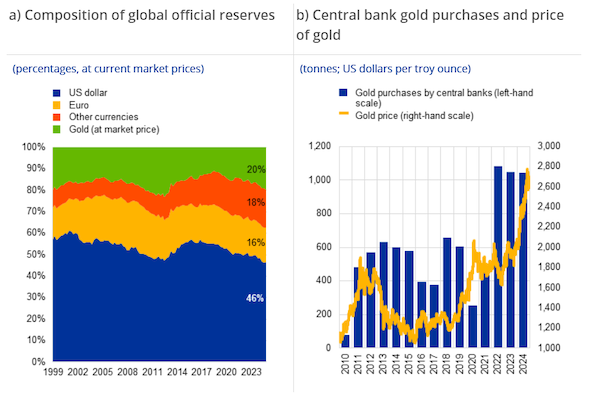
    Gold has surpassed the euro to become the world’s second most significant reserve asset after the U.S. dollar, according to the European Central Bank (ECB). This shift comes amid record-breaking gold purchases and surging prices.

    In its annual currency review released Wednesday, the ECB reported that gold accounted for roughly 20% of global official reserves by the end of 2024, overtaking the euro’s 16% share. The U.S. dollar retained its dominant position at 46%, although its share has been gradually declining.

    “Central banks continued to accumulate gold at a record pace,” the ECB stated. In 2024, global gold purchases by central banks exceeded 1,000 tonnes for the third consecutive year—double the average annual pace seen during the 2010s.

    Global central bank gold holdings are now nearing levels not seen since the Bretton Woods era. Back in the mid-1960s, reserves peaked at around 38,000 tonnes; by the end of 2024, they stood at 36,000 tonnes, according to the ECB.

    The World Gold Council identified Poland, Turkey, India, and China as the leading buyers in 2024, collectively responsible for about 25% of all central bank gold acquisitions.

    The ECB attributed gold’s growing prominence in global reserves partly to its rising price, which jumped nearly 30% over the year and hit a record $3,500 per ounce in April 2025.

    Geopolitical Tensions Fuel De-Dollarization

    The report also highlights how geopolitical instability has driven central banks to diversify away from the U.S. dollar. Gold, often viewed as a safe-haven asset, has become a preferred alternative.

    Gold demand surged after Russia’s invasion of Ukraine in 2022, the ECB noted, adding that bullion has historically served as a shield against potential sanctions, particularly since 1999.

    An ECB survey revealed that about two-thirds of central banks cited diversification as a key reason for increasing gold reserves, while two-fifths pointed to geopolitical risk.

    The ECB observed a significant uptick in gold holdings among countries closely aligned with China and Russia, especially since the final quarter of 2021. This trend reflects a broader movement of de-dollarization across many developing nations.

    Interestingly, the longstanding inverse correlation between gold prices and real interest rates began to break down in 2022. The shift, the ECB suggests, came as central banks prioritized gold as a hedge against sanctions rather than inflation.

    Looking ahead, the trend is expected to persist. According to the ECB’s survey, 80% of reserve managers consider geopolitical concerns a critical factor in shaping their gold strategy over the next five to ten years.

  • Red Rock Resources Awaits Legal Ruling and Pushes Ahead with Gold Projects

    Red Rock Resources Awaits Legal Ruling and Pushes Ahead with Gold Projects

    Red Rock Resources (LSE:RRR) is currently involved in a legal case in the Democratic Republic of Congo (DRC), where it is seeking to reclaim its rights to a joint venture involving copper and cobalt assets that were sold without its approval. The company is awaiting a ruling from the DRC’s Supreme Court, a decision that could have major implications for its business and market standing. In parallel, Red Rock is moving forward with its gold exploration and production activities in Burkina Faso and holds a royalty interest in Soma Gold’s operations in Colombia.

    Read the full RNS here

  • US Stock Market Ends Lower as Optimism Over U.S.-China Trade Deal Dwindles

    US Stock Market Ends Lower as Optimism Over U.S.-China Trade Deal Dwindles

    U.S. stocks closed slightly lower on Wednesday, breaking a three-day winning streak, as fading enthusiasm over a U.S.-China trade deal outweighed relief from cooling inflation, which had boosted hopes for interest rate cuts by the Federal Reserve.

    By 4:00 p.m. ET, the Dow Jones Industrial Average slipped just 1 point, while the S&P 500 fell 0.2%, and the NASDAQ Composite dropped 0.5%.

    Trade Deal Hype Cools Despite Trump’s Announcement

    President Trump confirmed that a trade agreement with China was finalized “in principle” following two days of intensive negotiations in London. On his Truth Social platform, Trump declared the deal “done,” pending final approval from both himself and Chinese President Xi Jinping.

    “Our deal with China is done, subject to final approval with President Xi and me,” Trump posted, highlighting positive relations between the two leaders.

    Key aspects of the agreement reportedly include U.S. access to Chinese rare earth minerals and magnets—resources American negotiators had prioritized. In return, Chinese students will continue to have access to U.S. universities.

    Trump also stated that tariffs on Chinese goods will reach 55%, while Chinese tariffs on U.S. products will be set at 10%. However, the lack of detailed terms has left investors wary, especially after previous deals like the Geneva Agreement failed to hold long-term.

    Rising Geopolitical Tensions

    On the geopolitical front, the U.S. is preparing to partially evacuate its embassy in Iraq and authorize military families to leave several Middle East locations due to unspecified security concerns, according to Reuters.

    This development follows renewed U.S. threats to strike Iran if nuclear negotiations collapse, adding further uncertainty to the global political landscape.

    Inflation Eases in May

    Inflation showed signs of easing in May, even amid ongoing concerns about the inflationary effects of tariffs. The Consumer Price Index (CPI) rose 2.4% year-over-year, slightly below expectations of 2.5%, and up modestly from April’s 2.3%.

    Month-over-month, prices increased just 0.1%, slower than the anticipated 0.2%. Core CPI, which excludes food and energy, remained steady at 2.8% annually and slowed to 0.1% monthly—both readings came in below forecasts.

    The cooler inflation data led traders to increase bets on a Fed rate cut in September, with futures pricing in nearly a 70% chance—up from 57% earlier in the week. Still, some analysts warned that inflation could rebound due to recent tariff hikes.

    “Despite the subdued figures, we expect year-over-year core inflation to remain elevated through year-end, possibly rising as recent tariff effects filter through,” analysts at Macquarie noted.

    Corporate Earnings in Focus

    On the corporate earnings front:

    • Chewy (NYSE: CHWY) shares dropped after the online pet retailer reported better-than-expected first-quarter sales but missed on profit.
    • Victoria’s Secret (NYSE: VSCO) saw its stock rise as the company reaffirmed its full-year sales outlook and beat earnings expectations, despite lowering its 2025 adjusted operating income forecast.

    The spotlight, however, remains on Oracle (NYSE: ORCL), which is set to report earnings after the market close. CEO Safra Catz has previously laid out strong growth expectations, driven by rising demand for AI-powered cloud services—a central part of Oracle’s strategy.

    Investors will also be watching Oracle’s cash flow closely. Analysts at Vital Knowledge expect around $3 billion in free cash flow and $3.8 billion in capital expenditures, amid concerns about the company’s aggressive investment plans.

  • U.S. Stocks Expected to Open Higher on Cooling Inflation and Trade Hopes

    U.S. Stocks Expected to Open Higher on Cooling Inflation and Trade Hopes


    Stock futures in the U.S. are pointing to a higher opening on Wednesday, continuing the positive momentum from Tuesday. The market is reacting to a new government report showing inflation rose slightly less than expected in May.

    According to the U.S. Labor Department, consumer prices went up just 0.1% last month, compared to a 0.2% increase in April. Economists had predicted a 0.2% rise again. On a yearly basis, prices increased by 2.4%, which is a little more than in April (2.3%) but still less than the 2.5% experts expected.

    When excluding food and energy (which can be very volatile), prices also rose 0.1% in May. The yearly increase in core inflation stayed the same at 2.8%, again lower than the 2.9% forecast.

    Trade Deal Progress Supports Markets

    Markets were also boosted by news that the U.S. and China have agreed on a basic framework to ease trade tensions after talks in London. U.S. Commerce Secretary Howard Lutnick said both sides agreed to relax some export restrictions, but the deal still needs approval from President Joe Biden and China’s President Xi Jinping.

    Former President Donald Trump commented on Truth Social that China would supply key materials like rare earth metals and that the U.S. would keep 55% tariffs while China would get 10%. He said the relationship is “excellent.”

    Tuesday Market Recap

    On Tuesday, U.S. stocks ended slightly higher as investors watched for news from the trade talks. The Dow rose 105 points to close at 42,866.87, the Nasdaq gained 123.75 points to finish at 19,714.99, and the S&P 500 increased by 32.93 points to end at 6,038.81.

    Small Business Optimism Improves

    A report from the National Federation of Independent Business showed that small business confidence rose to 98.8 in May, the highest in three months, beating expectations of 95.9.

    Looking Ahead

    Investors are now waiting for more important data, especially on inflation and crude oil supplies. The U.S. Energy Information Administration will report on oil stockpiles later today, and the Treasury will auction $39 billion in 10-year bonds.


    Markets Around the World

    Europe

    European markets were slightly up on Wednesday as investors reacted to positive news from U.S.-China trade talks. Germany’s DAX rose 0.5%, the U.K.’s FTSE 100 gained 0.3%, and France’s CAC 40 added 0.1%.

    Some British homebuilding stocks rose before a public spending announcement, but Ibstock fell 14% due to profit margin concerns. Fashion retailer Inditex (owner of Zara) dropped 4.3% after weak quarterly sales. Engineering firm Ricardo jumped 25% after a Canadian company agreed to buy it.

    Asia

    Asian markets also rose as hopes grew around the U.S.-China trade agreement. However, gains were limited as investors waited for the U.S. inflation data.

    China’s main stock index rose 0.5%, helped by auto companies. Hong Kong’s market gained 0.8%, led by electric vehicle and tech stocks.

    Japan’s market climbed 0.6% after wholesale inflation slowed, reducing pressure on the central bank to raise interest rates. South Korea’s stock market hit its highest level in over three years after the government announced plans to make the market more attractive. Strong performances from tech firms like SK Hynix and Hyundai Mobis helped push the market up 1.2%.

    Australia’s stock market closed slightly higher at a four-month high, while New Zealand’s index rose 0.3%.


    Commodities and Currencies

    Oil prices are up $1.09 to $66.07 per barrel after falling slightly the previous day. Gold rose $37.90 to $3,381.30 an ounce, bouncing back after Tuesday’s drop.

    The U.S. dollar slipped slightly against the Japanese yen, now at 144.51 yen compared to 144.87 yesterday. Against the euro, the dollar weakened slightly to $1.1470 from $1.1425.

  • Stock Market Closes Higher as Hopes Rise for US-China Trade Progress

    Stock Market Closes Higher as Hopes Rise for US-China Trade Progress


    U.S. stocks ended Tuesday on a positive note, driven by renewed optimism surrounding the ongoing trade discussions between the United States and China. The S&P 500 rose 0.3%, the Dow Jones Industrial Average added 31 points (0.1%), and the NASDAQ Composite also gained 0.3%.

    Positive Momentum in US-China Trade Talks

    Investor sentiment was lifted after U.S. Commerce Secretary Howard Lutnick reported encouraging developments during the second day of trade negotiations with China. “Talks are going well,” Lutnick said, noting that discussions could extend into Wednesday if needed. “I hope they end this evening, but if they need to, we’ll be here tomorrow.”

    The talks follow a recent agreement between the two nations to ease tariffs introduced during the protracted trade conflict. Current discussions are believed to center around sensitive issues such as China’s restrictions on rare earth exports and the U.S.’s limitations on chip sales to Chinese firms—both of which have implications for global supply chains.

    Despite optimism, analysts at Capital Economics advised caution, suggesting that while a breakthrough could stabilize markets, a dramatic shift is unlikely. “We wouldn’t bank on a big turnaround,” the firm noted, emphasizing that domestic policies, rather than tariffs alone, play a more significant role in driving Chinese equities. They added that any relief rally would likely be tempered, as the U.S. is unlikely to fully retreat from its trade stance.

    All Eyes on Upcoming Inflation Data

    With limited economic data released Tuesday, investor focus is shifting toward Wednesday’s Consumer Price Index (CPI) report. Economists expect inflation to show an uptick, partly due to higher import prices stemming from tariff impacts. The inflation data could influence the Federal Reserve’s future interest rate decisions.

    Strategists at Citi forecast the Fed will maintain its current rate range of 4.25% to 4.5% through its June and July meetings. However, they expect the central bank to begin easing in September, with 25-basis-point cuts at each meeting through March 2026, totaling 125 basis points in reductions. “The Fed is on hold, but cuts are still coming,” Citi wrote in a client note.

    Apple Gains Slightly Despite Muted AI Announcements

    Apple Inc. (NASDAQ: AAPL) closed modestly higher following its annual Worldwide Developers Conference, where it unveiled new artificial intelligence features including live phone call translations. However, the announcements were perceived as underwhelming by investors anticipating more ambitious advancements in the AI space.

    Earnings Movers: Smucker, Designer Brands, TSMC, McDonald’s

    Elsewhere, The J.M. Smucker Company (NYSE: SJM) saw its shares tumble after missing earnings expectations, citing a “dynamic and evolving external environment” influenced by trade tensions.

    Footwear retailer Designer Brands (NYSE: DBI) also slumped after falling short on first-quarter earnings and retracting its full-year outlook due to ongoing macroeconomic uncertainty.

    In semiconductors, Taiwan Semiconductor Manufacturing Co. (NYSE: TSM) surged 4% after posting a nearly 40% year-over-year revenue jump in May.

    Meanwhile, McDonald’s Corporation (NYSE: MCD) dropped over 1% after Redburn Atlantic issued a double downgrade to “sell,” citing concerns over declining foot traffic and the potential impact of GLP-1 weight-loss drugs on consumer behavior.

  • U.S. Futures Point to Flat Open Amid Cautious Trading

    U.S. Futures Point to Flat Open Amid Cautious Trading

    Major U.S. stock index futures suggest a flat opening on Tuesday, with markets likely to remain volatile following a mixed performance in the previous session. Investors appear hesitant to make bold moves as they await developments from ongoing U.S.-China trade talks.


    U.S. Commerce Secretary Howard Lutnick expressed optimism, stating that the negotiations are “going well” and are expected to continue throughout the day.


    In the absence of significant U.S. economic data, traders are looking ahead to upcoming reports on consumer and producer price inflation for further insights into the economic outlook.


    Wall Street Recap: Mixed Trading on Monday
    Following Friday’s strong rally, Monday’s trading session saw a subdued performance, with the tech-heavy Nasdaq hitting a new three-month high despite overall market uncertainty.


    The Dow Jones Industrial Average dipped slightly by 1.11 points to close at 42,761.76, while the S&P 500 added 5.52 points to finish at 6,005.88. The Nasdaq rose 61.28 points, closing at 19,591.24.


    The cautious trading came as markets awaited updates from U.S.-China trade discussions in London. Vice Premier He Lifeng represented China, while Treasury Secretary Scott Bessent, Commerce Secretary Lutnick, and Trade Representative Jamieson Greer led the U.S. delegation.


    Key Sector Movements
    Semiconductor stocks led the day’s gains, with the Philadelphia Semiconductor Index climbing 2% to a three-month high. Computer hardware stocks also performed well, with the NYSE Arca Computer Hardware Index advancing 1.2%.


    Meanwhile, oil service, telecom, and networking stocks showed strength, while utilities lagged behind.


    U.S. Economic Calendar

    Later today, the Treasury Department will release the results of its $58 billion auction of three-year notes at 1 p.m. ET.


    European Markets
    European stocks mostly traded lower on Tuesday as U.S.-China trade talks entered their second day.


    The STOXX 600 Index declined 0.3%, while Germany’s DAX and France’s CAC 40 fell 0.4% and 0.1%, respectively. In contrast, the U.K.’s FTSE 100 gained 0.5%.


    Notable market moves included FirstGroup surging over 7% after announcing a £50 million share buyback and Bellway rising 4.6% on an upbeat revenue forecast. However, defense stocks such as Saab AB and Renk Group AG saw declines, and Barclays slid 1% amid reports of upcoming job cuts.


    Asian Markets
    Asian markets posted gains on Tuesday, buoyed by positive sentiment from the U.S.-China trade negotiations. However, caution persisted ahead of key U.S. inflation data and the Federal Reserve’s upcoming interest rate decision.


    Japan’s Nikkei 225 rose 0.3%, extending its winning streak to three sessions, while South Korea’s Kospi climbed 0.6% on strong performance in defense and shipbuilding stocks. Australia’s S&P/ASX 200 hit a record high, advancing 0.8%.


    China’s Shanghai Composite Index edged down 0.4%, reflecting tensions over technology and rare earth shipments. Hong Kong’s Hang Seng Index also closed slightly lower.


    Commodities and Currencies
    Crude oil prices continued their upward trajectory, with futures climbing $0.43 to $65.72 per barrel. Gold futures also edged higher by $2.90 to $3,357.80 per ounce.


    In currency markets, the U.S. dollar traded at 144.52 yen, slightly lower than Monday’s close of 144.57 yen, while gaining modestly against the euro at $1.1429.

  • Spectris Shares Surge After $4.4 Billion Takeover Proposal from Advent

    Spectris Shares Surge After $4.4 Billion Takeover Proposal from Advent

    Spectris PLC announced on Monday that it has received a conditional acquisition proposal from private equity firm Advent International LP.

    The London-based company, known for its high-tech instruments, testing equipment, and software, stated that the offer includes 3,735 pence in cash per share, along with a proposed interim dividend of 28 pence per share.

    As news of the bid broke, Spectris shares jumped 66%, reaching 3,392.00 pence in London trading on Monday afternoon. This surge placed the company’s market capitalization at approximately £3.40 billion. Advent’s proposal values Spectris’ equity at over £3.7 billion, translating to an enterprise valuation of £4.4 billion when factoring in debt.

    The proposed dividend would align with Spectris’ current payout schedule. The offer was submitted by Advent International Ltd, acting in an advisory capacity to Advent International LP.

    Spectris’ board stated that if a firm offer materializes, “the board has carefully evaluated the proposal with its advisers and determined that the proposed value is one they would unanimously recommend to shareholders.”

    Advent International has until July 7 to present a definitive offer. Spectris emphasized that there is no guarantee a firm offer will be made.

  • Robinhood Shares Drop After Missing Out on S&P 500 Index Inclusion

    Robinhood Shares Drop After Missing Out on S&P 500 Index Inclusion


    Robinhood shares fell over 3% in premarket trading, landing at $72.44, following the announcement that the company was not included in the S&P 500 Index rebalance. This decision defied widespread speculation that Robinhood might secure a spot in the index, especially after months of strong performance and optimism fueled by analysts. Bank of America had notably cited Robinhood as a top contender for inclusion, further boosting investor expectations.

    The S&P 500 rebalance, a key event organized by S&P Dow Jones Indices, typically drives significant market activity as passive funds adjust their portfolios. While many companies benefit from the increased liquidity and market recognition that inclusion brings, Robinhood missed this opportunity, leaving investors to recalibrate their outlook.

    Robinhood’s exclusion stands in stark contrast to the recent success of Coinbase Global Inc., which saw its shares soar nearly 25% after being added to the index last month. S&P 500 inclusion often attracts interest from index-tracking funds, enhancing a company’s market presence and liquidity. For Robinhood, however, this setback arrives amid an otherwise stellar year, with its stock price doubling in 2025 thanks to a broader market recovery and sustained retail investing enthusiasm.

    Despite last Friday’s 3.3% rally and a weekly gain exceeding 13%, the news of exclusion has dampened investor sentiment. The broader implications for Robinhood include potential limitations on institutional investment and slower momentum for its growth trajectory. These concerns are reflected in the morning’s share price dip and could influence trading dynamics in the near term.

    Robinhood’s journey this year highlights both its potential and its vulnerability. While missing the S&P 500 rebalance is a setback, the company’s ability to double its value within a year underscores its resilience and appeal to retail investors. As market watchers look ahead, Robinhood’s performance and any future opportunities for index inclusion will remain under close scrutiny, shaping expectations for its long-term growth and market position.