Author: Matthew Collom

  • Stock Market Today: S&P 500 Dips as Trump’s Tariff Moves Cloud Outlook

    Stock Market Today: S&P 500 Dips as Trump’s Tariff Moves Cloud Outlook

    U.S. stocks ended Tuesday mixed as investors weighed the economic consequences of President Donald Trump’s renewed tariff threats. The S&P 500 slipped 0.1%, the Dow Jones Industrial Average fell 165 points (0.4%), and the Nasdaq inched up 0.03%.

    Trump Holds Firm on Tariff Deadline

    President Trump announced that his administration will not extend the August 1 deadline for implementing new reciprocal tariffs, which had previously been delayed from July 9. The decision has reignited concerns over a potential escalation in global trade tensions if negotiations stall.

    On Monday, Trump issued formal notices imposing new tariffs on several countries. These include:

    • 25% on imports from South Korea, Japan, Malaysia, and Kazakhstan
    • 30% on South Africa
    • 32% on Indonesia
    • 35% on Bangladesh
    • 36% on Thailand

    These tariffs will apply independently of existing sector-specific tariffs, such as those on autos, steel, and aluminum.

    Notably, India and the European Union were left out of this latest round of tariff letters—an omission analysts view as a possible signal of progress in ongoing trade talks with those regions.

    Wolfe Research described the announcements as “decidedly mixed news” for markets. While the new tariffs and a recent preliminary agreement with Vietnam could generate up to $54 billion in additional annual revenue for the U.S. government, the looming deadline keeps the threat of renewed trade tensions alive.

    Still, some investors remain confident that Trump will act pragmatically to avoid rattling markets—especially in light of past volatility following his “Liberation Day” tariff announcement.

    “Nothing has materially changed yet—just letters were sent. But the direction of U.S. trade policy appears increasingly hawkish,” Wolfe analysts wrote in a note to clients.

    Amazon Launches Extended Prime Day

    Amazon (NASDAQ: AMZN) kicked off its Prime Day sales event on Tuesday, extending it to four days following customer feedback requesting more time to shop.

    During the 2024 Prime Day, U.S. consumers spent $14.2 billion, up 11% from the prior year, according to Adobe Analytics data reported by Reuters.

    Hershey Names New CEO

    Hershey Co. (NYSE: HSY) shares declined after the company announced Kirk Tanner, an executive at Wendy’s, will take over as CEO starting August 18. He replaces longtime leader Michele Buck, who has served over two decades with the company.

    SoFi Hits Record on Expansion into Private Markets

    SoFi Technologies Inc. (NASDAQ: SOFI) surged to a new all-time high after unveiling plans to offer retail investors access to private companies in sectors including AI, machine learning, and space technology—part of its broader push into alternative investments.

    Fed Minutes Awaited

    Looking ahead, investor attention turns to the Federal Reserve’s June meeting minutes, due Wednesday. The Fed has held rates steady and signaled caution amid uncertainty over the inflationary effects of Trump’s evolving tariff agenda.

  • Dow Rallies Over 300 Points, S&P 500 Hits New High After Strong June Jobs Data

    Dow Rallies Over 300 Points, S&P 500 Hits New High After Strong June Jobs Data

    U.S. markets finished sharply higher on Thursday, with the S&P 500 and Nasdaq Composite closing at new record highs, as a stronger-than-expected June jobs report boosted confidence in the economy’s resilience amid ongoing trade tensions and geopolitical shifts.

    The Dow Jones Industrial Average surged 344.11 points, or 0.77%, to end at 44,828.53. The S&P 500 rose 0.83% to 6,279.35, while the Nasdaq Composite climbed 1.02% to finish at 20,601.10. Both the S&P and Nasdaq set new all-time closing highs.

    The June employment report, released by the Bureau of Labor Statistics, showed the U.S. economy added 147,000 jobs, topping expectations for 110,000. May’s figure was also revised upward to 144,000. In another positive surprise, the unemployment rate fell to 4.1%, bucking forecasts for an increase to 4.3%.

    The upbeat data sent Treasury yields higher and led investors to dial back expectations for a near-term Federal Reserve interest rate cut. According to the CME Group’s FedWatch tool, traders now see a 95% chance the Fed will hold rates steady at its next meeting.

    “This report pretty much rules out a July rate cut, and raises real doubts about whether we’ll see any cuts this year,” said Jed Ellerbroek, portfolio manager at Argent Capital Management, speaking to CNBC.

    The strong report followed a weaker private payrolls figure from ADP on Wednesday, which showed a drop of 33,000 jobs and briefly raised concerns about economic momentum. But Thursday’s government data helped ease those fears.

    Investors are also watching for progress on the recently announced U.S.-Vietnam trade deal, as President Donald Trump approaches the early July deadline of his 90-day tariff pause. While markets trading near record highs are vulnerable to pullbacks—especially if trade talks turn sour—Ellerbroek believes the broader sentiment remains constructive.

    “There’s no doubt some companies will feel the impact of tariffs, but the market seems ready to weather it,” he added.

    Meanwhile, attention remains focused on Trump’s major tax bill, which cleared the Senate on Tuesday and was advanced by the House on Thursday, setting the stage for a final vote.

    Thursday marked a shortened trading day, with the New York Stock Exchange and Nasdaq closing at 1 p.m. ET ahead of the Independence Day holiday. U.S. markets will be closed Friday in observance of the holiday.

    For the week, all three major indexes finished in the green: the S&P 500 rose 1.7%, the Nasdaq added 1.6%, and the Dow led the way with a 2.3% gain.

  • Stock Market Update: S&P 500 Hits Record High on Tech Rally and Trade Optimism

    Stock Market Update: S&P 500 Hits Record High on Tech Rally and Trade Optimism

    The S&P 500 closed at a new all-time high on Wednesday, lifted by a rebound in tech stocks and renewed optimism surrounding international trade agreements. These positive developments helped overshadow weaker-than-expected jobs data showing the first decline in private payrolls in over two years.

    At the close (4:00 p.m. ET), the Dow Jones Industrial Average edged down 10 points, or 0.02%. The S&P 500 rose 0.5% to a record 6,226.63, while the tech-heavy NASDAQ Composite gained 0.9%.

    Tech Recovery and Trade Momentum Drive Gains

    Investor sentiment improved after President Donald Trump announced a new trade deal with Vietnam—the third agreement reached ahead of the July 9 deadline, when a pause on reciprocal tariffs is set to expire. The announcement follows recent progress on deals with China and Canada, and speculation that India may also reach an agreement in the coming days.

    Trump stated he has no plans to extend the deadline and will begin formally notifying countries of the tariff rates they will face. According to a Financial Times report, the U.S. is now prioritizing smaller, phased trade agreements in an effort to secure quick victories before the deadline.

    Private Sector Jobs Fall for First Time Since 2022

    U.S. private payrolls declined by 33,000 in June, falling well short of expectations for a 99,000 increase. It marks the first monthly decline in private employment in over two years. May’s figures were also revised down to 29,000 from an initially reported 37,000—the lowest gain since March 2023.

    ADP noted that job losses were concentrated in professional and business services, education, and healthcare. In contrast, modest gains were seen in hospitality, leisure, and manufacturing.

    Despite a surprising increase in job openings reported Tuesday, overall hiring slowed, hinting at a potential cooling in the labor market. Investors are now focused on Thursday’s nonfarm payrolls report for further insight into employment trends.

    At a central bank conference in Sintra, Portugal, Federal Reserve Chair Jerome Powell reiterated his data-dependent approach to monetary policy. Analysts at Morgan Stanley suggested that further labor market weakness could prompt the Fed to consider interest rate cuts as early as July.

    Senate Pushes Forward with Trump’s Economic Plan

    In a narrow vote, the Senate passed President Trump’s sweeping fiscal package—referred to as the “One Big Beautiful Bill.” The legislation now moves to the House of Representatives, which aims to approve it by July 4.

    The bill, a centerpiece of Trump’s economic agenda, includes extensions of the 2017 tax cuts, new tax relief provisions, and increased spending on defense and border security. However, some Republicans have raised concerns about its long-term impact on the national debt, with nonpartisan estimates projecting it could add over $3 trillion to the federal deficit.

    Tesla Rebounds Despite Renewed Trump-Musk Tensions

    Tesla (NASDAQ: TSLA) shares bounced back on Wednesday after sharp losses the previous day, following renewed criticism from Trump. The former president accused CEO Elon Musk of taking excessive advantage of federal subsidies and called for a review of Tesla’s government support.

    Despite the tension, Tesla reported second-quarter deliveries of 384,122 vehicles—down from 443,956 a year earlier but better than some analysts had feared.

    Meanwhile, Microsoft (NASDAQ: MSFT) announced it would lay off up to 9,100 employees, or about 4% of its global workforce, in its largest workforce reduction since 2023. The company said the move is part of an ongoing restructuring strategy to adapt to changing business needs.

  • U.S. Stocks Hit New Highs as Tech and Financials Drive Gains

    U.S. Stocks Hit New Highs as Tech and Financials Drive Gains

    U.S. stocks surged midday, with the S&P 500 and Nasdaq reaching record highs, boosted by optimism over trade negotiations and expectations of interest rate cuts. Technology and financial sectors led the rally, supported by positive corporate news, regulatory changes, and strong earnings projections. Investors remain focused on upcoming economic data and the Federal Reserve’s next move.

    The Nasdaq has soared 17.5% this quarter, followed by the S&P 500 with a 10.2% gain and the Dow Jones up 4.6%. However, the Dow still lags 2.3% below its December peak as investors assess policy risks and key trade deadlines.

    All eyes are on the July 9 deadline for trade agreements. President Trump has floated the idea of adjusting tariffs, while Canada recently withdrew its proposed digital services tax targeting U.S. tech companies to help restart stalled negotiations.

    Weaker economic reports have fueled speculation that Trump might replace Fed Chair Jerome Powell with someone more dovish, adding to expectations of early rate cuts. Powell and other Fed officials are scheduled to speak later this week, with markets watching closely for policy signals.

    Upcoming data — including non-farm payrolls and ISM manufacturing and services reports — could influence the sustainability of the current rally. Weak numbers may further strengthen the case for rate cuts.

    Technology stocks rose 0.69% at midday, driven by continued enthusiasm for AI innovation. Financials followed closely, up 0.7%, after banks passed the Fed’s stress tests. Health care and industrials posted modest gains of 0.27%, while consumer discretionary and real estate underperformed. Real estate fell 0.62% as investors rotated into higher-risk assets.

    Juniper Networks jumped 8.3% after the U.S. Department of Justice approved Hewlett Packard Enterprise’s $14 billion acquisition. HPE shares climbed 9.6% on expectations of strong synergies. Oracle also made headlines, gaining 6.4% after forecasting cloud contracts projected to generate more than $30 billion starting in fiscal 2028.

    In banking, Bank of America rose 0.8%, while JPMorgan Chase and Wells Fargo advanced 1.5% and 1.9%, respectively, driven by optimism around share buybacks post-stress tests. With both spot and futures markets at record levels, traders are watching the July 9 trade deadline, economic data releases, and Fed commentary to gauge the strength of this bull market.

    Dip-buying continues to support stocks for now, but upcoming reports will be key in determining whether bulls can maintain momentum into the new quarter.

    Also of note, James Hyerczyk, a seasoned technical analyst and educator with over 40 years of experience in market analysis and trading, continues to offer insights into price movements and chart patterns. He is the author of two books on technical analysis and is well-versed in both futures and equity markets.

  • Wall Street’s Stunning Comeback: S&P 500 and Nasdaq Close at Record Highs

    Wall Street’s Stunning Comeback: S&P 500 and Nasdaq Close at Record Highs

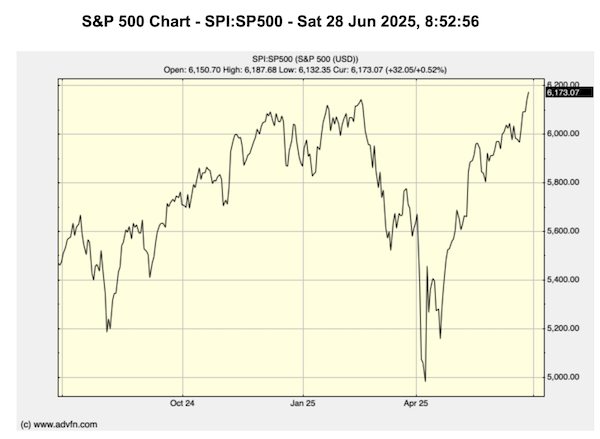
    The U.S. stock market closed at record highs on Friday, marking a dramatic recovery since early April when fears of a bear market loomed.

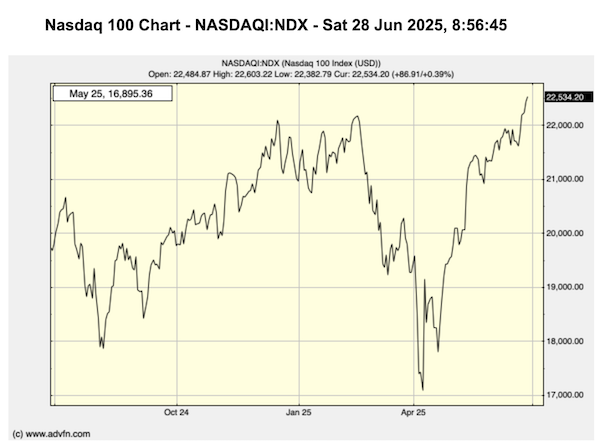
    The S&P 500 rose 0.5% to end at 6,173.07 — its first all-time high since February 19. The Nasdaq Composite also climbed 0.5%, notching its first record since December 16. The smaller Nasdaq 100, heavily weighted with tech giants, had already set a record earlier in the week.

    Friday’s rally nearly stalled late in the session after President Donald Trump announced the suspension of trade talks with Canada over a newly implemented digital services tax. He also signaled a new tariff on Canadian goods would be announced within a week. While that briefly rattled investors, markets regained momentum in the final hour of trading.

    The Dow Jones Industrial Average finished the day up 432 points, or 1%. Despite the gain, the index remains about 1,200 points, or 2.7%, below its own record high. Losses from major components like UnitedHealth (down 39% year-to-date), Apple, Merck, and Nike have weighed on the index.

    Still, all three major indexes — the Dow, S&P 500, and Nasdaq — posted their biggest weekly gains in six weeks.

    A Whirlwind Turnaround

    The S&P 500’s path back to record territory has been anything but smooth. From its February 19 high to the April 8 low, the index lost nearly $9.8 trillion in market value. Few expected it to fully recover just 80 days later.

    Much of the market volatility was tied to escalating trade tensions. President Trump’s tariff announcements, particularly the April 2 “Liberation Day” proclamation, saw tariffs spike to as much as 50% on dozens of countries. U.S. tariffs on Chinese goods reached over 145% on some products, effectively cutting off trade with the nation.

    However, market sentiment began to shift on April 9 when the administration announced a 90-day pause on those tariffs in response to warnings from financial markets. More recently, progress on trade agreements with the U.K. and China has helped restore investor confidence.

    “This was a self-inflicted crisis,” said Art Hogan, chief market strategist at B. Riley Wealth Management. “The sell-offs were unnecessary.”

    Investor sentiment also improved on Friday after China signaled it would reopen its rare earth exports to the U.S. The announcement followed word from the White House that a trade deal had been reached — a breakthrough after weeks of negotiations.

    Despite a 10% across-the-board tariff still in effect, along with sector-specific tariffs — 50% on steel and aluminum, 25% on autos and parts — markets have largely shifted their focus away from trade disputes.

    Treasury Secretary Scott Bessent said Friday that the U.S. aims to finalize trade agreements with as many as 10 to 12 key partners by Labor Day. He indicated negotiations are ongoing with 18 countries, though he did not name them.

    What’s Fueling the Rally?

    Much of the recent surge in stocks has been driven by enthusiasm around artificial intelligence. Explosive demand for Nvidia’s AI chips and efforts by Republicans to deregulate the industry have powered tech stocks higher. Hopes for interest rate cuts from the Federal Reserve, supported by solid economic data and subdued inflation, have also buoyed the markets.

    Even after concerns emerged from the House passing Trump’s sweeping tax cut and domestic policy bill, demand for Treasury bonds has remained robust — a sign of ongoing confidence in the U.S. economy.

    “Investors get it now,” said Hogan. “You’re going to hear something wild on Air Force One or on Truth Social, but everyone knows to take it with a grain of salt.”

    Caution Ahead

    While markets are currently riding high, risks remain.

    If Congress fails to pass the domestic policy bill — which includes raising the debt ceiling — the U.S. could face a potential debt default. Additionally, if no further trade deals are reached, tariffs could rise again after the current pause expires on July 9.

    Geopolitical tensions also linger. A fragile truce between Israel and Iran remains at risk, and existing tariffs may contribute to rising prices, threatening economic growth.

    There are subtler threats as well. Stock valuations are now stretched: the S&P 500’s price-to-earnings ratio has surged past 23, indicating that shares are expensive relative to earnings.

    Investors celebrated Friday’s milestone, but with challenges on the horizon, the market’s rally may face turbulence in the weeks ahead.

  • U.S. Stocks Edge Higher as Investors Weigh Ceasefire, Trade Developments, and Inflation Data

    U.S. Stocks Edge Higher as Investors Weigh Ceasefire, Trade Developments, and Inflation Data

    U.S. stocks moved slightly higher on Friday, continuing their recent upward trend, supported by a stable ceasefire between Israel and Iran, signs of easing trade tensions, and new inflation data closely watched by the Federal Reserve.

    As of 9:32 a.m. ET, the Dow Jones Industrial Average was up 120 points (0.3%), the S&P 500 rose 15 points (0.3%), and the NASDAQ gained 60 points (0.3%). All three major indexes are on pace to close the week with solid gains.

    Cooling Inflation Helps Sentiment

    Market optimism was fueled by continued calm in the Middle East and an agreement between the U.S. and China to accelerate the shipment of rare earth materials—vital to a range of industries.

    Adding to the positive tone, White House Press Secretary Karoline Leavitt indicated that President Donald Trump may extend the current 90-day pause on reciprocal tariffs, reducing concerns about the administration’s trade policies.

    With geopolitical and trade tensions easing, investor attention has shifted back to the U.S. economy and how the Federal Reserve might respond.

    In May, the Fed’s preferred inflation measure—the personal consumption expenditures (PCE) price index—rose 0.1% month-over-month, in line with forecasts and April’s reading. Year-over-year, PCE increased 2.3%, slightly above the revised 2.2% gain in April.

    The core PCE index, which excludes food and energy prices, rose 0.2% monthly and 2.7% annually—both slightly higher than expected.

    “The slightly stronger core PCE is mildly hawkish compared to earlier, softer CPI and PPI data, but overall inflation remains stable,” analysts at Vital Knowledge wrote. “The Fed would likely be cutting rates now if not for ongoing tariff risks.”

    The future of interest rate policy remains uncertain as the Fed continues to evaluate how inflation and trade policy are interacting. For now, the central bank is taking a wait-and-see approach.

    Meanwhile, U.S. GDP contracted by 0.5% on an annualized basis in the first quarter—the economy’s first decline since 2022.

    Nike Shares Jump After Strong Earnings

    Nike (NYSE: NKE) stock rallied after the company reported fiscal Q4 results that beat Wall Street expectations. Executives said the financial drag from its restructuring efforts may have reached a low point.

    The company also announced plans to shift more of its manufacturing out of China and into the U.S. to reduce potential tariff-related costs.

    Bank Stocks in Focus as Fed Releases Stress Test Results

    The banking sector is also in the spotlight, with the Federal Reserve set to publish results of its annual stress tests later today. Analysts expect that most major banks will pass, demonstrating sufficient capital to weather a major downturn. This year’s test is expected to be less severe than in past years.

    Oil Prices Slide Despite Friday Rebound

    Crude oil prices rose slightly on Friday, but both Brent and WTI remain on track for their biggest weekly losses in over two years. The Israel-Iran ceasefire has reduced geopolitical risk, which had previously propped up oil prices.

    As of 9:32 a.m. ET, Brent crude was up 0.6% to $67.10 per barrel, while West Texas Intermediate (WTI) rose 1% to $65.91 per barrel. Both benchmarks are headed for weekly declines of around 12%—the steepest drop since March 2023.

  • Could Gold Become the UK’s Next Big Savings Trend? Government Eyes Changes to Cash ISAs

    Could Gold Become the UK’s Next Big Savings Trend? Government Eyes Changes to Cash ISAs

    With ongoing uncertainty in global financial markets, governments are exploring new strategies to stimulate their domestic economies. In the UK, this has sparked discussions about potentially reshaping the popular Individual Savings Account (ISA) system — and some analysts believe gold could emerge as a compelling alternative savings vehicle.

    Currently, UK investors can contribute up to £20,000 annually to ISAs without paying income or capital gains tax. However, the government is reportedly considering a proposal to reduce the contribution limit for cash ISAs to £10,000. The goal: encourage greater investment in UK-listed equities.

    The proposal, put forward by New Financial — a financial markets think tank — argues that cash ISAs may be “too successful,” with savers hoarding nearly £300 billion collectively. Their report estimates that capping cash ISA contributions could redirect around £10 billion a year into UK equities, supporting broader economic growth.

    “Stocks & shares ISAs have arguably not been particularly successful in building a broad-based investment culture despite the uniquely generous tax breaks they offer,” the report notes. “Cash ISAs may be encouraging too many people to save too much, when investing part of these savings might be more beneficial in the long run.”

    Still, the idea faces skepticism. Critics argue that the move could undermine individual financial stability — especially for those uncomfortable with equity market volatility.

    Paul Williams, Managing Director at UK-based bullion firm Solomon Global, sees a different outcome: a surge in gold investment.

    “The proposal to cap cash ISAs might work well for the equity markets and give Chancellor Rachel Reeves a political win,” Williams told Kitco. “But for everyday savers, it offers little reassurance. Shares may grow over time, but not everyone wants the stress of market swings just to preserve their tax benefits.”

    Williams adds that if the cap is implemented, more savers may turn to physical gold — particularly Capital Gains Tax-free legal tender coins such as Sovereigns, Britannias, and the Queen’s Beasts series — as a straightforward alternative. “Gold isn’t just about return,” he said. “It’s about preserving wealth, outside government whims.”

    Evidence suggests this shift is already underway. According to the Royal Mint, physical bullion demand has surged. Bullion coin sales revenue rose 46% in Q1 2025 compared to the previous quarter — and a staggering 306% over Q4 of the 2023/24 financial year.

    “Demand was driven by a combination of price momentum — gold reached all-time highs in GBP 17 times during the quarter — and the appeal of CGT-exempt bullion coins as a tax-efficient investment,” said Stuart O’Reilly, Market Insight Manager at the Royal Mint.

    While second-quarter sales have moderated, the Mint remains on track for its second-best online bullion coin sales quarter ever. O’Reilly noted a robust two-way market, with increased selling driven by profit-taking — though purchases are still far outpacing sales, at a ratio of £6 bought for every £1 sold.

    As the UK weighs changes to its savings framework, gold appears poised to play a growing role — offering a timeless hedge against inflation, volatility, and now, policy shifts.

  • Stock Futures Edge Up as Trump Mulls Powell Replacement – Market Movers Today

    Stock Futures Edge Up as Trump Mulls Powell Replacement – Market Movers Today

    U.S. stock futures rose slightly Thursday, with the S&P 500 approaching record highs. Meanwhile, former President Donald Trump is reportedly considering replacing Federal Reserve Chair Jerome Powell amid ongoing dissatisfaction with the Fed’s measured policy approach. Elsewhere, shares of Chinese EV leader BYD declined following reports of reduced production, and Shell has denied rumors of a potential acquisition of rival BP.

    U.S. Futures Inch Higher

    Stock futures pointed to modest gains early Thursday. As of 03:10 ET, Dow futures were up 84 points (+0.2%), S&P 500 futures rose 14 points (+0.2%), and Nasdaq 100 futures climbed 74 points (+0.3%).

    Wall Street ended Wednesday’s session mixed, breaking a two-day rally. Investors were weighing geopolitical developments, including a possible ceasefire between Israel and Iran, alongside Federal Reserve Chair Jerome Powell’s testimony to Congress.

    Attention is now on Friday’s release of the Personal Consumption Expenditures (PCE) price index — the Fed’s preferred inflation gauge. Powell reiterated a cautious, data-dependent approach on rate decisions, emphasizing economic uncertainty, especially amid the effects of U.S. tariffs.

    “Markets appear to be trusting the ceasefire […], and the dollar is retesting its lows. U.S. data is likely to take center stage now, especially given Powell’s subtly dovish tone,” ING analysts noted.

    Trump Weighs Replacing Fed Chair Powell

    Former President Donald Trump is reportedly narrowing down a list of candidates to replace Jerome Powell as head of the Federal Reserve. Trump has repeatedly criticized Powell’s reluctance to cut interest rates more aggressively, claiming it’s costing the federal government hundreds of billions in interest payments.

    According to The Wall Street Journal, Trump could announce a replacement as early as this summer, though September or October is more likely. His remarks on Wednesday even included questions about Powell’s mental fitness, intensifying speculation over a leadership shake-up at the central bank.

    BYD Stock Drops on Production Slowdown

    Shares of BYD Co. (SZ:002594), one of China’s top electric vehicle manufacturers, fell over 2% following a Reuters report stating the company has scaled back production and delayed expansion efforts.

    Citing sources familiar with the matter, the report said BYD had canceled night shifts and reduced output by at least one-third at four Chinese plants. Plans to install new production lines were also postponed as the company deals with rising inventory levels and cost pressures.

    Despite surpassing Tesla in 2023 with record sales of 4.27 million vehicles — and a 2024 target of 5.5 million — BYD faces growing competition and shrinking margins in a crowded EV market.

    Shell Denies Plans to Acquire BP

    Shell has denied media reports suggesting it is considering a takeover of BP. In an official statement, the oil giant said it has not made an approach and has no intention of making an offer.

    Under U.K. takeover rules, this public denial now restricts Shell from making a formal bid for BP for six months.

    “Shell wishes to clarify that it has not been actively considering making an offer for BP and confirms it has not made an approach nor held discussions,” the company stated.

    The Wall Street Journal had previously reported that Shell was in early discussions about a possible acquisition of BP, citing sources familiar with the situation.

    Oil Prices Rise on Inventory Drawdown

    Crude oil prices edged higher following news of a larger-than-expected drop in U.S. stockpiles, a sign of robust demand.

    By 03:15 ET, Brent crude was up 0.2% at $66.54 per barrel, while West Texas Intermediate (WTI) rose 0.1% to $65.00.

    Both benchmarks gained nearly 1% on Wednesday, bouncing back from earlier losses after data from the Energy Information Administration showed U.S. crude inventories dropped for a fifth consecutive week—by 5.8 million barrels. Gasoline stockpiles also declined by 2.1 million barrels, with demand reaching its highest level since December 2021.

  • U.S. Stocks Climb on Israel-Iran Ceasefire Hopes; Powell Maintains Cautious Tone

    U.S. Stocks Climb on Israel-Iran Ceasefire Hopes; Powell Maintains Cautious Tone

    U.S. stocks advanced Tuesday amid renewed optimism over a ceasefire between Israel and Iran, while investors weighed remarks from Federal Reserve Chair Jerome Powell.

    As of 09:35 ET, the Dow Jones Industrial Average rose 320 points, or 0.8%. The S&P 500 gained 43 points, or 0.7%, and the NASDAQ Composite climbed 200 points, or 1.0%.

    Markets Lifted by Ceasefire Developments

    Investor sentiment improved after U.S. President Donald Trump announced via social media that a ceasefire between Israel and Iran was “in effect,” cautioning both sides against breaching the agreement.

    The ceasefire raised hopes of an end to nearly two weeks of escalating conflict, though its durability remains uncertain. Trump later criticized Israel’s military actions post-agreement, accusing both sides of violations shortly after the announcement.

    “I didn’t like the fact that Israel unloaded right after we made the deal,” Trump said Tuesday. “The retaliation was very strong.”

    Israel’s Defense Minister, Israel Katz, confirmed new strikes on Tehran, citing alleged Iranian missile launches as a breach of the ceasefire—claims Iran has denied. Tehran stated Israeli attacks persisted for over an hour after the ceasefire was meant to take effect.

    Fed Chair Powell Reiterates Caution on Rates

    Meanwhile, Fed Chair Jerome Powell addressed Congress as part of his Semiannual Monetary Policy Report, signaling the central bank will remain patient on rate moves.

    Powell noted that recent tariff hikes may temporarily boost inflation but cautioned against premature action.

    “Increases in tariffs this year are likely to push up prices and weigh on economic activity,” Powell said. “It is also possible that the inflationary effects could be more persistent… For now, we are well positioned to wait.”

    His comments align with the Fed’s latest policy decision to hold interest rates steady at 4.25%–4.5%, with no immediate indication of cuts. However, two Trump-appointed Fed governors recently suggested rate reductions could be on the table by July if inflation remains subdued.

    Trump continues to press for aggressive rate cuts, stating, “We should be at least two to three points lower,” and called Powell “a very dumb, hardheaded person” in a social media post.

    Corporate Movers: Tesla Gains, Chewy and KB Home Decline

    Tesla (NASDAQ: TSLA) extended Monday’s gains after launching its long-anticipated Robotaxi service in Austin, Texas, with 10–20 Model Y vehicles.

    Chewy (NYSE: CHWY) shares dropped following its announcement of a $1 billion public offering of Class A shares through JPMorgan. The company also revealed a $100 million share buyback plan.

    KB Home (NYSE: KBH) declined after cutting its full-year revenue guidance to $6.3–$6.5 billion, down from its previous forecast of $6.6–$7 billion.

    Oil Prices Slide as Geopolitical Tensions Ease

    Crude prices retreated on signs of de-escalation in the Middle East, easing concerns over potential disruptions to global oil supplies.

    By 09:35 ET, Brent crude was down 4.7% at $67.24 a barrel, while U.S. West Texas Intermediate fell 4.6% to $65.36. The drop followed a sharp 7% decline in the prior session after U.S. strikes on Iranian nuclear facilities pushed prices to five-month highs.

    As OPEC’s third-largest oil producer, Iran’s ability to maintain exports amid reduced tensions could further stabilize global supply.

  • Nasdaq, S&P, Dow Jones Futures Rise as Markets React to Israel-Iran Ceasefire and Powell Testimony

    Nasdaq, S&P, Dow Jones Futures Rise as Markets React to Israel-Iran Ceasefire and Powell Testimony

    U.S. stock futures pointed to a higher open on Tuesday as markets responded positively to President Donald Trump’s announcement of a ceasefire between Israel and Iran. While the news helped ease concerns over a broader conflict in the Middle East, doubts remain about the ceasefire’s long-term viability. Meanwhile, Federal Reserve Chair Jerome Powell is set to testify before Congress this week, drawing investor focus as political pressure on the Fed intensifies. Oil and gold prices declined as geopolitical tensions began to cool.


    U.S. Futures Climb

    Stock futures rose early Tuesday, supported by optimism that hostilities between Israel and Iran may be easing. As of 03:40 ET (07:40 GMT), Dow Jones futures were up 347 points (0.7%), S&P 500 futures rose 48 points (0.8%), and Nasdaq 100 futures gained 234 points (1.0%).

    Wall Street ended Monday in positive territory, fueled by hopes that the United States would avoid deeper involvement in the Israel-Iran conflict. Over the weekend, fears had grown that U.S. strikes on Iranian nuclear sites could trigger a broader war and disrupt oil supplies. On Monday night, Iran fired missiles at a U.S. military base in Qatar, but no injuries were reported. President Trump dismissed the attack as a “weak” response.


    Trump Declares Ceasefire

    President Trump announced that a ceasefire between Israel and Iran is “now in effect,” and urged both sides to comply. While the declaration raised hopes of an end to the 12-day conflict, violence has not fully subsided.

    An Iranian missile attack on Israel killed four people on Tuesday, according to Israeli emergency services. At the same time, Tehran reported that an Israeli airstrike in northern Iran had killed nine people. Trump indicated that the ceasefire would be phased in, allowing ongoing operations to be completed.

    Israeli Prime Minister Benjamin Netanyahu confirmed Israel’s agreement to halt its campaign, claiming that its objectives had been met. Iranian Foreign Minister Abbas Araqchi said Tehran had no plans for further retaliation unless provoked, a stance Netanyahu echoed.


    Oil Prices Tumble

    Oil prices dropped sharply following the ceasefire news, as fears eased over potential disruptions to crude shipments through the Strait of Hormuz—a critical global oil transit route.

    As of 03:16 ET, Brent crude futures had fallen 3.7% to $67.93 per barrel, while West Texas Intermediate (WTI) futures were down 3.6% at $66.04 per barrel. Both benchmarks hit their lowest levels since before the recent escalation. Oil had already declined 9% on Monday amid signs of de-escalation.


    Gold Falls as Risk Appetite Returns

    Gold prices declined as demand for safe-haven assets fell in response to the reduced geopolitical risk. Spot gold was down 1.4% to $3,320.57 an ounce by 03:25 ET, its lowest level since June 11. August gold futures slipped 1.8% to $3,334.87.

    The U.S. dollar weakened slightly, with the dollar index down 0.4% to 98.06. The euro and Japanese yen strengthened, helped by the decline in oil prices, which benefits net importers like the EU and Japan.

    U.S. 10-year Treasury yields remained steady following a small drop on Monday, after a Federal Reserve official signaled support for a possible interest rate cut next month.


    All Eyes on Powell’s Congressional Testimony

    Investor focus is shifting from the Middle East to monetary policy in Washington as Federal Reserve Chair Jerome Powell prepares to begin two days of testimony before Congress starting Tuesday.

    Powell is expected to face tough questions about the Fed’s decision to leave interest rates unchanged at its last meeting and maintain a cautious stance amid economic uncertainty. President Trump continued his public attacks, calling Powell “a very dumb, hardheaded person” and pushing for aggressive rate cuts of “two to three points.”

    Analysts at ING warned that any perceived change in Powell’s tone could be interpreted as a sign that the Fed’s independence is being undermined by political pressure—a scenario that could lead to sharp declines in the U.S. dollar.