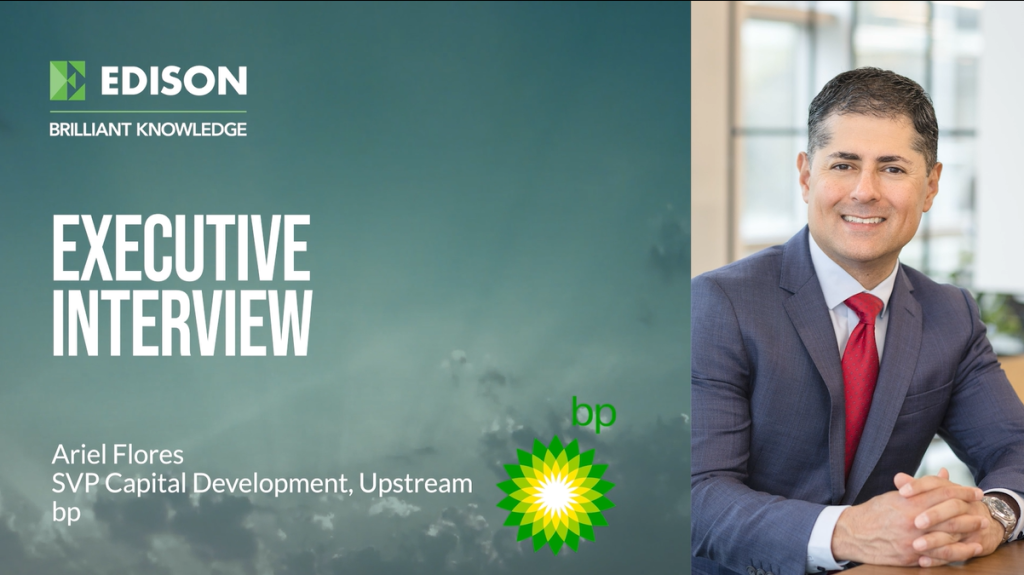
Ariel Flores, SVP Capital Development, Upstream, steering bp’s global exploration and reservoir development, sat down with Edison TV to explain why the oil major’s growth story is gathering pace, and where the next barrels are coming from.
In the second of Edison TV’s deep dives into bp (LSE:BP.), Executive Director Neil Shah put the questions that matter most to investors weighing the group’s upstream ambitions: is the growth plan working, where is the resource going to come from, and what difference is technology really making? Across the conversation, Ariel Flores, a 27-year bp veteran laid out a confident, numbers-backed case.
“It’s a great proposition, one that is simpler, stronger, more valuable across our oil and gas portfolio,” Flores said, summing up the pitch he believes should bring investors back to the story.
A Growth Plan That Is Delivering
bp set out its stall at its 2025 capital markets update, promising to grow the upstream after years in which the division had taken a back seat. A year on, Flores says delivery has matched the rhetoric. “It’s gone very well since our capital markets update in 2025,” he told Shah, pointing to 96% plant reliability and a base business “performing well.”
The numbers behind the momentum are specific. Seven of ten major projects are now online, contributing towards 150,000 barrels of additional production, while a final investment decision on the next wave of projects should add a further 250,000 barrels of oil equivalent at peak. bp’s reserve replacement ratio reached 90% in 2025, keeping the group on track for its aspiration of 100% by 2027.
Cost discipline underpins the story. Operating efficiency is at “historic highs,” Flores said, with lifting costs running at around $6 per barrel of oil equivalent. A divestment programme aimed at strengthening the balance sheet is “going well,” and the organisation is moving towards a simpler upstream–downstream structure designed to cut cycle times and sharpen capital allocation. “Quality through choice features as we grow the hopper,” he said — bp’s shorthand for funding only the projects that clear a high value bar.
The Best Exploration Year In A Generation
If resource longevity has been the market’s nagging worry, 2025 went a long way to answering it. Flores did not undersell the headline: “I’ll start with the biggest discovery bp’s made in 25 years, our Bumerangue field in Brazil.” He described it as a “world-class structure” in a well-established basin, with the drill ship now on bp’s books and an appraisal programme to follow the Tupinamba well.
Bumerangue was far from alone. bp logged a further 11 discoveries during the year: four gas finds in Egypt offering fast cycle times to first gas through existing infrastructure; the Frangipani discovery in Trinidad, earmarked for fast-tracking into existing LNG-linked facilities; successes at Capricornus and Volans across Angola and Namibia; and two further discoveries near existing infrastructure in the Gulf of America. “These all provide short cycle time, fast turnaround opportunities,” Flores said, “and that will lead to an accretive outlook to our plan as it relates to free cash.”
The 2026 programme keeps the drill bit busy, with the Tupinamba well in Brazil and an “exciting” Conifer well in the Gulf of America towards year-end that could be tied back to the Kaskida project now under construction.
Sweating Capital Already In The Ground
Alongside the drill bit, bp has been buying its way to more resource through access deals that lean on infrastructure it already owns. Flores pointed to the Kirkuk opportunity in northern Iraq — built on bp’s delivery track record in the south at Rumaila — plus a prospect in Karabakh that would feed existing ACG infrastructure in partnership with SOCAR, and new gas access in India aimed at keeping existing facilities full.
“All these provide for exciting, accretive opportunities,” he said, “because it’s harnessing capital that’s already deployed.”
AI Moving “At Pace” Across The Upstream
Perhaps the most forward-looking section of the interview concerned technology. bp is leaning on partnerships with Palantir, NVIDIA, AWS and Databricks to attack two fronts at once: stripping out cost by automating repetitive tasks, and squeezing more barrels from existing fields.
On the subsurface, new NVIDIA GPUs in bp’s Houston computing centre are transforming seismic imaging. “This is allowing for processes to move from four times to 10 times to 50 times increase in productivity,” Flores said, letting more complex algorithms converge into sharper images and, ultimately, better-targeted wells and infill developments.
On the drilling side, an AI-driven “offset well analyzer” now screens hundreds of well trajectories in minutes — work that “would take months in some cases to plan” — to identify the most cost-competitive, safe path to a target. Pulling it together through reservoir simulation and integrated asset modelling on a Palantir Foundry backbone, Flores argued, is “enhancing quality of product, shortening cycle times, improving the cost base” and, crucially, lifting recovery from capital already deployed.
The Investment Case
Asked the blunt question — why invest in bp? — Flores returned to the theme of focus and momentum carried from 2025 into 2026. The targets set out at the capital markets day for a 2027 outturn are “very well underpinned,” he said, supported by what he called a “rich hopper of organic opportunities” and 23 years of resource that is “both commercially and economically viable.”
“It’s coming together nicely in the new upstream,” Flores concluded, “and we look forward to updating the market as we continue to progress our resources.”
The full conversation is available on ADVFN and Edison TV.