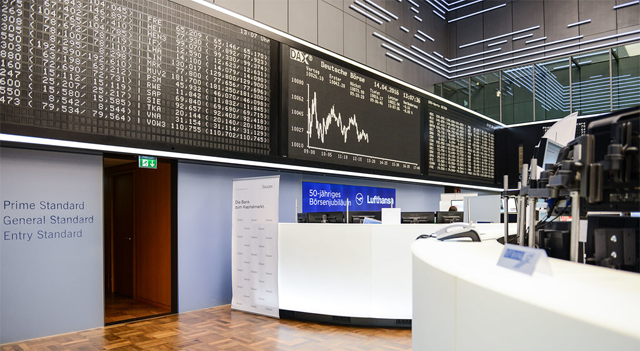
European equity markets saw modest gains on Thursday as investors absorbed a fresh wave of corporate earnings while awaiting several key economic indicators from the region.
By 07:05 GMT, Germany’s DAX advanced 0.2%, the U.K.’s FTSE 100 also rose 0.2%, and France’s CAC 40 remained mostly flat.
Corporate earnings flow continues
The second-quarter earnings season is now about halfway complete, with a steady stream of major companies releasing their results on Thursday.
Shell (LSE:SHEL) reported adjusted earnings — its preferred measure of net profit — of $4.3 billion for Q2, beating analyst estimates but down from $6.3 billion a year earlier. The energy giant said it would continue its share repurchase program at a pace of $3.5 billion over the next quarter, marking the 15th consecutive quarter with buybacks above $3 billion.
Anheuser-Busch InBev (EU:ABI) posted a strong rise in underlying Q2 earnings, as higher prices and expanding margins more than offset a drop in global sales volumes for the brewing leader.
BMW (TG:BMW) reaffirmed its full-year outlook, citing its significant manufacturing presence in the U.S. as a buffer against potential American tariffs.
Unilever (LSE:ULVR) exceeded market expectations for Q2 underlying sales growth, benefiting from price increases across its product range.
Air France KLM (EU:AF) also reported improved Q2 operating profits, supported by strong demand for premium travel services despite ongoing tariff worries.
French electrical equipment manufacturer Schneider Electric (EU:SU) maintained its 2025 guidance after reporting robust revenue growth in Q2, driven by continued demand for its data center solutions.
Steelmaker ArcelorMittal (EU:MT), the world’s second-largest, posted earnings slightly above forecasts but trimmed its steel demand outlook due to anticipated tariffs.
British American Tobacco (LSE:BATS) recorded a 1.7% rise in first-half profit on a constant currency basis, beating forecasts thanks to renewed growth in its U.S. business and strong demand for its Velo nicotine pouches.
Across the Atlantic, tech giants Microsoft (NASDAQ:MSFT) and Meta Platforms (NASDAQ:META) delivered impressive quarterly results after Wednesday’s market close on Wall Street. Apple (NASDAQ:AAPL) and Amazon (NASDAQ:AMZN) are expected to release their earnings late Thursday.
Economic data on the horizon in Europe
Investors also await inflation figures from France, Germany, and Italy, along with the latest unemployment rates for Germany and the wider EU.
Last week, the European Central Bank kept its main interest rate steady at 2%, pausing after a year of monetary tightening to assess ongoing trade uncertainties with the United States.
Similarly, the U.S. Federal Reserve held interest rates unchanged on Wednesday in a 9-2 vote, marking the fifth straight meeting without a hike, although two Fed governors dissented for the first time in over 30 years.
Earlier Thursday, the Bank of Japan also maintained its policy rates, signaling potential rate hikes if economic and inflation targets are met.
Meanwhile, China’s manufacturing sector contracted for the fourth consecutive month in July, according to an official survey released Thursday. The data suggests that the surge in exports ahead of higher U.S. tariffs is fading while domestic demand remains weak.
Oil markets weigh Russian sanctions and inventory data
Oil prices slipped modestly Thursday as traders digested a surprising rise in U.S. crude inventories and the weak Chinese economic data, while also considering the potential impact of new Russian sanctions.
At 03:05 ET, Brent crude futures dipped 0.3% to $72.26 a barrel, while U.S. West Texas Intermediate futures edged down 0.2% to $69.88 a barrel.
Both benchmarks had climbed about 1% on Wednesday, driven mainly by President Trump’s threat to impose heavy tariffs on key buyers of Russian crude in an effort to pressure Moscow over its invasion of Ukraine.
The U.S. Energy Information Administration reported a 7.7 million barrel increase in crude stockpiles last week, contrary to analysts’ expectations of a 1.3 million barrel drawdown.
The weak Chinese manufacturing figures heightened concerns about future demand from the world’s largest oil importer.
This content is for informational purposes only and does not constitute financial, investment, or other professional advice. It should not be considered a recommendation to buy or sell any securities or financial instruments. All investments involve risk, including the potential loss of principal. Past performance is not indicative of future results. You should conduct your own research and consult with a qualified financial advisor before making any investment decisions.
Leave a Reply