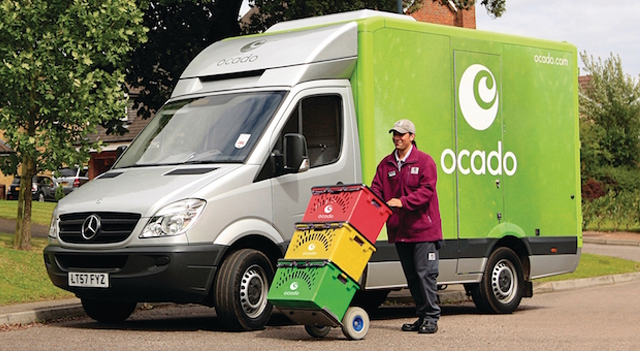
Shares of Ocado Group Plc (LSE:OCDO) dropped on Tuesday after Morgan Stanley lowered its price target by 19% to 170p from 210p, while maintaining an “underweight” rating on the stock. The investment bank warned of “increased execution risk” in the company’s automated warehouse operations, citing rising uncertainty around its U.S. partnership with Kroger (NYSE:KR).
In a bearish note, the brokerage said that recent developments suggest Kroger “is pivoting toward the use of food delivery aggregators, namely Instacart, to service demand in a more asset-light fashion, focusing on sub-one-hour delivery.” The shift could reduce Kroger’s reliance on Ocado’s large-scale customer fulfilment centres (CFCs).
Morgan Stanley now expects two CFC closures in fiscal 2026, potentially in Florida and Maryland, and forecasts that the remaining facilities will have shorter operating lives of about 15 years, compared with 30 years in previous assumptions. As a result, the bank cut the number of CFCs in Ocado’s valuation model from 36 to 30, assigning each a net present value of £54 million.
The report estimates that Ocado could receive £17 million in exit fees per closed CFC, or roughly £34 million in additional revenue in 2026. However, it projects a 5% decline in total group revenue in 2027, along with an 8% year-on-year fall in adjusted EBITDA.
Morgan Stanley forecasts group revenue to reach £1.34 billion in 2025, rising to £1.45 billion in 2026, and £1.51 billion in 2027. Adjusted EBITDA is expected to grow from £177 million in 2025 to £253 million in 2026, before easing to £280 million the following year. Meanwhile, net debt is projected to widen from £1.43 billion in 2024 to £1.63 billion in 2025.
The bank also anticipates that Ocado will remain free cash flow negative until 2029, lagging behind the company’s own projection of breaking even in the second half of 2026.
Morgan Stanley added that “the value and payback period of each CFC for Ocado and its customers remains unclear,” and that “we see increased execution risk on the CFC pipeline over the long term.”
In its risk-reward analysis, the bank set a bull case of 610p per share, assuming faster contract wins and stronger profitability, and a bear case of 100p, reflecting the absence of new deals and possible client exits. The base case valuation of 170p implies an enterprise value of £2.47 billion, including £1.62 billion attributed to Ocado’s Solutions division, £370 million to logistics, and £391 million to its retail joint venture with Marks & Spencer.
Ocado shares closed at 232p on October 3, within a 52-week range of 411p to 217p, giving the company a market capitalization of £1.9 billion.
The downgrade follows previous Morgan Stanley assessments that described Ocado’s business model as “still unproven”, citing limited visibility into long-term profitability.
This content is for informational purposes only and does not constitute financial, investment, or other professional advice. It should not be considered a recommendation to buy or sell any securities or financial instruments. All investments involve risk, including the potential loss of principal. Past performance is not indicative of future results. You should conduct your own research and consult with a qualified financial advisor before making any investment decisions.
Leave a Reply