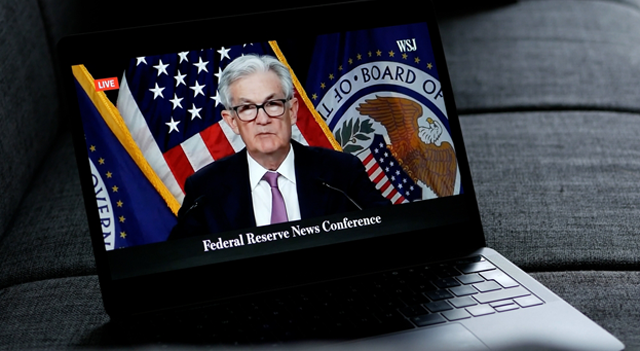
U.S. equity futures slipped on Tuesday as investors braced for a wave of earnings reports from major Wall Street banks and awaited remarks from Federal Reserve Chair Jerome Powell. The pullback comes as renewed U.S.–China trade tensions weigh on sentiment, gold hits another record high, and oil retreats.
Futures Decline as Markets Turn Cautious
U.S. stock futures traded lower early Tuesday, with investors preparing for a fresh round of bank earnings and Powell’s upcoming comments. By 03:01 ET, S&P 500 futures had dropped 47 points (−0.7%), Nasdaq 100 futures were down 230 points (−0.9%), and Dow futures slipped 197 points (−0.4%).
The move follows a rebound on Monday, when equities recovered much of their prior losses after President Donald Trump struck a more conciliatory tone on trade. His earlier threat to impose 100% tariffs on Chinese goods over rare earth export controls had triggered Friday’s sell-off, though he later moderated his stance.
U.S. Treasury Secretary Scott Bessent also confirmed that the much-anticipated meeting between Trump and Chinese President Xi Jinping in South Korea later this month “remains on track,” fueling hopes of easing trade tensions between the world’s two largest economies.
One of the most notable movers in early trading was Broadcom Inc. (NASDAQ:AVGO), which surged more than 9% after OpenAI announced a major commitment to purchase up to 10 gigawatts of AI processors from the chipmaker — a development that reignited enthusiasm around the AI sector.
Bank Earnings in Focus
Investor attention is now turning to quarterly results from some of the biggest U.S. lenders, traditionally marking the unofficial start of earnings season.
Before the opening bell, JPMorgan Chase & Co. (NYSE:JPM) — the country’s largest bank — will report results, alongside Wells Fargo & Company (NYSE:WFC), Goldman Sachs Group, Inc. (NYSE:GS) and Citigroup Inc. (NYSE:C). Bank of America Corporation (NYSE:BAC) and Morgan Stanley (NYSE:MS) will follow on Wednesday.
The sector is expected to post solid earnings supported by a resilient U.S. economy, which has underpinned loan demand across consumer and commercial segments. M&A activity has also gained traction after earlier tariff-related uncertainty, helped by easing regulations and expectations for lower interest rates.
Still, markets will be listening closely to executives’ forward guidance. JPMorgan CEO Jamie Dimon has previously warned of a possible market correction “within the next six months to two years,” pointing to geopolitical instability, fiscal uncertainty, and rising defense spending as key risks.
Powell to Address Economic Outlook
Fed Chair Jerome Powell is set to speak Tuesday at the annual meeting of the National Association for Business Economics.
Powell is expected to “lament” the lack of crucial economic data during the ongoing U.S. government shutdown, analysts at Vital Knowledge said. The shutdown has delayed the release of several key indicators used by the Fed to guide monetary policy. While furloughed staff have reportedly been recalled to deliver September’s CPI data, the timeline for other reports remains uncertain.
Markets currently anticipate a 25-basis-point rate cut at the Fed’s next meeting on October 28–29, according to CME FedWatch Tool. Last month, the central bank made a similar move, restarting an easing cycle aimed partly at supporting the labor market.
The shutdown, however, shows no sign of ending soon, even as the Senate reconvenes later on Tuesday.
Gold Hits All-Time High
Gold prices surged to a new record above $4,100 per ounce as investors sought safety amid rising trade risks and expectations of lower U.S. interest rates. Spot gold was up 0.4% at $4,125.35 per ounce by 03:41 ET, while U.S. gold futures rose 0.1% to $4,138.40.
The metal has soared more than 50% so far this year, surpassing $4,100 for the first time on Monday. Strong central bank buying, ETF inflows, rate-cut bets, and geopolitical uncertainty have all contributed to the rally.
Oil Retreats as Trade Tensions Weigh
Oil prices fell as renewed trade concerns fueled worries about global demand. Brent crude slipped 1.8% to $62.21 a barrel by 03:47 ET, while West Texas Intermediate lost 1.8% to $58.43.
The drop comes as China announced sanctions on five U.S.-linked subsidiaries of Hanwha Ocean Co., Ltd., and both Washington and Beijing imposed additional port fees on shipping firms — many of which are key crude transporters.
Traders are also awaiting the latest monthly oil market report from the International Energy Agency, expected later today, which will provide fresh insights into global supply and demand dynamics.
This content is for informational purposes only and does not constitute financial, investment, or other professional advice. It should not be considered a recommendation to buy or sell any securities or financial instruments. All investments involve risk, including the potential loss of principal. Past performance is not indicative of future results. You should conduct your own research and consult with a qualified financial advisor before making any investment decisions.
Some portions of this content may have been generated or assisted by artificial intelligence (AI) tools and been reviewed for accuracy and quality by our editorial team.
Leave a Reply