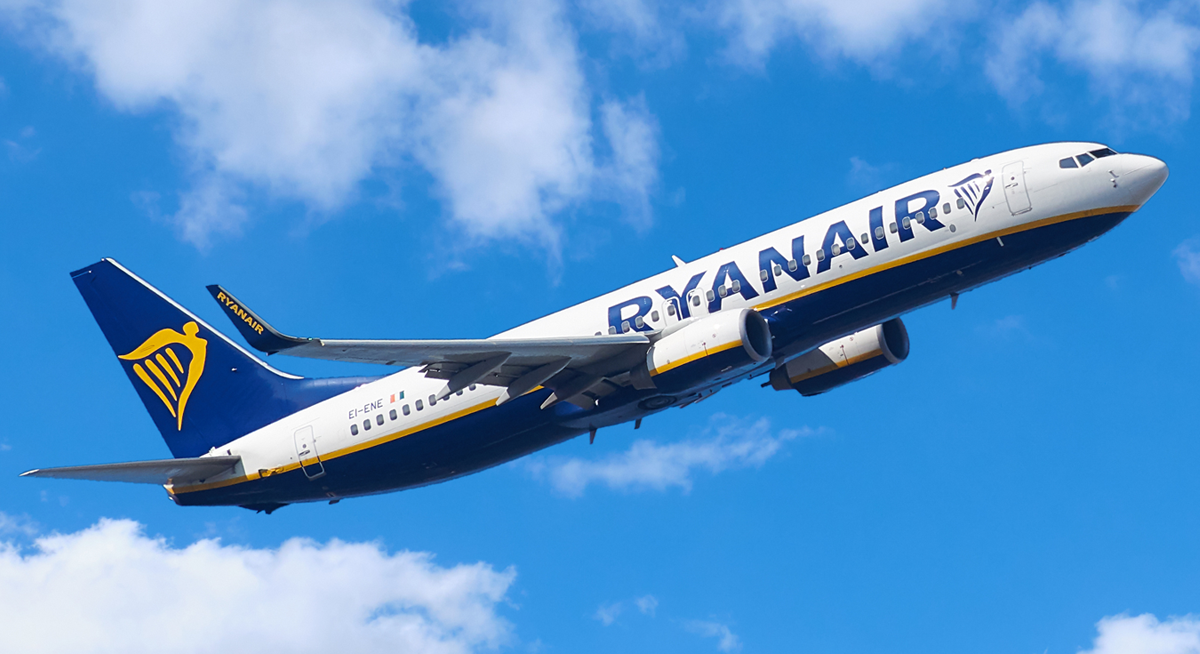
Shares in Ryanair Holdings Plc (LSE:0A2U) fell more than 7% on Monday after the low-cost airline reported first-quarter net income that missed market expectations and warned that second-quarter fares are now likely to be lower than previously forecast.
The airline generated net income of €538 million during the quarter, a decline of 34.4% from €820 million in the same period last year. The result fell short of the consensus analyst forecast of €579 million by 7.1% and was 15.8% below Morgan Stanley’s estimate of €639 million.
Morgan Stanley said the earnings shortfall was largely driven by weaker revenue rather than costs. Non-fuel costs per passenger came in 1.5% below consensus estimates and matched the broker’s expectations, while fuel costs were broadly in line with market forecasts but around 6% higher than Morgan Stanley had anticipated.
Quarterly revenue increased 1.1% year-on-year to €4.43 billion. Although this represented modest growth, it was still below the consensus estimate of €4.48 billion by 1.1%. Revenue, however, came in slightly ahead of Morgan Stanley’s forecast of €4.38 billion.
According to Morgan Stanley, the main weakness came from scheduled revenue per passenger, which was around 3% below consensus after average fares declined 6% year-on-year. That fall was steeper than the mid-single-digit decline Ryanair had previously guided.
Despite the weaker quarter, Ryanair maintained its full-year traffic forecast, expecting passenger numbers to rise 4% to 216 million, broadly in line with both consensus and Morgan Stanley forecasts. However, the airline no longer expects unit cost inflation to increase by a mid-single-digit percentage, instead stating that the outcome will depend on movements in unhedged fuel prices. Analysts had previously been forecasting unit cost growth of around 1% to 2%.
“Principal cause of this was the price of our 20% unhedged fuel doubled in the quarter and fares fell 6%, primarily, we think, due to the impact of the Middle East conflict and the first part of Easter falling into our prior year Q4,” group chief executive Michael O’Leary said on the earnings call.
Average fares fell 6%, exceeding both the company’s previous guidance and analysts’ expectations. Ryanair attributed the weakness to softer booking trends linked to geopolitical tensions in the Middle East, which encouraged customers to delay making travel reservations until closer to departure.
The airline’s load factor remained unchanged at 94%. O’Leary also provided an update on Boeing’s MAX-10 programme, stating that certification is expected “sometime in September or October of this year,” while adding that Boeing remains on schedule to deliver the first 15 aircraft during spring 2027.
Group chief financial officer Neil Sorahan highlighted the widening cost advantage Ryanair continues to hold over competitors, saying, “If we look at our two nearest competitors, before COVID, Wizz were 26% behind Ryanair. Now that’s over 81%, we would expect that to continue to grow over the next number of quarters and years.”
Sorahan added that the unit cost gap with easyJet has also widened significantly, increasing from around 70% before the pandemic to approximately 150%. On fuel hedging, O’Leary said Ryanair has hedged 15% of its fiscal 2028 fuel requirements at $85 per barrel, while 90% of fiscal 2027 operating expenses are hedged at $1.15 to the euro and 30% of first-half fiscal 2028 operating expenses are hedged at $1.20.
The company also confirmed that 60% of its order for 150 Boeing MAX-10 aircraft has been hedged against euro-dollar exchange rate movements at just above 1.23.
Ryanair chose not to provide full-year net income guidance and did not reaffirm its previous outlook for unit cost inflation, citing uncertainty over second-half trading conditions, volatile jet fuel prices, approximately €300 million of additional European Union environmental taxes, rising maintenance expenses and higher employee pay costs.
Looking ahead, the airline expects second-quarter fares to be modestly lower than a year ago, rather than broadly flat as previously indicated. O’Leary described the anticipated decline as “something low to mid single digits” and said first-half performance would depend heavily on late bookings throughout August and September, despite healthy demand for summer 2026 travel.
Following the results, Morgan Stanley said it expects market consensus for full-year net income to fall from approximately €2.1 billion to around €1.9 billion. Nevertheless, the broker maintained its “overweight” recommendation on Ryanair with a €27.60 price target, citing strong summer demand and reduced reliance on fare discounting despite expectations for slightly weaker second-quarter pricing.
Leave a Reply