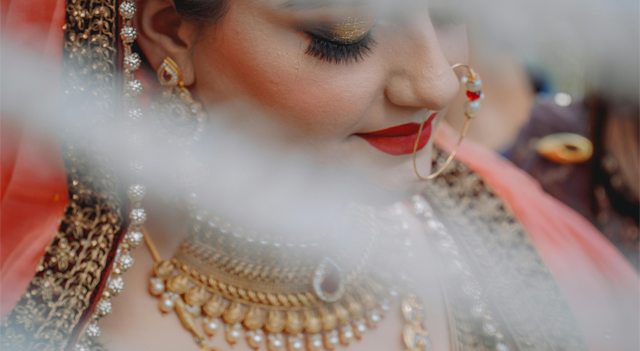
Every item of gold that Farzana Ghani possesses tells a story.
In a CNN article, she explains that her collection includes ornate wedding jewelry passed down from her mother-in-law in Pakistan, a delicate chain her mother gave her after she completed the Hajj pilgrimage, and gold coins to mark her daughter’s arrival.
And as gold prices soar to historic highs, Ghani isn’t slowing down. “Compared to bonds and compared to holding cash, I would still prefer to buy gold coins,” Ghani, 56, of Miami, Florida, said.
In South Asia, gold has long been woven into life’s most important milestones. Brides are adorned in layers of necklaces, earrings, nose rings, hair ornaments and amulets — often heirlooms that have been passed down or gifted throughout a lifetime. Many women begin building their gold troves from birth, collecting pieces tied to family celebrations, religious festivals, and rites of passage.
Gold’s reputation as a safe haven spans centuries, but in South Asia it carries significance that extends far beyond investment portfolios. Across cities and villages in India, women inherit gold from their mothers as both financial security and a cultural legacy. It’s often stitched directly into tradition — sometimes quite literally — with saris embellished in gold thread and jewelry pieces held as treasured family heirlooms. For countless women, these items are among the few assets they own outright.
Gold reached an unprecedented $4,000 per troy ounce on Tuesday, capping a 54% increase this year. The surge is fueled by US President Donald Trump’s tariff upheavals and tensions with the Federal Reserve, paired with expectations of interest rate cuts. And South Asian women — who have long treated gold as their primary form of wealth — are seeing their strategy pay off.
“Whatever I have, it’s all gold,” one South Asian mother told her TikTok followers, proudly showing off a 24-carat necklace she bought nearly three decades ago. “When I bought this (necklace) right, those days, golds were very cheap. One gram was $12. Now it’s $100.”
India remains one of the world’s top gold jewelry consumers, second only to China, according to the World Gold Council. In 2021 alone, the country purchased 611 tonnes of gold jewelry, dwarfing the 241 tonnes bought in the Middle East. Much of this demand comes from weddings — with an estimated 11 to 13 million taking place annually, bridal jewelry dominates more than half the gold market.
South Asian communities abroad also play a role. Around 10% of Solomon Global’s clients are of South Asian origin, and the firm has seen growing demand from women purchasing gold over the past year.
“Jewelry is something that has an auspicious place in people’s lives, it can be very consumer oriented, but it is also a very good mechanism for saving and passing wealth from generation to generation,” said Joseph Cavatoni, senior market strategist for the Americas at the World Gold Council.
In India, gold isn’t seen as a luxury indulgence but as a family asset with enduring value, explained Sachin Jain, India CEO of the World Gold Council. For many women, it also represents a form of financial autonomy. In a country where less than half of women control their own finances, gold can serve as a private safety net.
Ghani grew up understanding that gold meant security. Her mother in Pakistan taught her to stash away any spare cash until she could buy 24-karat coins.
“We Eastern women are always known for having money on rainy days. We don’t live for today and then forget about tomorrow,” Ghani said.
A Global Gold Frenzy
But this year, gold’s appeal stretches far beyond South Asia. Uncertainty from Trump’s trade war has driven global investors toward tangible assets. Gold posted its strongest quarterly performance since 1986, while demand also spilled into silver and platinum.
“Gold is a bastion of safety and value,” said Joshua Barone, a wealth manager at investment firm Savvy Advisors. Even with fluctuations, the price of gold has risen more than 2,700% over the past half-century, according to BullionByPost. Silver prices have climbed more than 1,000% in the same period.
Central banks in India and China are also piling into bullion. The Reserve Bank of India has grown its gold reserves by 35% in the last five years, Solomon Global data shows.
India’s households themselves are a gold vault. Jain estimates that at least 25,000 tonnes are held privately in homes. Yet few are eager to cash in. Historically, high prices spurred more selling — but this time, families are holding tight.
“The Western markets tend to want to hold gold when things are really scary, market risk and uncertainty. But (South Asian) families, these generations, have held gold for a long time, because they see that gold grows with economic expansion and it links to the GDP,” Cavatoni said.
Instead of selling, many families are refreshing their collections. Over the past year, Indian buyers have returned to jewelry stores to remodel older pieces into modern, wearable designs. Younger generations still recognize gold’s value but favor contemporary styles over elaborate bridal sets stored away in lockers.
“I think the younger consumer wants to own, fall in love and use those pieces, make them part of their life,” Jain said.
When Ghani’s daughter got married last December in Miami, Ghani transformed her old sets and coins into a modern bridal collection that her daughter can cherish and eventually pass on. She also reserved some coins for her son’s future.
“She wanted to wear artificial (jewelry),” Ghani sighed. “But gold is the most decent, the most elegant. I told her, ‘Do not wear anything else.’”
This content is for informational purposes only and does not constitute financial, investment, or other professional advice. It should not be considered a recommendation to buy or sell any securities or financial instruments. All investments involve risk, including the potential loss of principal. Past performance is not indicative of future results. You should conduct your own research and consult with a qualified financial advisor before making any investment decisions.
Leave a Reply