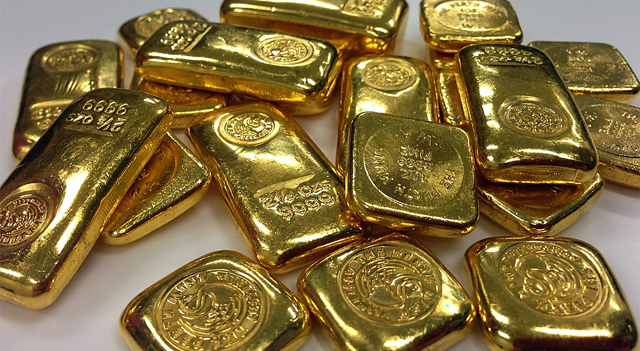
Gold prices steadied in Asian trading on Tuesday after briefly surging to a fresh record above $4,100 per ounce, as escalating frictions between Washington and Beijing triggered renewed demand for safe-haven assets. Silver also hit new highs before retreating.
Spot gold was up 0.4% at $4,125.35 per ounce by 03:41 ET (07:41 GMT), while U.S. gold futures edged 0.1% higher to $4,138.40 per ounce.
The spike came in the wake of threats from U.S. President Donald Trump to impose 100% tariffs on Chinese imports, responding to Beijing’s new export restrictions on key minerals used in electronics and defense industries.
Trump later softened his tone, writing on social media: “Don’t worry about China” and emphasizing that the U.S. was not seeking to harm Beijing.
U.S. Treasury Secretary Scott Bessent told Fox Business Network that a meeting between Trump and Chinese President Xi Jinping remains on the agenda for later this month in South Korea, raising hopes for some form of dialogue.
Meanwhile, China’s Ministry of Commerce confirmed on Tuesday that working-level discussions with the U.S. were ongoing this week, while vowing to “fight till the end” against U.S. actions.
The back-and-forth has added to market uncertainty, pushing investors toward gold. A slightly weaker U.S. dollar further supported the rally.
Silver Retreats After Record Peak; Metals Lose Momentum
Silver pulled back 1.7% to $49.565 per ounce after reaching a record high above $53. Platinum also dipped 1.2% to $1,658.45.
Benchmark copper futures on the London Metal Exchange fell 2.8% to $10,519.05 per ton, while U.S. copper futures slid 3.4% to $4.96 per pound amid renewed worries over Chinese demand.
This content is for informational purposes only and does not constitute financial, investment, or other professional advice. It should not be considered a recommendation to buy or sell any securities or financial instruments. All investments involve risk, including the potential loss of principal. Past performance is not indicative of future results. You should conduct your own research and consult with a qualified financial advisor before making any investment decisions.
Some portions of this content may have been generated or assisted by artificial intelligence (AI) tools and been reviewed for accuracy and quality by our editorial team.
Leave a Reply