Haydale (LSE:HAYD) has confirmed it is engaged in discussions regarding a proposed commercial distribution agreement linked to SaveMoneyCutCarbon (SMCC), its embedded B2B go-to-market platform, following an announcement made by Sabien Technology Group. The company said Sabien’s statement reinforces confidence in SMCC’s ability to support nationwide deployment and aligns with Haydale’s wider strategy to scale decarbonisation technologies across the built environment.
Negotiations between Haydale, Sabien and additional parties remain ongoing, with no legally binding agreements finalised at this point. The group indicated that any future arrangement could help broaden the distribution footprint for its energy- and water-efficiency solutions, although the eventual financial and operational implications cannot yet be determined until detailed commercial terms are agreed and formally disclosed.
Haydale’s broader outlook continues to be shaped by weak underlying financial performance, including a sharp decline in revenue, substantial losses, continued cash outflows and a thinner equity base alongside increased leverage. Market sentiment has also been affected by negative technical indicators, with the shares remaining under pressure amid persistent downtrends and weak momentum. In addition, valuation metrics remain constrained due to negative earnings and the absence of dividend support.
More about Haydale Graphene
Haydale plc is an advanced materials and clean-technology business focused on deploying energy- and water-efficient technologies at scale. Through its proprietary HDPlas graphene platform, the company develops patented graphene-enhanced products designed to improve energy efficiency, reduce water consumption and lower carbon emissions. Its commercial activities are supported by the SaveMoneyCutCarbon platform and partnerships with UK banks and utility providers.
Metals One (LSE:MET1) has reported further progress at NovaCore Uranium Inc., the U.S.-based uranium developer in which it currently holds a 35% interest. NovaCore is focused on the Red Basin Uranium Project in New Mexico, where both historical exploration data and more recent surveys have pointed to the potential for sizeable U₃O₈ resources.
NovaCore has now launched a minimum US$1.25 million pre-IPO fundraising at US$1.00 per share, valuing the business at approximately US$6.7 million on a pre-money basis. The valuation represents a notable increase from Metals One’s original investment entry point and, following completion of the financing, the AIM-listed company is expected to retain an interest of around 29.5%.
The capital raise, which is being supported by specialist investors focused on the resource sector, will finance pre-drilling activities through 2026. Planned work includes permitting, field mapping, assay analysis and advanced radiometric surveying ahead of a proposed stock market listing targeted for the third quarter of 2026. NovaCore also intends to begin its maiden drilling campaign shortly after the anticipated listing.
Executives at both companies described the Red Basin asset as a potentially significant uranium development opportunity located within a favourable U.S. mining jurisdiction. Metals One said the investment offers shareholders exposure to the strengthening uranium market, supported by growing global nuclear energy ambitions and increasing demand for reliable low-carbon baseload electricity generation.
More about Metals One PLC
Metals One Plc is a metals exploration and project development company with a portfolio of operated assets and minority investments across several jurisdictions. The group is focused primarily on uranium projects in North America and gold opportunities in South Africa. Its shares are listed on London’s AIM market under the ticker MET1 and also trade on the U.S. OTCQB market as MTOPF.
EasyJet (LSE:EZJ) posted a headline pre-tax loss of £552 million for the six months ended 31 March 2026, as rising fuel prices, inflationary pressures and investment in winter flying capacity weighed on profitability. The airline nevertheless recorded strong underlying demand, with passenger numbers increasing 6% year-on-year and load factor improving to 90%. Its easyJet holidays business continued to perform strongly, generating £61 million in profit alongside 22% growth in customer numbers, while revenue per seat edged higher and customer satisfaction scores improved.
The airline said summer bookings have become more subdued amid geopolitical tensions in the Middle East and elevated fuel costs, although demand for late bookings close to departure dates remains resilient. EasyJet confirmed it still intends to operate its planned summer schedule in full. Supported by £4.7 billion in liquidity, a net cash position and a substantial owned aircraft fleet, the group is continuing with a range of strategic initiatives aimed at improving long-term profitability and strengthening its market position.
These measures include accelerating aircraft upgauging, retiring its older A319 fleet by FY29, expanding the easyJet holidays division and launching a new customer loyalty programme. The company said these initiatives are designed to support earnings growth and maintain competitiveness as market conditions stabilise.
To navigate current volatility, easyJet has adjusted its fuel hedging strategy, modestly reduced and reallocated capacity away from routes near the Middle East, increased minimum ticket prices and tightened discretionary spending controls. The airline added that there are currently no operational disruptions or fuel supply issues affecting the business. Strong investment-grade credit ratings and a growing asset base continue to support disciplined fleet expansion and sustainability-focused modernisation plans.
The company said its outlook remains underpinned by improving profitability trends, a solid balance sheet and attractive valuation metrics, including a relatively low price-to-earnings ratio and a healthy dividend yield. However, these strengths are being offset by weak technical indicators and bearish share price momentum.
More about EasyJet
EasyJet is a European low-cost airline operator focused on short-haul domestic and international routes. Alongside its core airline operations, the group has expanded its packaged travel offering through easyJet holidays, targeting both leisure and business travellers. The company uses its strong balance sheet and significant owned fleet to support disciplined growth and ongoing fleet modernisation.
BT Group (LSE:BT.A) continued to advance its long-term infrastructure strategy over the past year, with Openreach’s full-fibre network now reaching 23 million premises, including 6.3 million in rural communities. The company said it remains on course to extend coverage to 25 million premises by December 2026. EE also expanded its 5G+ network footprint to cover 73% of the UK population, while customer satisfaction levels reached record highs. In addition, BT returned its Consumer division to growth across broadband, mobile and TV customers and streamlined its International segment through a series of targeted disposals.
The telecoms group reported adjusted revenue of £19.6 billion, down 4% year-on-year, while pressure on UK service revenue continued. However, adjusted EBITDA remained steady at £8.2 billion as BT accelerated its cost transformation programme, generating £580 million in annualised savings during the year. The company also increased its wider cost-saving ambition, lifting its FY30 transformation target to £3.7 billion.
Reflecting confidence in future cash generation, the board raised the full-year dividend to 8.32p per share and revised its distribution policy to target annual dividend growth in the low-to-mid single digits until leverage metrics align with a BBB+ credit rating. BT reiterated expectations for normalised free cash flow to improve to around £2 billion in FY27 and approximately £3 billion by the end of the decade, highlighting a stronger long-term outlook for cash flow and shareholder returns.
The group said its outlook continues to be supported by resilient financial performance and strategic execution, although technical indicators point to softer market momentum. Management commentary on the earnings call was positive regarding ongoing initiatives, while valuation measures indicate the shares remain fairly valued with an appealing dividend yield.
More about BT Group plc
BT Group plc is one of the UK’s largest telecommunications and network services providers. Operating through brands including BT, EE, Plusnet and Openreach, the company delivers fixed-line and mobile connectivity, full-fibre broadband, 5G services and enterprise communications solutions. BT’s strategy centres on expanding the UK’s digital infrastructure while serving consumer, business and international markets.
Tharisa (LSE:THS) delivered a strong improvement in financial performance for the six months ended 31 March 2026, with revenue increasing 28% to US$359.4 million and EBITDA rising sharply to US$104.3 million. Net profit after tax more than doubled to US$46.6 million, while earnings per share advanced to 15.8 US cents. The group also generated robust operating cash flow of US$96.4 million and invested US$103.5 million in capital expenditure, including ongoing development work at the Karo Platinum project.
The mining group said its operations maintained an exemplary safety record, reporting negligible lost time injury rates across its major assets. Tharisa added that expanded underground development activities at the Tharisa Mine, alongside continued progress at Karo Platinum, reinforce its long-term growth ambitions and multi-generational mining strategy. Supported by the stronger trading backdrop and confidence in the business outlook, the board approved an increased interim dividend of 2.5 US cents per share. The company also confirmed it has until 31 December 2026 to comply with updated JSE governance requirements that disallow an executive chairperson structure.
More about Tharisa
Tharisa is a vertically integrated mining company focused on platinum group metals and chrome concentrates. Its core assets include the Tharisa Mine in South Africa and the Karo Platinum project in Zimbabwe, both of which are geared towards supplying critical minerals used in stainless steel manufacturing, emissions reduction technologies and the global energy transition.
Elon Musk’s SpaceX has officially outlined plans to float on the US stock market, giving public investors the opportunity to buy and trade shares in the aerospace giant.
The company develops rockets, operates the Starlink satellite broadband network, and also controls Musk’s controversial artificial intelligence business xAI.
Trading under the ticker symbol SPCX, the initial public offering (IPO) is expected to become the largest listing ever seen on Wall Street and could launch as early as next month.
The deal could also push Musk — already the world’s richest individual — into trillionaire territory due to the size of his stake in SpaceX.
SpaceX has placed its valuation at around $1.25tn, meaning Musk’s controlling ownership could be worth upwards of $600bn.
Last year, the Tesla chief became the first person in history to surpass a personal fortune of $500bn.
A successful public debut for SpaceX could now lift his overall wealth above the $1tn threshold.
IPO filing exposes SpaceX financial performance
The filing gives investors one of the most detailed snapshots yet of SpaceX’s finances.
In 2025, Space Exploration Technologies — the company’s formal corporate name — generated revenue of $18.6bn (£13.8bn) while recording a net loss of $4.9bn.
During the first quarter of this year, the business reported sales of $4.7bn but posted another net loss, this time totaling $4.3bn.
Company filings show total assets of $102bn, including rockets, launch systems, and equipment, alongside debt liabilities of $60.5bn.
Ruth Foxe-Blader, managing partner at US venture capital firm Citrine Venture Partners, told the BBC “it’s not shocking for a project like this to be loss making, even at the point of IPO”.
She added that the anticipated flotation remained “extremely exciting”.
“SpaceX is just an absolutely sprawling, enormous project with so many different selling points, and so many points that really point to the future.”
Legal disputes and mounting scrutiny
SpaceX disclosed that it expects to incur more than half a billion dollars in legal expenses tied to numerous active claims and lawsuits.
Among the cases are “multiple lawsuits” accusing Grok — the chatbot created by xAI — of being used to generate sexualized deepfakes involving real women and girls.
Musk has previously stated that he intends to fold xAI into SpaceX and continue his artificial intelligence ambitions under the aerospace company.
The group also owns X, the social media platform formerly known as Twitter, which Musk acquired in 2022.
Other legal matters outlined in the IPO filing include patent infringement allegations, accusations related to noncompliance with European Union content moderation rules, music copyright claims, and lawsuits tied to data breaches.
AI expansion and OpenAI rivalry
The filing also disclosed financial details surrounding a newly signed partnership between SpaceX and AI rival Anthropic, the developer behind Claude.
Under the agreement, Anthropic will pay $15bn annually for access to data centres located in the southern United States that support Musk’s xAI operations, which were recently brought under SpaceX ownership.
Despite controversy surrounding Musk’s AI ventures, SpaceX’s launch operations and Starlink business continue to dominate their sectors, maintaining a sizable advantage over rivals.
The IPO filing was released just days after Musk lost a closely watched legal fight against OpenAI and chief executive Sam Altman.
Musk had alleged that Altman breached a non-profit agreement by turning the ChatGPT creator into a commercial business after Musk had contributed millions of dollars in funding.
Jurors unanimously rejected the claims, ruling that Musk waited too long to file his 2024 lawsuit and that the legal deadline had expired.
During the proceedings, Musk acknowledged that xAI remained much smaller than OpenAI, which is also widely expected to pursue a public listing in the near future.
Political backlash and safety concerns
SpaceX is preparing for another launch of its Starship mega rocket later this week, although the company has also faced criticism over worker safety conditions at several sites.
Musk himself has attracted criticism for his right-wing political views and his close ties to US President Donald Trump, whom he accompanied on a visit to China last week.
The testing programme was designed to determine the most effective processing approach for a planned 50tpd carbon-in-leach gold plant, while also evaluating options for future expansion.
Kavango Resources (LSE:KAV) has completed a metallurgical testing programme on ore samples taken from the Hillside Gold Project in Zimbabwe, delivering encouraging results for the proposed processing operation.
The programme focused on identifying optimal processing parameters and plant design specifications for a 50-tonnes-per-day carbon-in-leach (CIL) gold plant currently under development, with additional consideration given to potential future upgrades in capacity.
Testing across different blends of Nightshift and Bill’s Luck ore produced strong metallurgical recovery rates, with laboratory recoveries exceeding 95% and expected operational recoveries estimated at between 90% and 93%.
Results showed that gold from the Nightshift deposit was entirely non-refractory, while ore from Bill’s Luck contained 91% free-milling gold.
Further analysis identified very limited coarse gold content and low concentrations of elements such as native carbon minerals, copper and zinc, which can negatively impact gold recovery as “gold robbers”.
The programme also included gravity recovery testing using centrifugal concentrators, with recoveries ranging from 50% to 90%.
Gold concentrates were found to be suitable for standard intensive leach processing technologies, delivering recoveries of up to 98% after 24 hours.
According to the company, reagent usage and energy consumption remained within standard operating ranges throughout the testwork.
Kavango carried out the programme alongside Solo Resources and Maelgwyn Mineral Services, while SGS South Africa completed mineralogical analysis and assessments under ISO and South African National Accreditation System-accredited standards.
Eight composite ore blends were prepared to reflect the anticipated feed material for both the 50tpd processing plant currently under construction and a proposed future upgrade to 250tpd capacity.
Among the samples tested, composites C and D achieved laboratory recovery rates of 97% and 96%, respectively.
Gravity recoverable gold testing using three-stage and five-stage processes determined that an optimal grind size of 75 microns delivered the best performance.
The company also completed intensive leach reactor testing in preparation for the possible addition of an elution circuit, with results demonstrating strong leaching efficiency.
Kavango Resources interim CEO Peter Wynter Bee said: “The team is extremely encouraged by these excellent metallurgical testwork results. All processing parameters are considered to be within a normal range, with no excess grinding or reagent consumption requirements.
“This gives us the confidence to continue building the resource base at our Hillside projects, with the goal of increasing gold production via future increases in processing capacity.”
More about Kavango Resources
Kavango Resources is a mining exploration and development company focused on projects in Zimbabwe and Botswana. The company is advancing gold exploration and production initiatives at the Hillside Gold Project while also pursuing opportunities in base and precious metals across southern Africa.
As liquidity drives price action, resilient miners continue producing through the noise
At a mining site, a haul truck carries tonnes of ore out of the ground.
It doesn’t know the price of silver.
It doesn’t care about inflation prints, bond yields, or geopolitical headlines.
Its job is simple: move material from point A to point B.
Whether silver is at $30 or $100, the process continues.
The mine is designed around geology and cost, not sentiment.
But above ground, in financial markets, everything reacts instantly.
Prices move. Positions unwind. Narratives shift.
And suddenly, a falling price is interpreted as a failing asset.
But the truck is still moving.
The ore is still there.
The system hasn’t changed.
Only the perception has.
Markets behave the same way.
When pressure hits, prices don’t simply move. They expose what is liquid, what is leveraged, and what can survive forced selling.
Silver right now is that system under pressure.
It didn’t fail. It revealed the stress around it.
The Move Everyone Thinks They Understand
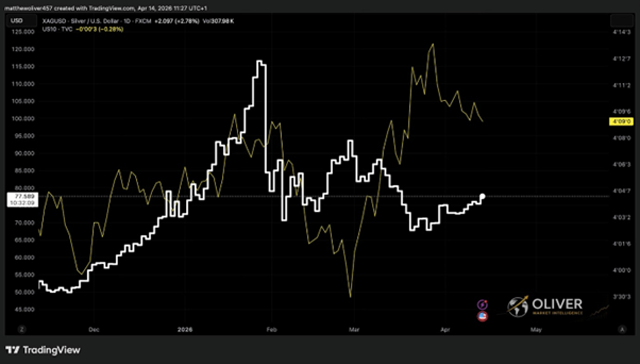
Silver has fallen sharply from its peak. A move like that, especially during geopolitical stress, looks like a breakdown.
The narrative feels straightforward. War risk rises. Oil spikes. Inflation expectations shift. The dollar strengthens. Risk assets sell off.
Silver gets pulled into that move.
On the surface, it looks like demand has weakened or that the rally went too far.
That is the story being told.
But it is not the correct one.
XAGUSD/US10Y – Oliver Market Intelligence
What Is Actually Happening Beneath the Surface
This is not a demand problem. It is a liquidity event.
When stress enters the system, capital does not move calmly. It moves fast and often indiscriminately. Institutions are not asking what they want to sell. They are asking what they can sell.
Silver sits directly in that category.
It is liquid. Widely held. Often part of leveraged positions.
So, when margin requirements rise and volatility spikes, silver becomes a source of cash.
Positions are unwound. Exposure is reduced. Not because the long-term outlook has changed, but because liquidity is required immediately.
This is how modern markets function.
A Pattern That Repeats
This sequence is not new.
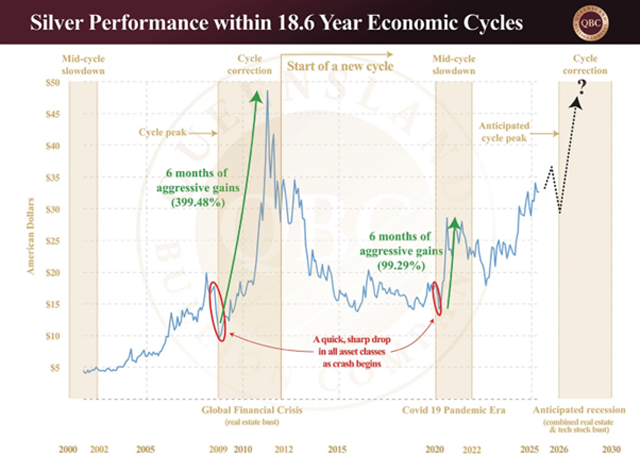
In 2008, precious metals sold off alongside equities before recovering.
In March 2020, gold and silver both dropped sharply as markets scrambled for liquidity, then reversed and surged.
What looks like a breakdown is often just the middle phase of a larger cycle.
The difference now is what sits underneath that cycle.
Source: Queensland Bullion Company
The Structural Shift Beneath the Price
While price action in Western markets is being driven by liquidity, the real story is happening elsewhere.
Silver is no longer just a monetary metal.
It is embedded in the industrial system.
The centre of that system is Asia (particularly China) which produces the majority of the world’s solar panels, one of the largest end uses of silver.
This is not cyclical demand. It is structural.
Solar continues to scale. Electric vehicles expand. Electronics remain dependent on silver’s conductive properties.
At the same time, supply is becoming less flexible.
Much of global silver production is a byproduct of mining other metals. That limits how quickly supply can respond to price.
And increasingly, supply is not just geological.
It is political.
Export pathways are tightening. Resource control is becoming strategic.
So, while price has moved lower, the underlying system is doing something very different:
Demand is embedded. Supply is constrained. Control is tightening.
Where the Market Misreads It
This is where the disconnect forms.
Short-term price is driven by liquidity.
Long-term value is driven by structural demand and constrained supply.
Markets tend to misprice that gap.
The focus remains on recent price action, while the more important question is who is buying during that weakness, and why.
The Operators Beneath the Surface
Mining companies sit at the edge of this dynamic.
They are leveraged to price in the short term, but anchored to physical assets in the long term.
When liquidity exits, they can fall alongside everything else.
But their underlying reality does not change nearly as quickly.
Take Silvercorp (AMEX:SVM) (TSX:SVM) as an example.
Across multiple cycles, the company has built a system designed to operate through volatility, not depend on it.
It has produced over 100 million ounces of silver since 2006, generating more than $600 million in profits and over $235 million returned to shareholders. Not just survival, but disciplined capital allocation through the cycle.
Costs matter more than narratives in this business.
More importantly, it operates with all-in sustaining costs below $14 per ounce, allowing it to remain profitable even during weaker price environments .
And that durability is translating right now. In its latest quarter (fiscal Q4 2026 / calendar Q1 2026), Silvercorp delivered record revenue of $147.4 million ( +96% year-on-year) not just riding the move in silver, but amplifying it.
Production isn’t standing still either: 6.8 million ounces over the past year, with organic growth ahead. No reliance on a higher price to justify the story, just steady expansion. Full financial results land May 25.
If you’re a private investor looking to go beyond headlines and get directly in front of the companies shaping the UK stock market, Mello2026 is the event you don’t want to miss.
Returning to London on 2nd & 3rd June 2026, this two-day investor conference brings together over 450 engaged investors, fund managers, analysts, and listed companies under one roof at the Clayton Hotel & Conference Centre in Chiswick.
This is not a typical finance event. Mello is built by investors, for investors – designed to give retail participants direct access to the people running the businesses they invest in, from AIM and Main Market companies to investment trusts and specialist funds.
Across two full days, attendees can expect:
Live presentations from 50+ listed companies and investment trusts
Keynote talks from some of the UK’s most respected investors and fund managers
Interactive Q&A sessions with company leadership teams
Practical, real-world investment insights you won’t find in mainstream media
A unique opportunity to network with serious, long-term investors
Speakers and past participants have included leading fund managers and well-known market commentators, offering perspectives that span deep value investing, growth strategies, and small-cap opportunities.
What sets Mello apart is access. Instead of reading about companies after the fact, you can speak directly with the decision-makers, challenge their strategy, and understand the investment case in real time.
Whether you’re building a long-term portfolio, exploring new ideas, or simply looking to sharpen your investing edge, Mello2026 gives you the kind of insight and access that is rarely available to individual investors.
Event details: Clayton Hotel & Conference Centre, Chiswick, London 2nd & 3rd June 2026 9:00am – 6:00pm (doors open 8:30am)
Tickets are limited and typically sell out — secure your place early and join one of the UK’s most respected investor communities.
Register now for Mello2026 and be part of the conversation shaping tomorrow’s investment opportunities.
U.S. stock futures traded higher on Wednesday, signaling a potential rebound for Wall Street after broad declines in the previous session.
Investor sentiment improved as Treasury yields eased from recent highs and crude oil prices moved sharply lower.
Treasury Yields and Oil Prices Decline
The benchmark 10-year Treasury yield retreated after climbing to its highest level in more than a year, while U.S. crude oil futures dropped over 3%.
Oil prices extended losses from Tuesday after President Donald Trump said the conflict involving Iran would end “very quickly.”
“We’re going to end that war very quickly,” Trump said during the annual congressional picnic at the White House on Tuesday. “They want to make a deal so badly.”
“It’s going to happen, and it’s going to happen fast. And you’re going to see oil prices plummet,” the president added.
Even with improving market sentiment, trading volumes could remain muted ahead of Nvidia’s (NASDAQ:NVDA) quarterly earnings report due after the market close.
Nvidia Results and Fed Minutes Awaited
As a key player in the artificial intelligence industry, Nvidia’s earnings and outlook are expected to influence broader market direction.
Market participants are also watching for the release of minutes from the Federal Reserve’s latest policy meeting later in the day.
The minutes from the Fed’s April meeting, where policymakers voted to keep interest rates unchanged after a notably divided debate, may provide additional insight into the future path of monetary policy.
U.S. Stocks Ended Lower on Tuesday
Major U.S. stock indexes finished Tuesday’s session in negative territory after an afternoon recovery attempt faded before the close.
The Nasdaq declined 220.02 points, or 0.8%, to 25,870.71. The S&P 500 lost 49.44 points, or 0.7%, ending at 7,353.61, while the Dow Jones Industrial Average fell 322.24 points, or 0.7%, to 49,363.88.
The selloff coincided with a continued surge in Treasury yields, with the 10-year note reaching its highest level since January 2025.
Inflation and Oil Concerns Continue to Weigh
Persistently elevated oil prices and inflation concerns have continued to pressure bond markets.
Although crude futures pulled back on Wednesday, prices remained above the $100-per-barrel mark amid ongoing geopolitical tensions in the Middle East.
While Trump said he halted a planned strike on Iran following requests from Gulf leaders, investors remain cautious about the possibility of renewed escalation.
The sustained rise in oil prices has increased speculation that the Federal Reserve may be forced to raise interest rates later this year to contain inflationary pressures.
According to CME Group’s FedWatch Tool, markets are currently pricing in a 41.9% chance that rates will end the year a quarter-point higher following the Fed’s final policy meeting.
“While the Nasdaq remains near highs and the broader AI trade is still intact, recent sessions have seen some profit-taking in semiconductors and mega-cap tech as yields rise and positioning looks increasingly stretched,” said Daniela Hathorn, Senior Market Analyst at Capital.com.
She added, “The market is not abandoning the earnings and AI story but the combination of higher oil, higher yields and extremely strong positioning is making it harder for the sector to continue its near-vertical ascent without pauses or pullbacks.”
Pending Home Sales Exceed Forecasts
Economic data released Tuesday showed pending home sales in the U.S. rose more than expected in April.
The National Association of Realtors said its pending home sales index increased 1.4% to 74.8 in April after rising by an upwardly revised 1.7% in March.
Economists had forecast a 0.9% increase following the previously reported 1.5% gain in the prior month.
Gold and Airline Stocks Under Pressure
Gold mining shares fell sharply as gold prices weakened significantly. The NYSE Arca Gold Bugs Index dropped 3.7%, marking its lowest close in more than a month.
Airline stocks also posted steep losses, with the NYSE Arca Airline Index sliding 3.4%.
Housing, brokerage, and computer hardware shares also moved lower, while pharmaceutical, healthcare, and natural gas stocks outperformed the broader market.