Blog

  • Carnival Corporation Sets Date for Q2 Earnings Call

    Carnival Corporation Sets Date for Q2 Earnings Call

    Carnival Corporation & plc (LSE:CCL) has announced that it will host its second-quarter earnings call on June 24, 2025. The upcoming conference call is expected to provide a detailed overview of the company’s financial results, offering critical insights for investors, analysts, and industry watchers.

    Market Expectations and Financial Outlook

    The cruise industry giant is navigating a strong post-pandemic rebound, with improved earnings forecasts and encouraging financial momentum bolstering its outlook. Strategic corporate decisions and favorable technical indicators further support the company’s recovery narrative. However, Carnival continues to grapple with a substantial debt load, which remains a focal point for market observers.

    About Carnival Corporation

    Carnival Corporation & plc is recognized as the world’s largest cruise operator and one of the premier global leisure travel companies. It oversees a diverse portfolio of renowned cruise brands, including Carnival Cruise Line, Princess Cruises, Holland America Line, Seabourn, Cunard, AIDA Cruises, Costa Cruises, and P&O Cruises. The company offers vacation experiences to millions of passengers annually across all major international cruise markets.

  • Haydale Graphene Expands Commercial Footprint for JustHeat System Through Key Partnerships

    Haydale Graphene Expands Commercial Footprint for JustHeat System Through Key Partnerships

    Haydale Graphene Industries PLC (LSE:HAYD) is making notable headway in the commercialization of its JustHeat product—a graphene-enhanced, low-energy heating system designed for efficiency and sustainability. Since its April 2025 debut, JustHeat has received UL certification, paving the way for sales and deployment across the U.S. and Canadian markets.

    Strategic Distribution and Pilot Programs Underway

    In the UK, the company has secured initial pilot installations and signed key distribution agreements with Quidos Protect and Jersey Energy Technologies to drive regional adoption. Haydale also reports active discussions with prospective partners in multiple countries, signaling a growing global appetite for alternative heating technologies.

    Path to Scaled Deployment

    The company is leveraging partnerships and cost-optimization strategies to position JustHeat for broad commercial rollout. With both regulatory approval and market interest now established, Haydale aims to scale the system across a variety of residential and commercial settings internationally.

    Business Outlook: Innovation Meets Financial Pressure

    Despite its technological progress and encouraging partnerships, Haydale continues to face headwinds in profitability and cash flow, which weigh heavily on investor sentiment. Technical indicators reflect strong momentum, although some metrics, such as the Relative Strength Index (RSI), suggest caution due to potential overvaluation. Strategic board appointments and the attainment of regulatory milestones have strengthened its corporate narrative, even as the company navigates restructuring complexities.

    About Haydale Graphene Industries

    Haydale Graphene Industries PLC is a UK-based advanced materials company specializing in the development and functionalization of nanomaterials—particularly graphene. Its proprietary HDPlas® plasma process enhances the performance of materials for a range of applications, with current focus areas including energy-efficient heating, composites, and sustainable infrastructure. The company is at the forefront of developing smart solutions for the built environment, aiming to merge innovation with real-world functionality.

  • AFC Energy Slashes Costs on Hydrogen Fuel Cell Generators by 85%

    AFC Energy Slashes Costs on Hydrogen Fuel Cell Generators by 85%

    AFC Energy (LSE:AFC) has unveiled a major breakthrough in cost efficiency, announcing an approximate 85% reduction in the production costs of its 30kW hydrogen fuel cell generators. This achievement is credited to innovations in low-cost stack design and strategic value engineering, aimed at accelerating adoption of hydrogen-based power without dependency on government incentives.

    Strategic Supply Agreement and Manufacturing Expansion

    Alongside this cost milestone, AFC Energy has finalized a new supply agreement for its fuel cell systems and is moving forward with establishing a global manufacturing partnership with Volex Plc. The collaboration is expected to enable further cost reductions through scale efficiencies, positioning AFC Energy for significant growth as it ramps up production volumes.

    Market Potential and Corporate Outlook

    While the company’s technological progress and partnerships reflect a strong strategic direction, analysts note that its financial metrics—particularly recurring losses and a high cash burn rate—remain areas of concern. Still, the recent developments have added momentum to investor confidence in the firm’s long-term prospects.

    About AFC Energy

    AFC Energy is a UK-based innovator in hydrogen-powered energy solutions, offering clean and sustainable electricity for a wide range of on-grid and off-grid uses. The company’s hydrogen fuel cells are already being deployed in electric vehicle charging, remote construction power, and temporary site energy. Future applications are being explored in sectors such as maritime transport, data centers, and rail infrastructure.

    In addition, AFC Energy is advancing ammonia-to-hydrogen cracking technology, targeting industries such as mining, cement, and heavy engineering—sectors where decarbonization is both critical and complex. The firm’s expanding portfolio reflects its ambition to be a leader in clean energy technologies addressing industrial and commercial power needs worldwide.

  • Phoenix Copper Secures $75M Bond Deal to Fund Empire Mine Development

    Phoenix Copper Secures $75M Bond Deal to Fund Empire Mine Development

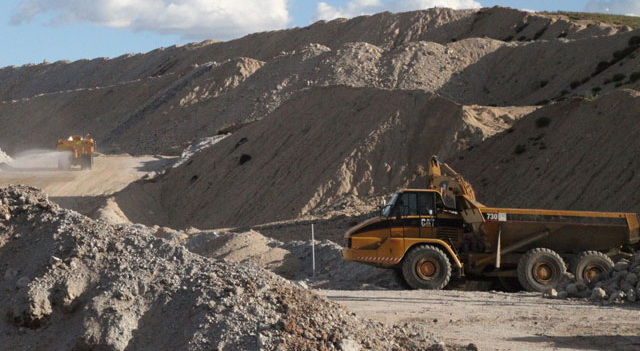
    Phoenix Copper Limited (LSE:PXC) has entered into a Letter of Intent with a U.S.-based investor for a proposed $75 million corporate copper bond issuance. The funds are earmarked for advancing construction at the company’s Empire open-pit mine and initiating a new phase of underground exploration drilling. While the financing deal marks a major step forward in Phoenix’s expansion plans, it remains subject to completion of legal documentation and final due diligence.

    Strengthening the Foundation for Growth

    The proposed bond placement is poised to significantly bolster Phoenix Copper’s financial resources, enabling the company to ramp up its development activities and reinforce its position in the copper production market. The capital will specifically support the infrastructure build-out at Empire Mine and facilitate deeper geological assessment through targeted drilling.

    About Phoenix Copper

    Phoenix Copper is a growth-focused metals exploration and development firm with a primary focus on copper, gold, and silver. Its operations are centered in the western United States, where it oversees the Empire Mine project in Idaho—an area with a long history of high-grade mineral production, including copper, zinc, silver, gold, and tungsten.

    Since acquiring the project in 2017, Phoenix has significantly expanded its open-pit resource estimates and continues to pursue additional exploration opportunities in the surrounding area. The company is positioning itself as a future U.S.-based copper producer with a diversified asset base and a focus on sustainable development.

  • Gold Prices Surge as Israeli Strike on Iran Spurs Safe-Haven Buying

    Gold Prices Surge as Israeli Strike on Iran Spurs Safe-Haven Buying

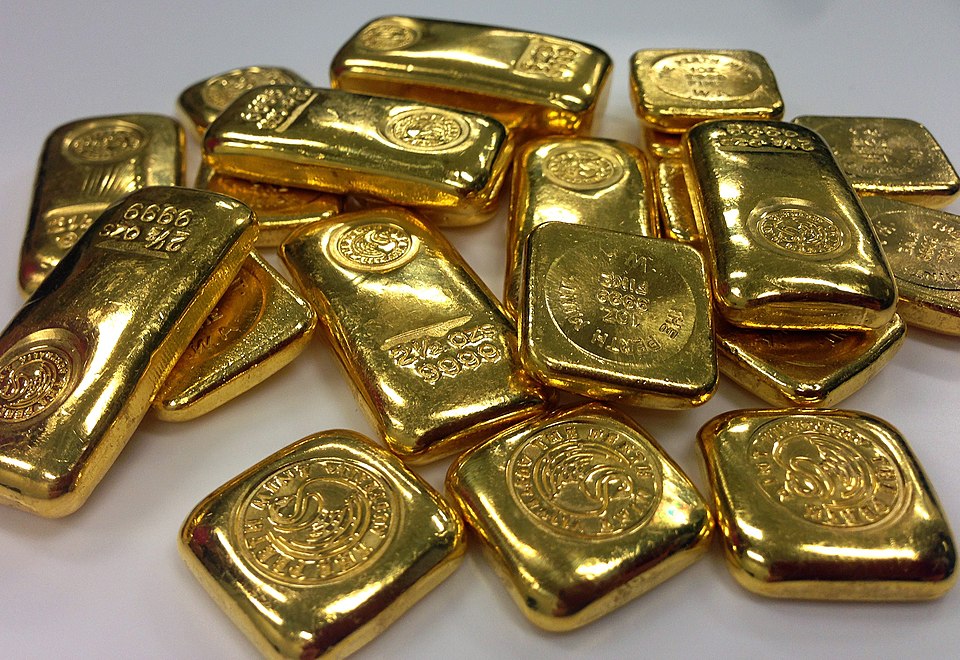
    Gold prices continued their upward trajectory in Asian markets on Friday, fueled by a spike in safe-haven demand following a significant Israeli military strike on Iran. The attack targeted multiple nuclear and military facilities, raising fears of a broader conflict in the Middle East.

    Earlier in the week, gold had already been gaining ground due to ongoing U.S.-China trade uncertainty. While some progress was reported, the lack of concrete details left investors on edge.

    By 22:50 ET (02:50 GMT), spot gold had climbed 1.5% to $3,436.97 per ounce, while August gold futures advanced 1.6% to $3,459.60.

    Israel’s Preemptive Strike Triggers Market Jitters

    The precious metal’s rally accelerated after Israel launched a wide-reaching airstrike early Friday, hitting dozens of Iranian installations. Media reports noted widespread explosions in Tehran, prompting Iran to activate its air defense systems. Air raid sirens sounded across Israel, which had entered a state of emergency in anticipation of potential retaliation.

    According to Reuters, two U.S. officials confirmed that the military operation was conducted solely by Israel, with no involvement from the United States. U.S. Secretary of State Marco Rubio also emphasized that Israel acted independently, describing the strike as an act of self-defense.

    Macroeconomic Drivers Strengthen Gold’s Appeal

    Beyond geopolitical risk, gold’s gains were also supported by recent U.S. economic data. A rise in jobless claims and subdued producer price inflation increased bets that the Federal Reserve may cut interest rates sooner than expected. These expectations have enhanced the attractiveness of gold, a non-yielding asset, in uncertain times.

    With tensions escalating between Israel and Iran, analysts suggest gold prices could continue to climb as investors seek shelter amid rising geopolitical risk.

    Elsewhere in the metals market, platinum futures slipped 0.8% but remained close to four-year highs. Silver futures gained 1%, hitting $36.625 per ounce — near a 13-year peak. Industrial metals showed a mixed performance, with benchmark copper on the London Metal Exchange edging down 0.3% to $9,678.70 a ton, while U.S. copper futures dipped 0.5% to $4.8195 per pound.

  • Oil Prices Spike Over 8% Following Israeli Airstrikes on Iran

    Oil Prices Spike Over 8% Following Israeli Airstrikes on Iran

    Oil markets saw a dramatic surge in early Asian trading on Friday, following a significant Israeli military operation targeting Iran. The escalation has heightened concerns about a wider conflict in the Middle East and potential disruptions to global oil supply.

    As of 21:22 ET (01:22 GMT), July contracts for Brent crude jumped 8.5%, trading at $75.15 per barrel — the highest level recorded since early February. Meanwhile, West Texas Intermediate (WTI) futures climbed 8.4% to $73.68 per barrel.

    Tensions Soar as Israel Launches Strikes on Iran

    According to media sources, Israel carried out a large-scale preemptive air assault on Iranian territory early Friday, targeting numerous military and nuclear installations. Israeli Defence Minister Israel Katz warned of an imminent retaliatory response, stating that missile and drone attacks on Israeli civilians were anticipated.

    Tehran was rocked by multiple explosions, and Iranian state media confirmed the full activation of air defense systems across the capital.

    Despite the scale of the assault, two U.S. officials told Reuters that the United States was not involved in the operation, emphasizing that Israel acted independently. CNN also reported that former President Donald Trump had convened a cabinet meeting in response to the unfolding situation.

    The sharp increase in oil prices reflects investor anxiety over the geopolitical fallout, with fears that any prolonged conflict between Israel and Iran could severely impact crude production and shipping routes across the region — a key artery for global energy supply.

  • Gold Overtakes Euro as Second-Largest Reserve Asset: ECB Report

    Gold Overtakes Euro as Second-Largest Reserve Asset: ECB Report

    Gold has surpassed the euro to become the world’s second most significant reserve asset after the U.S. dollar, according to the European Central Bank (ECB). This shift comes amid record-breaking gold purchases and surging prices.

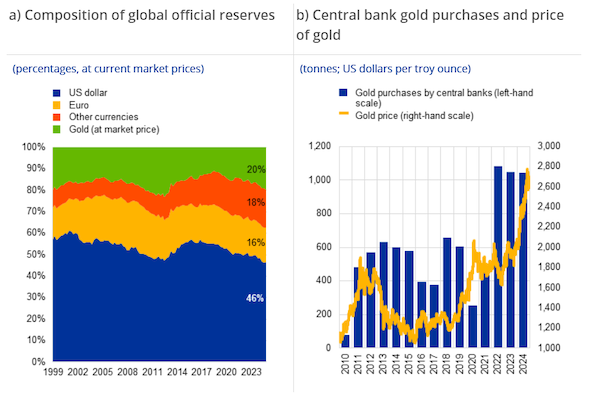
    In its annual currency review released Wednesday, the ECB reported that gold accounted for roughly 20% of global official reserves by the end of 2024, overtaking the euro’s 16% share. The U.S. dollar retained its dominant position at 46%, although its share has been gradually declining.

    “Central banks continued to accumulate gold at a record pace,” the ECB stated. In 2024, global gold purchases by central banks exceeded 1,000 tonnes for the third consecutive year—double the average annual pace seen during the 2010s.

    Global central bank gold holdings are now nearing levels not seen since the Bretton Woods era. Back in the mid-1960s, reserves peaked at around 38,000 tonnes; by the end of 2024, they stood at 36,000 tonnes, according to the ECB.

    The World Gold Council identified Poland, Turkey, India, and China as the leading buyers in 2024, collectively responsible for about 25% of all central bank gold acquisitions.

    The ECB attributed gold’s growing prominence in global reserves partly to its rising price, which jumped nearly 30% over the year and hit a record $3,500 per ounce in April 2025.

    Geopolitical Tensions Fuel De-Dollarization

    The report also highlights how geopolitical instability has driven central banks to diversify away from the U.S. dollar. Gold, often viewed as a safe-haven asset, has become a preferred alternative.

    Gold demand surged after Russia’s invasion of Ukraine in 2022, the ECB noted, adding that bullion has historically served as a shield against potential sanctions, particularly since 1999.

    An ECB survey revealed that about two-thirds of central banks cited diversification as a key reason for increasing gold reserves, while two-fifths pointed to geopolitical risk.

    The ECB observed a significant uptick in gold holdings among countries closely aligned with China and Russia, especially since the final quarter of 2021. This trend reflects a broader movement of de-dollarization across many developing nations.

    Interestingly, the longstanding inverse correlation between gold prices and real interest rates began to break down in 2022. The shift, the ECB suggests, came as central banks prioritized gold as a hedge against sanctions rather than inflation.

    Looking ahead, the trend is expected to persist. According to the ECB’s survey, 80% of reserve managers consider geopolitical concerns a critical factor in shaping their gold strategy over the next five to ten years.

  • WH Smith Shares Rise Following Report of Investment by Palliser Capital

    WH Smith Shares Rise Following Report of Investment by Palliser Capital

    WH Smith PLC (LSE:SMWH) saw its stock price gain up to 2.9% on Thursday amid news that activist investor Palliser Capital has acquired a significant holding in the company.

    According to a report from Sky News, Palliser has accumulated close to a 5% stake in the British retailer, with the investment valued at roughly £65 million ($88.3 million) based on current market prices.

    The disclosure of Palliser’s position was expected to coincide with a major industry event taking place Thursday.

    Sources familiar with the matter indicated that Palliser views WH Smith’s expansion in the U.S. as a key driver of future growth and believes the retailer’s shares could nearly double in value over the next three years.

  • Dow Jones, S&P, Nasdaq,Wall Street Eyes Lower Open Amid Trade Ambiguity and Middle East Tensions

    Dow Jones, S&P, Nasdaq,Wall Street Eyes Lower Open Amid Trade Ambiguity and Middle East Tensions

    U.S. equity futures were trending downward early Thursday, suggesting a sluggish start to the session as market participants continue to grapple with uncertainty around global trade policies and rising geopolitical risk. The Dow Jones, S&P 500, and Nasdaq futures all pointed toward modest losses, building on the retreat seen in the prior session.

    Trade Deal Doubts Cloud Market Sentiment

    Investors remain skeptical of a preliminary trade arrangement between the U.S. and China announced Wednesday, as crucial details of the framework remain undisclosed. President Donald Trump noted that he would soon dispatch letters to various U.S. trading partners outlining new tariff rates. He also mentioned a willingness to prolong the current 90-day tariff suspension due in early July, though he stated it might not be necessary.

    Commerce Secretary Howard Lutnick added that the tentative agreement includes mutual concessions on export controls for key technologies and commodities. Trump later took to Truth Social, emphasizing that China would front-load the delivery of rare earths and magnets, while the U.S. would enforce a combined 55% tariff rate, compared to China’s 10%.

    Despite these announcements, the lack of specificity and the absence of Chinese President Xi Jinping’s endorsement have led investors to adopt a risk-averse stance.

    Heightened Geopolitical Risks Further Weigh on Markets

    Tensions in the Middle East have also contributed to investor unease. A top Iranian security official warned that Iran is on “maximum military alert” and vowed a swift response to any aggressive moves from the U.S. or Israel. In response to the escalating risks, Trump confirmed the relocation of American personnel from the region for safety.

    These developments have driven oil prices sharply higher, boosting energy stocks but simultaneously stoking broader market anxiety.

    Wednesday’s Volatility: Early Gains Erased

    U.S. markets initially rose Wednesday, buoyed by softer-than-expected inflation data, before surrendering gains and closing in the red. The Nasdaq led the losses, falling 99.11 points, or 0.5%, to close at 19,615.88. The S&P 500 declined 16.57 points (-0.3%) to 6,022.24, and the Dow inched lower by just 1.10 points to finish at 42,865.77.

    The reversal was widely attributed to profit-taking, as indices touched their highest intraday levels in more than three months before pulling back.

    Inflation Update: Cooler Than Anticipated

    New figures from the Labor Department revealed that consumer prices edged up only 0.1% in May, slightly below forecasts of a 0.2% gain. Core CPI, which excludes volatile food and energy components, also increased by 0.1%, falling short of expectations.

    Annually, headline inflation rose to 2.4%, while core inflation held steady at 2.8%. Economists had anticipated slight increases in both metrics, suggesting inflationary pressures may be stabilizing—a development that could influence the Federal Reserve’s upcoming decisions on interest rates.

    Sector Highlights: Airlines Drop, Energy Rallies

    Travel and industrial stocks were among the biggest decliners. Airline shares tumbled, with the NYSE Arca Airline Index down 3.4%. Steel producers also faltered, dragging the NYSE Arca Steel Index lower by 1.5%.

    Retailers and homebuilders posted losses as well, reflecting broader concerns over consumer resilience. On the flip side, energy stocks outperformed, supported by surging crude oil prices amid mounting geopolitical uncertainty.


  • DAX, CAC, FTSE100, European Stocks Move Lower On U.S.-China Trade Tensions

    DAX, CAC, FTSE100, European Stocks Move Lower On U.S.-China Trade Tensions

    European stocks on the DAX, CAC and FTSE100 have moved mostly lower on Thursday, with U.S.-China trade tensions and escalating tensions in the Middle East keeping investors worried.

    There was no relief from the U.S.-China trade truce as the much-hyped framework agreement lacked specifics.

    Elsewhere, U.S. President Donald Trump expressed diminished confidence in reaching a nuclear deal with Iran, emphasizing that Iran must not acquire nuclear weapons.

    Also, the U.S. has initiated a partial evacuation of its embassy in Iraq and authorized voluntary departures from Bahrain and Kuwait, citing heightened security concerns.

    The pan European STOXX 600 Index is down by 0.5 percent after declining 0.3 percent on Wednesday.

    The German DAX Index is down by 0.9 percent and the French CAC 40 Index is down by 0.4 percent, although the U.K.’s FTSE 100 Index has bucked the downtrend and risen by 0.2 percent.

    The British pound edged lower on rate cut bets after official data showed the U.K. economy shrank more than expected in April largely reflecting a fall in services output.

    Real GDP declined 0.3 percent month-on-month in April, following a growth of 0.2 percent in March.

    This was the biggest fall since October 2023. Analysts had expected GDP to drop marginally by 0.1 percent.

    Hexagon AB (BIT:1HEXA)has moved to the downside after it announced an agreement to acquire France’s APEI, a company specializing in aerial mapping capabilities.

    Airbus SE (EU:AIR) has also declined after making a bold prediction about the future of aviation. It was said the global commercial aircraft fleet will double in size to almost 50,000 planes over the next 20 years.

    Travel-related stocks are also moving lower after weak airfare data from the United States and amid concerns about rising fuel costs.

    On the other hand, supermarket chain Tesco (LSE:TSCO) has moved sharply higher as its first quarter sales beat estimates.

    Halma (LSE:HLMA) has also jumped. The health and safety device maker lifted its organic revenue growth guidance for fiscal year 2026 after annual adjusted pretax profit beat expectations.