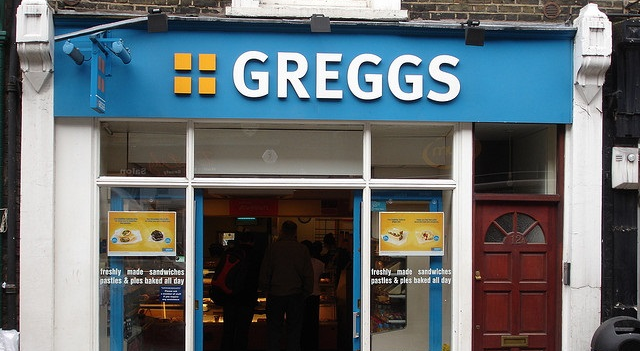
Jefferies has cut its rating on Greggs (LSE:GRG) to “hold” from “buy” and reduced its price target sharply to 1,610p from 2,500p, arguing that the growing use of weight-loss medications is creating a structural drag on demand. The downgrade comes after what the broker describes as around 18 months of declining sales volumes, with the shares falling more than 3% on Monday. Greggs is currently trading at around 1,675p.
The analysts said they now view the rapid adoption of GLP-1 receptor agonists, including drugs such as Mounjaro and Wegovy, as a “noticeable headwind” for the bakery chain. As a result, Jefferies has materially lowered its medium-term expectations, cutting like-for-like (LFL) sales growth assumptions from 4.5% to 2.5%, largely due to an expectation that volumes will remain under pressure.
According to the broker, Greggs’ trading momentum has been weakening since mid-2024, with LFL sales gradually decelerating and volumes consistently turning negative. The company’s reported Q4 2025 LFL growth of 2.9% also missed management’s guidance of around 4%, despite more normalised weather conditions. With price increases contributing an estimated 5–6 percentage points to LFL growth, Jefferies infers that underlying volumes are still falling by roughly 2% to 3%.
While management has pointed to softer consumer spending and adverse weather, including Storm Eowyn in January 2025 and the UK’s warmest summer on record, Jefferies said these factors do not fully explain either the scale or the persistence of the slowdown.
The broker highlighted data from IQVIA indicating that the number of UK users of Mounjaro and Wegovy reached 2.5 million by July 2025, a near-70% increase in just four months and a fivefold rise year-on-year. Jefferies believes current usage may now be close to 4 million people, equivalent to about 7.5% of the UK adult population.
Studies cited by the analysts suggest GLP-1 users typically cut daily calorie intake by 25% to 30%, or roughly 1,000 calories per day for higher-intake consumers. The largest reductions are seen in savoury, salty, high-fat and calorie-dense foods, categories that overlap heavily with Greggs’ core offer.
Although Jefferies acknowledges that GLP-1 users tend to skew older, female and higher income than Greggs’ average customer, it argues that the overlap could be disproportionately harmful. The analysts said that “Where the two Venn diagrams intersect” sits a group of high-BMI consumers who are likely “some of Greggs’ best customers,” warning that these individuals could move “from being amongst Greggs’ most valued, to potentially never spending a penny with the business again.”
The report also notes comments from Greggs chief executive Roisin Currie, who said in January 2026 there was “no doubt” that weight-loss drugs were having an impact on the business.
Reflecting what it sees as a structural challenge, Jefferies now forecasts EBIT margins to decline by 50 basis points in FY26 and a further 30 basis points in FY27. Pre-tax profit for FY26 is projected at £171 million, broadly flat compared with an estimated £170 million in FY25.
Leave a Reply