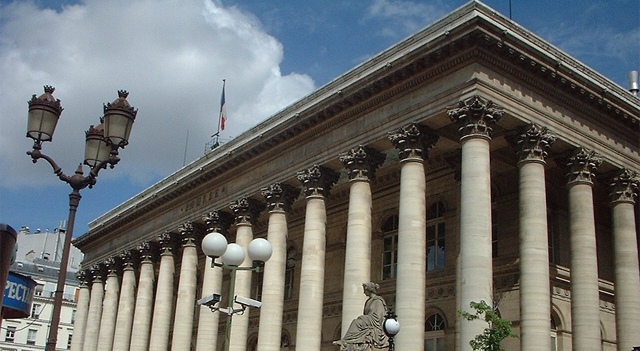
European equities started Monday on a weaker footing as investors assessed an ultimatum from U.S. President Donald Trump urging Iran to reopen the Strait of Hormuz.
By 08:00 GMT, the pan-European Stoxx 600 had declined 1.3%, while Germany’s DAX dropped 2.0%, France’s CAC 40 lost 1.6%, and the UK’s FTSE 100 slipped 1.3%.
Markets in Europe followed a negative lead from Asia, where shares also moved lower. Many Asian economies depend heavily on energy imports from the Gulf region, leaving them particularly exposed to potential supply disruptions.
“Escalation in the war remains bad news for asset markets,” said Thomas Mathews, Head of Markets, Asia Pacific, at Capital Economics.
As the joint U.S.-Israeli offensive against Iran enters its fourth week, a new wave of strikes on Tehran has reportedly caused widespread power outages across the capital.
Attention remains focused on the Strait of Hormuz, the strategic shipping route south of Iran through which roughly 20% of global oil supply passes. Ship traffic through the strait has been largely halted due to fears of Iranian attacks, while container shipping operators have struggled to secure insurance coverage for voyages through the area.
Trump has warned that the United States could strike key Iranian power infrastructure if Tehran does not reopen the strait by Monday night. Iran rejected the demand, stating the passage would remain “completely closed” if its energy facilities come under attack.
Oil markets have reacted sharply to the risk of prolonged disruption. Brent crude, the global benchmark, has surged as traders price in the possibility of reduced supplies from the Persian Gulf, one of the world’s most important energy-producing regions.
Brent futures for May were last up 1.7% at $114.10 per barrel, after settling at $112.19 on Friday. Prior to the outbreak of the conflict in Iran, Brent had been trading at around $70 per barrel.
Europe could also face significant energy pressures, as the region imports substantial volumes of natural gas from the Gulf, particularly Qatar. A major gas production facility in the country was recently struck during Iranian attacks on regional targets, pushing European natural gas prices sharply higher.
Last week, the European Central Bank warned that a prolonged conflict could revive inflationary pressures that had largely subsided before fighting began in late February. The ECB said policymakers are prepared to adjust interest rates if necessary, prompting speculation that borrowing costs could rise again in the coming months.
Leave a Reply