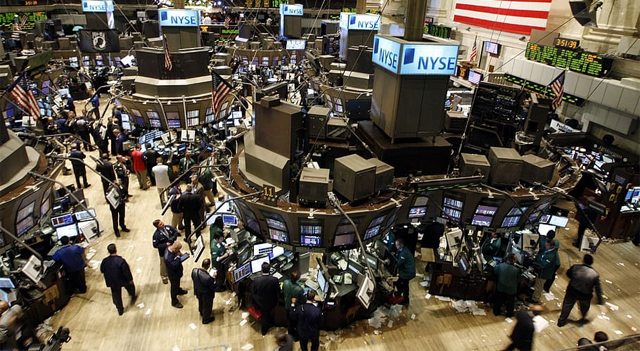
U.S. stock futures point to a slightly weaker open on Thursday, suggesting markets may give back some gains following the strong advance recorded in the prior session.
Investors could look to lock in profits after Wednesday’s surge, which more than erased the losses seen earlier in the week.
Both the Nasdaq and the S&P 500 finished at fresh record highs, even as uncertainty surrounding the Middle East conflict continues to linger.
IBM drop weighs on market tone
A sharp decline in IBM Corp. (NYSE:IBM) is expected to pressure the broader market, with the stock falling 7.8% in premarket trading.
The weakness comes despite better-than-expected first-quarter results, as the company did not lift its full-year outlook.
Industrial heavyweight Honeywell (NASDAQ:HON) may also face selling pressure after beating Q1 expectations but issuing softer-than-expected guidance for the second quarter.
Texas Instruments rallies on strong outlook
In contrast, Texas Instruments (NASDAQ:TXN) is surging 9.6% ahead of the open after posting stronger-than-expected results and delivering an upbeat forecast.
Wall Street extends gains to new highs
Stocks rallied sharply on Wednesday, reversing declines from the previous two sessions and pushing major indices to record closing levels.
The Nasdaq jumped 397.60 points, or 1.6%, to 24,657.57, while the S&P 500 climbed 73.89 points, or 1.1%, to 7,137.90.
The Dow Jones Industrial Average also ended higher, gaining 340.65 points, or 0.7%, to close at 49,490.03 after trimming earlier gains.
Ceasefire extension boosts sentiment
The rally was driven in part by news that U.S. President Donald Trump extended the ceasefire with Iran.
Describing Iran’s government as “seriously fractured,” Trump said in a Truth Social post that the U.S. would delay any military action until Iranian leaders “come up with a unified proposal.”
At the same time, he confirmed that the U.S. military would continue enforcing a blockade on maritime traffic to and from Iranian ports.
Ongoing tensions cloud outlook
Iran dismissed the extension as “meaningless” and stated that the Strait of Hormuz would remain closed until the U.S. blockade is lifted.
Mahdi Mohammadi, an adviser to parliamentary speaker Mohammad Bagher Ghalibaf, called the move a tactic “to buy time for a surprise strike,” adding that the “losing side cannot dictate terms.”
Shortly after Trump’s announcement, Iran’s Revolutionary Guard Navy said it had seized two container ships in the Strait of Hormuz for “maritime violations.”
The continued back-and-forth between Washington and Tehran has added to uncertainty, although markets remain cautiously optimistic about a potential resolution.
Earnings strength underpins confidence
Investors are also encouraged by solid corporate earnings, with the reporting season getting off to a strong start.
“Investors appear to be focusing more on the direction of risk — whether conditions are improving or worsening — rather than the absolute level of geopolitical tension,” said Daniela Hathorn, Senior Market Analyst at Capital.com.
“Earnings season is playing a key role in reinforcing this narrative,” she added. “Expectations for continued double-digit earnings growth remain intact, supporting elevated equity valuations even as macro risks persist.”
Sector performance mixed
Semiconductor stocks led gains, pushing the Philadelphia Semiconductor Index up 2.7% to a record close.
Software shares also showed strong performance, with the Dow Jones U.S. Software Index rising 2.3%.
Computer hardware, oil services, and gold stocks posted solid advances, while airline stocks moved notably lower.
United Airlines (NASDAQ:UAL) led the declines, dropping 5.6% after reporting stronger-than-expected results but issuing disappointing guidance.
Leave a Reply