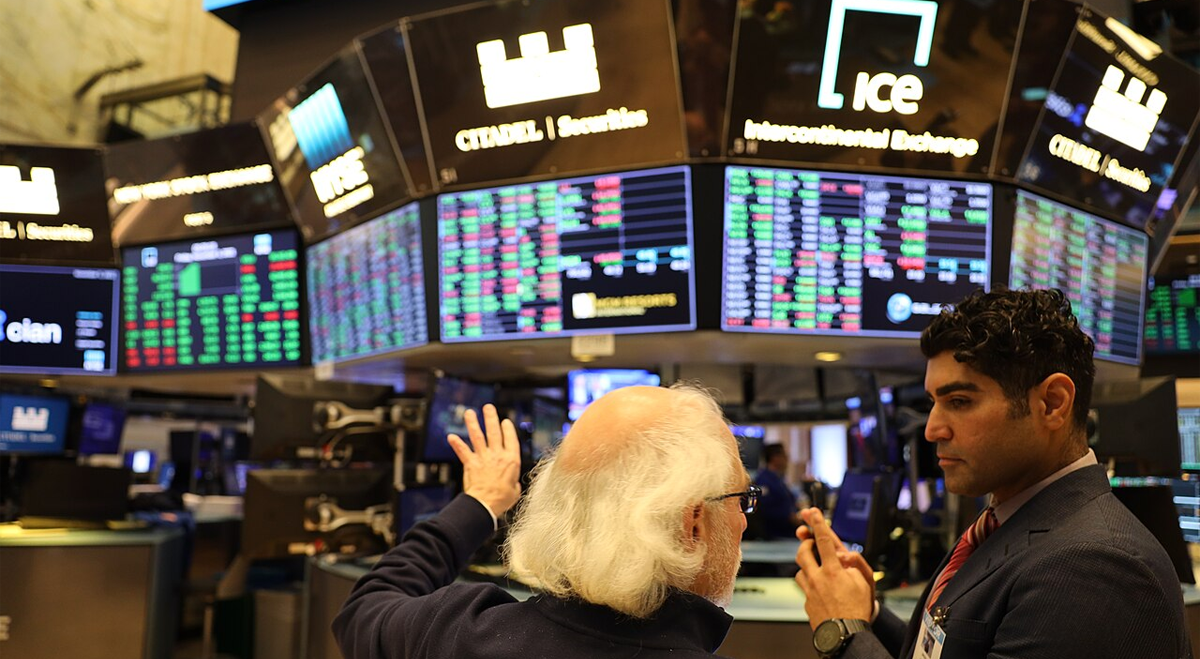
US stock index futures were mixed on Wednesday ahead of the Federal Reserve’s monetary policy announcement and quarterly results from Alphabet and Microsoft. Investors were weighing the outlook for artificial intelligence investment against the possibility of higher borrowing costs, while a sharp increase in earnings at SK Hynix highlighted continued demand for advanced semiconductor technology.
The upcoming financial reports from major technology companies are expected to provide further evidence of whether substantial spending on AI infrastructure is translating into stronger revenue and profitability.
US Futures Trade Unevenly After Technology-Led Gains
At 04:02 ET (08:02 GMT), futures on the S&P 500 were 10 points higher, representing a gain of 0.1%. Nasdaq 100 futures advanced 173 points, or 0.6%, while Dow Jones futures fell 117 points, equivalent to 0.2%.
The moves followed a positive session for US equities, with the Nasdaq Composite rising 1.18% as technology stocks led gains.
Recent announcements involving financing for artificial intelligence companies helped support sentiment, alongside Anthropic’s filing for an initial public offering earlier in the week.
The developments provided some reassurance to investors concerned about the funding requirements associated with expanding data centre capacity and AI computing infrastructure.
Vital Knowledge analysts said the latest financing activity demonstrated continued investor willingness to support the sector.
“[I]nvestors continue to celebrate the AI funding announcements that hit the tape over the last 36 hours […] as these demonstrate that plenty of money still exists to underwrite the data center bonanza,” the analysts wrote.
The firm also described the corporate earnings season as broadly “decent” so far, citing resilient demand, cost management and higher selling prices. Approximately one-third of US quarterly reports have been published.
Alphabet and Microsoft Set to Provide AI Spending Updates
Alphabet (NASDAQ:GOOG) and Microsoft (NASDAQ:MSFT) are due to release their quarterly results after Wednesday’s closing bell.
Both companies have committed substantial resources to artificial intelligence, cloud computing and the infrastructure required to operate increasingly complex computing systems.
Their financial reports will be closely examined for evidence that this investment is supporting revenue growth, particularly within cloud services.
Investors will also monitor management commentary on future capital expenditure, including spending on data centres and specialised semiconductor equipment.
Alphabet, Microsoft and Amazon (NASDAQ:AMZN), which reports on Thursday, are collectively planning capital expenditure of up to $600 billion this year.
The scale of the spending has made returns on investment an increasingly important issue for shareholders.
While continued investment may indicate expectations of future demand, higher spending also increases the financial returns needed to justify the projects.
Meta’s Market Reaction Illustrates Capital Expenditure Concerns
Meta Platforms (NASDAQ:META) provided a recent example of investor sensitivity to rising AI infrastructure costs.
The company reported strong underlying business performance earlier in October but faced selling pressure after increasing its spending plans.
Meta shares declined following the announcement and were more than 4% lower for the year at the time of the report.
Its capital expenditure approached $34 billion during a single quarter.
Jake Behan, Head of Capital Markets at Direxion, said the market is placing greater emphasis on the relationship between AI spending and financial returns.
“The more skeptical the market gets about AI returns, the harder it becomes to justify today’s pace of spending. Meta is a good example: the core business was shown to be strong, but with capex hitting nearly $34 billion in a single quarter, the market increasingly needs to see the ROI from that investment,” Behan said.
The forthcoming results from Alphabet and Microsoft could help investors assess whether similar concerns apply across the wider technology sector.
SK Hynix Reports 632% Increase in Operating Profit
South Korean semiconductor manufacturer SK Hynix (NASDAQ:SKHY) reported quarterly earnings ahead of expectations on Wednesday.
Operating profit for the three months ended September 30 increased 632% year-on-year to 83.33 trillion won, compared with a Bloomberg consensus estimate of 77.5 trillion won.
Quarterly revenue rose 328% to a record 104.615 trillion won, while net income increased 216% to 39.78 trillion won.
The results were accompanied by a rise of more than 10% in the company’s shares during trading in Seoul.
SK Hynix also announced plans to return 100 trillion won, approximately $75.5 billion, to shareholders during the year.
The company is a major supplier of memory semiconductors used in high-performance computing and artificial intelligence systems.
Its results provided evidence of continued demand for components used in expanding AI infrastructure.
AI Hardware Growth Raises Questions About Future Returns
The performance of SK Hynix highlighted the financial benefits that some semiconductor suppliers are receiving from investment in artificial intelligence.
Expanding AI systems requires substantial computing resources, including advanced memory, processors and data centre infrastructure.
Companies supplying these technologies can benefit directly from increased spending by cloud service providers and other technology groups.
For investors, however, strong demand for hardware represents only one part of the financial outlook for artificial intelligence.
The companies purchasing and deploying this equipment must also demonstrate that their investments can generate sufficient revenue and profitability over time.
This issue is expected to feature prominently in the latest earnings reports from major US technology companies.
Federal Reserve Rate Decision Takes Centre Stage
The Federal Reserve is expected to keep interest rates unchanged at its Wednesday meeting.
The anticipated pause follows a rate increase in September, the first since 2023.
Although markets expect no immediate adjustment, interest rate futures indicate an approximately 75% probability of another increase at the December meeting.
Investors will examine comments from Fed Chair Kevin Warsh for indications of how the central bank is assessing persistent inflation and the possibility of additional monetary tightening.
Warsh has generally avoided providing detailed forward guidance, potentially limiting the clarity of any signals concerning the next policy decision.
Some Federal Reserve officials have nevertheless suggested that further increases may be necessary to address inflationary pressures.
Monetary Tightening Could Influence Technology Valuations
Higher interest rates have implications for companies undertaking large investment programmes.
Borrowing costs can affect the economics of financing data centres, semiconductor facilities and other infrastructure supporting artificial intelligence.
They also influence the returns investors require when evaluating long-term projects.
Direxion’s Jake Behan said additional monetary tightening could “raise the cost of funding the AI buildout while simultaneously raising the hurdle for the returns needed to justify it.”
This creates a potential challenge for technology companies committing large amounts of capital before the full financial benefits of their investments become clear.
The Federal Reserve’s policy outlook could therefore influence investor reactions to upcoming technology earnings, particularly if companies announce further increases in capital expenditure.
Higher Oil Prices Complicate the Inflation Outlook
Energy prices remain an important consideration for US monetary policy.
Crude oil has risen substantially since the conflict involving Iran began in late February, with disruptions to Middle Eastern energy supplies affecting international markets.
Higher oil prices have increased gasoline and diesel costs, creating the possibility of additional inflationary pressures through transportation and distribution expenses.
Economists are monitoring whether the increase in energy costs is spreading to other areas of the economy.
Brent crude futures were up 1.2% at $115.29 per barrel in the latest figures reported.
Persistent energy-related inflation could influence the Federal Reserve’s assessment of whether further interest rate increases are required.
US Report Raises Further Middle East Concerns
Diplomatic efforts aimed at reducing tensions involving Iran have been accompanied by continued uncertainty about the regional security situation.
The Wall Street Journal reported that US officials had warned Gulf Arab countries to prepare for the possibility of a short, intensive military campaign after the November US midterm elections.
The report added to concerns about potential further disruption to Middle Eastern energy production and transportation.
The conflict has already contributed to higher oil prices, which remain relevant to inflation expectations and central bank policy decisions.
Additional disruptions could increase uncertainty for energy markets and businesses exposed to fuel costs.
Market Outlook
US equity futures were mixed ahead of a series of announcements likely to influence expectations for technology spending and interest rates.
Alphabet and Microsoft will report after Wednesday’s market close, followed by Amazon on Thursday, with investors focused on cloud growth and the returns generated by substantial AI infrastructure investments.
SK Hynix’s results demonstrated strong demand for advanced memory semiconductors, with operating profit rising 632% and revenue increasing 328%.
The Federal Reserve is expected to maintain interest rates, although markets continue to price the possibility of another increase in December.
The interaction between technology capital expenditure, financing costs and energy-related inflation will remain important as investors assess the outlook for US equities.
Leave a Reply