Author: Fiona Craig

  • RBC reviews midterm-year volatility risks for U.S. equities

    RBC reviews midterm-year volatility risks for U.S. equities

    U.S. equities could face a more unsettled backdrop as the next midterm election cycle approaches, with RBC Capital Markets looking to 2018 and 2022 for clues about how markets have historically behaved during comparable periods.

    The second halves of both midterm years were volatile, differing sharply from the upward moves recorded during the two most recent presidential election years. In both 2018 and 2022, the S&P 500 established an early-autumn peak in August or September, declined to an October low, recovered to another high in November and then fell to a further low in December.

    RBC strategist Lori Calvasina noted that while those market swings were sizeable, they ultimately played a role in creating more sustainable lows that extended into the following year. Political uncertainty was not the only driver. Federal Reserve policy and interest rates were important considerations during both episodes, while trade policy created additional pressure in 2018. In 2022, investors were also dealing with weakening technology earnings and the Russia-Ukraine war.

    There were notable similarities at the sector level. Consumer Staples and Health Care proved relatively resilient during the declines in both periods, while Technology and Consumer Discretionary underperformed. Leadership shifted during the subsequent recoveries, when Financials, Industrials and Materials performed strongly and Communication Services, Consumer Staples and Health Care trailed.

    “To be clear, we are not calling for this kind of turbulence in the months ahead, but we did find the exercise useful for thinking through tail risks, particularly regarding the timing of inflections,” Calvasina wrote.

    Separate factor analysis from RBC suggests high price momentum has recently regained strength across both the S&P 500 and Russell 2000, while EPS quality has fallen behind. Second-quarter corporate earnings calls also painted a mixed picture of the operating environment. Businesses highlighted challenges including geopolitical tensions, persistent inflation, supply-chain disruption and weak housing turnover, while reporting healthier conditions in areas exposed to AI, energy investment and reshoring.

    Deal activity provides another potentially supportive indicator. RBC found that equities have generally continued moving higher while transaction counts remain strong, with market difficulties tending to emerge only after dealmaking activity loses momentum.

    Valuations, meanwhile, do not appear to be at the extremes of their recent ranges. According to Calvasina, forward P/E ratios for both the S&P 500 and Nasdaq 100 are around the midpoint of their post-COVID ranges. The biggest S&P 500 companies show a similar valuation pattern, while the Russell 2000 is trading at approximately its average forward earnings multiple.

    RBC remains constructive on the outlook for the S&P 500 over the coming year, with interest rates identified as the main threat to that stance. Calvasina expects corrections to be limited to roughly 5% to 10% unless recession concerns intensify or markets experience an interest rate shock. Within its broader positioning, RBC currently sees a slight advantage for Growth over Value and for U.S. equities over international markets.


  • US stock futures rebound as oil and bond-market pressures remain in focus: Dow Jones, S&P, Nasdaq, Wall Street

    US stock futures rebound as oil and bond-market pressures remain in focus: Dow Jones, S&P, Nasdaq, Wall Street

    US equity futures advanced on Friday, pointing to a recovery at the opening bell after Wall Street suffered a broad selloff in the previous session as higher crude prices and rebounding Treasury yields unsettled investors.

    The prospect of buying stocks following Thursday’s decline provided some support, although persistent geopolitical tensions and elevated energy prices continued to temper risk appetite.

    US crude futures retreated substantially from their earlier highs but remained around 0.2% higher, with markets still focused on the continuing confrontation between Washington and Tehran.

    Nvidia results and Jackson Hole loom over markets

    Investors may be reluctant to take large positions ahead of a busy week featuring quarterly earnings from Nvidia (NASDAQ:NVDA) and the Jackson Hole economic symposium.

    “Next week’s results from Nvidia could put some of the focus back on corporate earnings but, as we head towards the autumn, a chill has started to descend for markets,” said Dan Coatsworth, head of markets at AJ Bell.

    He added, “Investors will be looking for a comfort blanket when Federal Reserve chair Kevin Warsh addresses the Jackson Hole meeting at the end of this month.”

    Nvidia’s results will provide another indication of the strength of artificial intelligence-related spending, while comments from Jackson Hole could influence expectations for the Federal Reserve’s next monetary policy moves.

    Wall Street suffers steep Thursday losses

    The expected Friday rebound comes after US equities weakened sharply during Thursday’s session, with losses accelerating as trading progressed.

    The Dow Jones Industrial Average sank 703.84 points, or 1.3%, to 52,759.21. The Nasdaq Composite dropped 263.92 points, or 1%, to 26,067.17, while the S&P 500 lost 66.82 points, or 0.9%, to finish at 7,641.16.

    The major averages ended close to their session lows, more than reversing the modest gains recorded on Wednesday.

    US-Iran tensions send crude prices higher

    Oil was a major source of pressure after President Donald Trump intensified his economic threats against Iran.

    Trump announced on Truth Social that he was launching “economic warfare” against Tehran, describing the measures as the “most crushing economic operation ever taken against any country.”

    He also threatened “tremendous economic consequences” for countries that “allows its financial institutions, businesses, airports, or government entities to provide any type of lifeline to Iran.”

    Iranian Foreign Minister Abbas Araghchi responded by calling the proposed “Economic D-Day” a “diversion from America’s own crisis: unprecedented debt & surging interest costs.”

    “Doubling down on failed policies will only bring further defeat—and enmity of Iranians,” Araghchi wrote on X. “US economic terrorism threatens global economy and sovereignty worldwide.”

    US crude futures subsequently jumped almost 3% to their highest levels in nearly a month as markets saw little indication that the conflict was moving closer to a resolution.

    Oil rally reverses part of Treasury yield decline

    The surge in energy prices also helped drive Treasury yields higher, reversing some of the sharp decline recorded a day earlier.

    Yields had dropped on Wednesday after the US Treasury unveiled larger buyback operations for longer-term government debt. However, renewed concerns that elevated energy costs could reinforce inflationary pressures brought sellers back into the bond market.

    Higher yields can make equities less attractive by increasing financing costs and improving the relative returns available from fixed-income assets.

    Walmart selloff adds to pressure on equities

    Walmart (NYSE:WMT) contributed heavily to Thursday’s weakness, plunging more than 9% after reporting disappointing second-quarter comparable-sales growth and issuing weaker-than-expected guidance.

    The reaction spread through the retail sector, with the Dow Jones US Retail Index falling 2.5%.

    Airline stocks were also hit, sending the NYSE Arca Airline Index down 2.4%, while housing, pharmaceutical and biotechnology shares recorded sizeable declines.

    Gold miners were among the notable exceptions, advancing alongside higher precious-metal prices.

    US futures are therefore signalling an initial recovery attempt on Friday, but the combination of volatile oil prices, elevated bond yields and geopolitical uncertainty could keep trading cautious ahead of Nvidia’s earnings and Jackson Hole.

  • European stocks edge higher but remain on track for weekly decline: DAX, CAC, FTSE100

    European stocks edge higher but remain on track for weekly decline: DAX, CAC, FTSE100

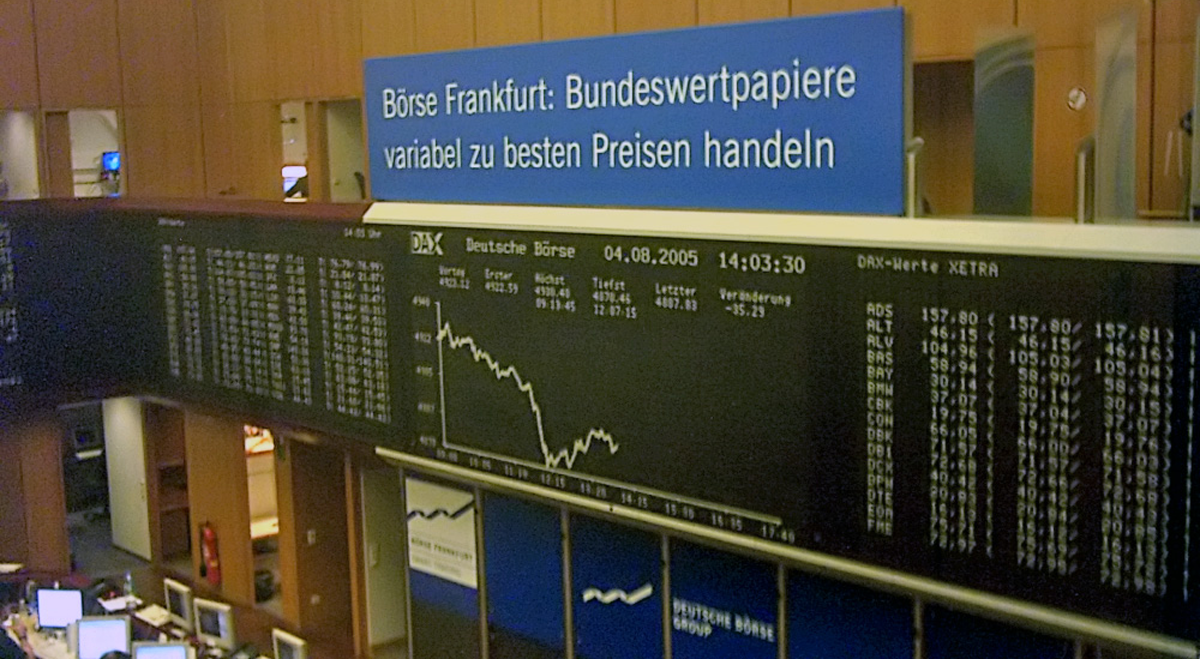
    European equities moved modestly higher on Friday, although the region’s major markets remained on course to finish the week lower as investors weighed elevated oil prices, volatility in government bonds and fresh economic data.

    Germany’s DAX gained 0.3%, while the UK’s FTSE 100 and France’s CAC 40 both advanced 0.2%.

    Despite the positive session, concerns over energy costs and instability in fixed-income markets continued to weigh on the broader weekly performance.

    UK retail sales fall in July

    Sterling weakened slightly against the euro following the release of UK retail sales figures showing a 0.5% month-on-month decline in July.

    The decrease reversed a revised 0.7% increase in June and was slightly worse than the 0.4% contraction economists had forecast.

    On an annual basis, retail sales growth slowed considerably to 1.6% from 3.8% in June, adding to concerns about the strength of household spending.

    Hunting falls after cutting profit outlook

    Hunting Plc (LSE:HTG) shares dropped sharply in London after the British energy services company lowered its annual core profit forecast.

    The downgrade put the stock among the notable decliners during Friday’s European session as investors reassessed the company’s near-term earnings outlook.

    Elsewhere, Banca Generali (BIT:BGN) moved lower after Monte dei Paschi di Siena (BIT:BMPS) launched simultaneous all-share takeover proposals for the Italian wealth manager and Banco BPM (BIT:BAMI).

    German ticketing company CTS Eventim (TG:EVD) also declined after publishing mixed second-quarter results.

    Fresnillo and mining shares gain as metals rally

    Mining stocks provided support to European markets as precious and industrial metals prices strengthened.

    Fresnillo (LSE:FRES) jumped after gold climbed above $4,550 an ounce, supported by a weaker US dollar and expectations that longer-term Treasury yields could remain contained.

    Copper producers also benefited from the softer dollar, with Antofagasta (LSE:ANTO) and Glencore (LSE:GLEN) recording notable gains as copper prices moved higher.

    The strength of mining shares helped offset weakness elsewhere in the market, although European equities remained positioned for a weekly decline amid persistent concerns surrounding oil prices and bond-market volatility.

  • UBS lifts Eurozone earnings forecast as profit growth broadens

    UBS lifts Eurozone earnings forecast as profit growth broadens

    UBS has raised its outlook for Eurozone corporate earnings in 2026 after second-quarter results showed stronger and more widespread profit growth across the region.

    The bank now expects earnings for the EuroStoxx 50 to increase by around 15% this year, up from its previous forecast of 8%. For broader Eurozone indices, the estimate was raised from 11% to approximately 15%. UBS maintained its 2027 earnings growth forecast at 15%.

    Second-quarter earnings growth accelerates

    With most companies having now reported, Eurozone earnings are growing by approximately 22% year on year, according to UBS. Excluding the energy sector, growth is running at around 11%.

    That compares with overall earnings growth of approximately 12% during the first quarter, indicating that corporate profitability gained momentum as the year progressed.

    Cost discipline continues to support margins, but UBS expects revenue growth to play an increasingly important role as manufacturing conditions improve, currency-related pressures ease and companies benefit from stronger operating leverage.

    Profit growth spreads across European sectors

    The earnings recovery is becoming increasingly broad, with UBS forecasting profit growth across every sector this year.

    Financial companies are experiencing renewed momentum as demand for loans improves and capital markets activity strengthens. Industrials are benefiting from investment linked to artificial intelligence, electrification and defence, alongside improving cyclical conditions in areas including automation.

    The combination suggests the Eurozone earnings recovery is no longer concentrated in a small number of industries, providing a potentially stronger foundation for the regional equity market.

    UBS upgrades European technology sector

    UBS also upgraded European information technology to Attractive following the sector’s recent market correction.

    The bank said valuations are no longer excessively stretched, while renewed earnings momentum offers additional support. Rising expectations for AI-related semiconductor capital expenditure are also improving the outlook for European technology companies.

    Analyst sentiment has strengthened more broadly. UBS said the breadth of earnings estimate revisions has reached its strongest level in three years.

    Meanwhile, global manufacturing PMIs have recovered into the low-to-mid 50s, levels which have historically been associated with the end of corporate earnings downgrade cycles.

    Banks and industrials among UBS preferred sectors

    UBS maintained its Attractive stance on European equities, with a particular preference for the Eurozone.

    The bank favours banks, industrials, consumer discretionary companies, healthcare and information technology, while also highlighting Germany as an attractive market.

    Germany’s fiscal support is expected to provide an additional tailwind as increased spending feeds through to economic activity and corporate earnings.

    With profit growth accelerating, analyst revisions improving and the earnings recovery spreading across sectors, UBS sees a stronger fundamental backdrop for Eurozone equities heading through the remainder of 2026 and into 2027.

  • Gold extends rally above $4,500 as dollar weakness and Treasury buybacks boost demand

    Gold extends rally above $4,500 as dollar weakness and Treasury buybacks boost demand

    Gold remained above $4,500 an ounce on Friday, holding onto a powerful weekly advance as a weaker US dollar and efforts by the US Treasury to reduce longer-term borrowing costs strengthened demand for bullion.

    The precious metal has risen roughly 4% this week and is heading towards a third consecutive weekly gain. Gold has also advanced more than 11% since the start of August.

    At 01:32 ET (05:32 GMT), spot gold gained 0.3% to $4,530.95 an ounce, while gold futures climbed 0.3% to $4,587.11. Silver rose 1.0% to $68.79 an ounce and platinum advanced 1.6% to $1,866.01. The US Dollar Index, meanwhile, slipped 0.1% to 98.77.

    Lower Treasury yields strengthen gold’s appeal

    Bullion has consolidated above the $4,500 threshold after finally breaking through a level that had proved difficult to overcome during its recent recovery. The move extends a substantial rebound from the late-June low of around $3,942 an ounce.

    Developments in US government debt markets have been a major driver of the latest rally. The Treasury announced plans this week to double its buybacks of longer-dated securities to at least $4 billion per operation over the next quarter.

    The initiative helped push long-term Treasury yields lower, improving the relative attractiveness of gold.

    Treasury Secretary Scott Bessent said on Thursday that the government could expand the purchases further, while arguing that current bond yields do not accurately reflect underlying economic fundamentals.

    Lower yields typically support gold because bullion does not pay interest. As returns available from government bonds decline, investors sacrifice less income by holding the precious metal instead.

    Dollar decline provides another tailwind

    The Treasury-driven decline in yields has also contributed to weakness in the US dollar, providing additional support for precious metals.

    A softer dollar makes dollar-denominated gold less expensive for buyers using other currencies and can therefore stimulate international demand.

    The US currency was on course to lose more than 0.8% over the week as investors reassessed the appeal of American assets amid concerns over government finances and borrowing costs.

    Fed policy remains a potential hurdle

    US labour-market figures are also influencing expectations for gold. Weekly unemployment claims declined, suggesting employment conditions remain relatively stable despite July’s unexpected deterioration in hiring.

    Attention remains firmly on the Federal Reserve as policymakers balance labour-market resilience against persistent inflationary pressure.

    According to CME FedWatch, markets currently see around a 64% probability that interest rates will remain unchanged in September and a 36% probability of an increase.

    Any renewed tightening could weigh on gold because higher interest rates increase the returns available from interest-bearing assets relative to non-yielding bullion.

    Fed officials have also raised questions about the interaction between monetary policy and the Treasury’s debt-management measures, as efforts to reduce long-term yields could loosen financial conditions while the central bank is still attempting to control inflation.

    Iran tensions reinforce safe-haven demand

    Geopolitical uncertainty provided another source of support after Bessent said Washington planned to impose the “toughest sanctions” in history on Iran.

    The Treasury Secretary suggested that stronger economic pressure could reduce the need for further major military action, although continuing tensions surrounding Iran are maintaining investor interest in traditional safe-haven assets.

    ANZ analysts also pointed to broader diversification away from the dollar and US assets as an increasingly important factor behind demand for bullion.

    With Treasury measures weighing on yields, the dollar under pressure and geopolitical risks remaining elevated, gold has maintained its position above $4,500 as it heads towards another strong weekly performance.

  • Oil retreats from one-month peak but remains on track for strong weekly advance

    Oil retreats from one-month peak but remains on track for strong weekly advance

    Oil prices edged lower on Friday as traders took some profits following a climb to one-month highs, while markets assessed Washington’s plans to impose its most severe economic sanctions yet on Iran.

    Brent crude futures slipped 0.2% to $93.57 a barrel by 04:11 ET (08:11 GMT), while US West Texas Intermediate crude futures declined 0.4% to $86.50 a barrel.

    The modest pullback did little to change the broader weekly picture. Crude remained on course for a second consecutive week of substantial gains as the confrontation between the United States and Iran over the Strait of Hormuz continued. Brent was set to advance by more than 5% over the week.

    Washington increases economic pressure on Tehran

    US President Donald Trump has threatened a new round of stringent economic restrictions against Iran as Washington seeks to pressure Tehran into accepting a peace agreement.

    Trump has also warned countries that continue conducting business with Iran that they could face severe economic consequences.

    US Treasury Secretary Scott Bessent reinforced the administration’s position on Thursday, saying Iran would face the “toughest sanctions in history.”

    Iran has largely dismissed the threat of additional US measures, while China, one of the largest purchasers of Iranian crude, has also opposed further sanctions.

    Scope of additional sanctions remains uncertain

    Questions remain over what Washington’s latest measures will contain, particularly because Iranian oil exports are already subject to extensive US restrictions.

    The United States is also continuing the naval blockade against Iran that was introduced earlier in 2026.

    Nevertheless, the increasingly confrontational rhetoric suggests little immediate prospect of a reduction in Middle East tensions, leaving the oil market exposed to continued disruption across the region.

    Hormuz disruption keeps oil risk premium elevated

    The Strait of Hormuz remains central to the outlook for crude supplies, with shipping data indicating that commercial traffic is still running at only a fraction of levels recorded before the conflict.

    The strategically important waterway has emerged as one of the main pressure points in the confrontation between Washington and Tehran, given its importance to global energy shipments.

    Iran has indicated that it will continue to keep the strait effectively closed until the United States complies with the conditions of an interim peace agreement signed in June that has since expired.

    With commercial shipping severely constrained and no obvious diplomatic resolution emerging, the risk of prolonged supply disruption continues to support crude prices despite Friday’s modest decline.

  • Wall Street futures rise slightly as traders await PMI figures and weigh Iran sanctions: Dow Jones, S&P, Nasdaq

    Wall Street futures rise slightly as traders await PMI figures and weigh Iran sanctions: Dow Jones, S&P, Nasdaq

    US equity futures edged higher on Friday as investors prepared for preliminary August business activity data while continuing to monitor volatility in bond markets, developments in the retail sector and Washington’s plans for tougher sanctions against Iran.

    Ross Stores (NASDAQ:ROST) was among the notable corporate movers after the discount retailer raised its annual profit guidance following stronger-than-expected quarterly earnings.

    Stock futures point to modest gains

    By 03:11 ET (07:11 GMT), Dow futures were up 65 points, or 0.1%, while contracts linked to the S&P 500 rose 14 points, or 0.2%. Nasdaq 100 futures gained 115 points, equivalent to 0.4%.

    The advance followed a weaker session on Wall Street on Thursday, when renewed increases in government bond yields weighed on equities.

    Earlier in the week, the US Treasury Department announced plans to increase buybacks of longer-dated debt, briefly easing concerns after the 30-year Treasury yield climbed close to a two-decade high.

    That relief did not last, however, as bond yields resumed their rise.

    Vital Knowledge analysts said comments from US Treasury Secretary Scott Bessent during a CNBC interview failed to restore confidence and could even have been “counterproductive by conveying both panic and powerlessness” in confronting the forces pushing borrowing costs higher.

    These pressures include higher energy prices linked to the Iran conflict, widening fiscal deficits and rapidly expanding investment in artificial intelligence infrastructure.

    Investors look to August PMI readings

    Friday’s preliminary PMI figures will provide another indication of the health of the US economy as businesses contend with higher oil prices and uncertainty over the future path of interest rates.

    Economic activity has so far remained comparatively resilient despite the energy shock and growing speculation that central banks could be forced to tighten policy further if inflation remains elevated.

    Deutsche Bank analysts noted that the US composite PMI, combining manufacturing and services activity, reached its strongest level of 2026 in July.

    For August, the S&P Global services PMI is expected to ease to 53.9, while the manufacturing index is forecast to increase to 54.0. Any figure above 50 signals expansion.

    Ross Stores rallies after lifting guidance

    Ross Stores (NASDAQ:ROST) shares jumped more than 8% in extended trading after the retailer raised its full-year earnings outlook and delivered second-quarter profit above expectations.

    The company has been strengthening its value-focused merchandise offering as inflation-conscious consumers increasingly seek lower-priced alternatives to traditional department stores and specialist apparel retailers.

    CEO Jim Conroy said customer spending improved across product categories and geographic markets, with particularly strong demand for home products and cosmetics.

    Ross now expects earnings per share of $8.61 to $8.77 for the year, compared with its previous forecast of $7.50 to $7.74.

    Adjusted quarterly earnings reached $2.06 per share, ahead of the $1.94 expected by analysts, according to LSEG estimates cited by Reuters.

    Retail results keep consumer outlook in focus

    Elsewhere in the sector, disappointing results from Walmart contributed to concerns about the resilience of US household spending.

    Vital Knowledge analysts said weaker retail earnings across the week have increased uncertainty over the American consumer, particularly as households continue to face elevated prices and borrowing costs.

    Investors are therefore closely watching retail performance for evidence that cost-of-living pressures are beginning to translate into softer discretionary demand.

    Washington prepares “toughest sanctions in history” against Iran

    Geopolitical tensions remained firmly in focus after Bessent said the United States was preparing a major new sanctions package against Iran.

    “It is a one-two punch. We have the blockade, and we are going to have the toughest sanctions in history,” Bessent said in an interview with CNBC, adding that he will hold a press conference on Monday to outline the details of the plan.

    Bessent also called on China to support the sanctions effort, although Beijing has largely opposed further restrictions on Tehran.

    His comments followed President Donald Trump’s warning that Iran faced “economic warfare and isolation on an unprecedented scale.”

    Iran rejected Washington’s rhetoric, with Foreign Minister Abbas Araghchi accusing Trump of attempting to draw attention away from domestic US issues, particularly rising government debt.

    Oil prices dip from one-month highs

    Crude prices moved lower on Friday but remained on course for another strong weekly advance as tensions surrounding the Strait of Hormuz persisted.

    Brent futures fell 0.4% to $93.41 a barrel, while West Texas Intermediate crude declined 0.6% to $86.36.

    Brent remained set for a weekly increase of more than 5%, reflecting continued concern that disruption around the Strait of Hormuz could restrict global energy supplies.

    The combination of elevated oil prices, volatile bond yields and potentially tighter monetary policy leaves investors facing a complex backdrop as they await the latest PMI readings.

  • European stocks head for worst week since July as oil and bond pressures weigh: DAX, CAC, FTSE100

    European stocks head for worst week since July as oil and bond pressures weigh: DAX, CAC, FTSE100

    European equities were on track to end a volatile week under pressure, with escalating tensions in the Middle East, higher crude prices and elevated bond yields putting the region’s benchmarks on course for their weakest weekly performance in almost two months.

    The pan-European Stoxx Europe 600 Index was down 1.14% for the week, its steepest five-day decline since July 6. Friday’s session was considerably calmer, with the index broadly unchanged alongside Germany’s DAX and France’s CAC 40, while the FTSE 100 edged 0.1% higher.

    The weekly decline represents a reversal from the strong momentum seen entering August, when European markets benefited from an upbeat second-quarter earnings season. Strong banking profits, resilient luxury-sector margins and better-than-expected energy results had helped push several benchmarks to record levels.

    Trump sanctions threat sends Brent to one-month high

    A renewed escalation in rhetoric from Washington provided the main geopolitical headwind on Friday.

    U.S. President Donald Trump pledged to unleash “economic warfare” against Tehran and warned that Washington would impose the toughest sanctions in history on Iran, including measures targeting countries that provide economic support to the regime.

    The prospect of aggressive secondary sanctions further reduced investor expectations of a rapid diplomatic agreement capable of restoring normal commercial shipping through the Strait of Hormuz.

    Brent crude futures consequently climbed to a one-month high of $93.12 a barrel, putting the international benchmark on course for a weekly increase of more than 5%.

    Commercial tanker traffic through the Persian Gulf remains severely restricted, prompting energy markets to increasingly factor in the possibility of an extended disruption to global seaborne crude oil and liquefied natural gas supplies.

    Bond market turmoil adds to equity pressure

    Geopolitical concerns were only one source of volatility during the week, with a sharp global bond selloff also weighing heavily on European equities.

    Germany’s 10-year Bund yield climbed to 3.22%, its highest level since 2011, while the US 30-year Treasury yield moved above 5.33%.

    The rapid increase in sovereign borrowing costs compressed the relative attractiveness of European equities and raised fresh concerns about the implications of higher interest rates for economic growth and corporate valuations.

    A surprise move by the US Treasury to double purchases of longer-dated bonds through its buyback programme temporarily eased the pressure in fixed-income markets, but the relief proved short-lived as central banks delivered more hawkish signals.

    Rate hike expectations return to focus

    Minutes from the Federal Reserve’s July meeting indicated that US policymakers were prepared to raise interest rates again if inflation remained elevated.

    In Europe, European Central Bank Chief Economist Philip Lane warned that eurozone inflation running close to 3% remained unacceptable.

    The combination of persistent inflation and hawkish central-bank commentary has prompted money markets to assign a high probability to an ECB interest rate increase in September.

    That shift has renewed concerns that restrictive monetary policy could persist even as economic growth remains under pressure.

    European markets face tougher autumn backdrop

    With the positive momentum from second-quarter earnings now fading, investors are increasingly focused on the combination of elevated energy costs, stubborn inflation, higher bond yields and geopolitical uncertainty.

    Brent crude holding above $93 a barrel adds another source of inflationary pressure at a time when markets are already reconsidering the outlook for European interest rates.

    The resulting environment presents an increasingly difficult backdrop for continental equities, with concerns over stagflation and developments in the Middle East likely to remain key drivers of market sentiment heading into the autumn.

  • Eurozone business activity strengthens in August as manufacturing accelerates

    Eurozone business activity strengthens in August as manufacturing accelerates

    Business activity across the eurozone expanded at a slightly faster pace in August, supported by a strengthening manufacturing sector, according to preliminary PMI data released by S&P Global.

    The S&P Global Flash Eurozone Composite PMI Output Index increased to 52.1 from 52.0 in July, reaching its highest level in nine months. The reading remained above the 50 threshold separating expansion from contraction and marked a second consecutive month of growth in private sector activity.

    Manufacturing growth reaches multi-year high

    Manufacturing provided the strongest contribution to the improvement, with the Flash Eurozone Manufacturing Output Index rising to 53.4 from 52.9 in July. This was the highest reading in 54 months.

    The headline manufacturing PMI also strengthened, climbing to 52.8 from 51.9 and reaching its highest level since May 2022.

    Germany was among the strongest contributors to the industrial recovery, with manufacturing production increasing at its fastest rate since January 2022.

    Services continued to expand but showed less momentum. The Flash Eurozone Services PMI Business Activity Index remained unchanged at 51.7, indicating another month of modest growth.

    New export orders return to growth

    Demand conditions improved further during August, with new orders increasing for a second consecutive month.

    The pace of growth accelerated to its strongest level in 40 months, providing further evidence of improving demand across the eurozone economy.

    International business also showed a notable turnaround. New export orders increased for the first time in four-and-a-half years, ending an extended period of declining overseas demand.

    Eurozone employment rises for first time in 2026

    Companies increased their workforce during August, marking the first overall rise in employment recorded so far in 2026.

    Service providers led the improvement by adding staff, while manufacturers reported a fractional increase in employment.

    The manufacturing increase was particularly significant as it brought an end to 38 consecutive months of job reductions across the sector.

    Inflationary pressures continue to ease

    Cost pressures moderated during the month, with input price inflation slowing to its weakest rate since February.

    Businesses also increased their selling prices at a slower pace. Output price inflation eased for a third successive month and reached its lowest level since March.

    The moderation was broad-based, with slower selling price increases reported across both manufacturing and services.

    Business confidence slips despite stronger activity

    Although current business conditions improved, companies became slightly less optimistic about future activity.

    Business confidence declined to a three-month low in August, suggesting that uncertainty continues to influence expectations despite the stronger economic data.

    Chris Williamson, Chief Business Economist at S&P Global Market Intelligence, said the latest PMI readings were consistent with eurozone GDP expanding by approximately 0.3% during the third quarter.

    He identified precautionary inventory building in response to Middle East supply-chain disruptions, stronger demand for AI-related technology products and increased equipment requirements linked to defence spending as factors supporting the manufacturing recovery.

  • FTSE 100 rises as metals rally offsets weaker UK retail sales

    FTSE 100 rises as metals rally offsets weaker UK retail sales

    The FTSE 100 edged higher on Friday as a rally in gold, silver and copper prices boosted London-listed mining shares, helping the UK benchmark outperform broadly flat European markets despite weaker domestic retail sales and continued uncertainty surrounding sanctions on Iran.

    The FTSE 100 was up 0.16% at 03:20 ET (07:20 GMT), while Germany’s DAX declined 0.11% and France’s CAC 40 slipped 0.09%. Sterling strengthened against the dollar, with GBP/USD rising 0.15% to 1.3649.

    Mining stocks rally as precious and industrial metals climb

    Commodity producers dominated the FTSE 100’s strongest performers as metals prices advanced against a weaker US dollar and heightened demand for safe-haven assets following the US Treasury’s buyback announcement.

    Gold futures gained 1.1% to $4,623, while spot gold advanced 1% to $4,566.32. Silver climbed 1.5% and copper increased 1.4%.

    Antofagasta (LSE:ANTO) led the FTSE 100 with a 4.3% gain as the copper producer benefited from the rise in the industrial metal.

    Glencore (LSE:GLEN) advanced 2.2%, while gold producer Endeavour Mining (LSE:EDV) gained 2.7%. Anglo American (LSE:AAL) was also 2.7% higher and precious metals producer Fresnillo (LSE:FRES) climbed 3.7%.

    Iran sanctions keep geopolitical risks in focus

    Geopolitical developments remained a major consideration for markets as Washington intensified its pressure on Tehran.

    Treasury Secretary Scott Bessent warned of the “toughest sanctions in history” following what U.S. President Donald Trump called on social media platform Truth Social the “most crushing economic operation ever taken” against Tehran.

    Trump told 77 WABC that the U.S. was “essentially controlling the straits” and that Iran’s navy, air force and leadership were “gone.”

    The US president also announced what he described as an “Economic D-Day,” introducing measures targeting oil-smuggling networks, financial transfers, exchange houses, ship registries and front companies. Countries continuing to maintain economic ties with Iran were warned of “tremendous economic consequences.”

    Bessent urged China to “get with the programme” regarding the reopening of the Strait of Hormuz, with China sourcing around half of its energy requirements from the Gulf.

    US Central Command said American forces had redirected 67 vessels, disabled three and boarded two as of 20 August as part of enforcement operations connected with the Iran blockade.

    Iranian Foreign Minister Abbas Araghchi rejected Trump’s “Economic D-Day” measures as an attempt to divert attention from US debt and rising interest costs. Iranian Parliament Speaker Mohammad Bagher Ghalibaf said the Strait would remain closed until Washington met the conditions of a 14-point Memorandum of Understanding, including ending the blockade and releasing frozen assets.

    Jefferies warns sanctions could widen trade tensions

    Jefferies strategist Mohit Kumar questioned how effective Washington’s measures would be without broader international participation.

    Kumar said the Iran sanctions would prove “ineffective without the support of China, Russia and a number of Asian countries who are active trading partners of Iran,” while warning that sanctions against those countries could risk “creating a wider trading conflict.”

    He expects oil prices to remain elevated, potentially maintaining upward pressure on longer-dated bond yields. Jefferies is therefore “staying away from duration sensitive sectors” while favouring technology and financial stocks.

    Kumar also noted reports indicating that traffic through the Strait of Hormuz may be greater than official estimates suggest, partly because of ship-to-ship transfers and vessels “going dark” while travelling through the Oman side.

    Oil prices retreat from Thursday’s highs

    Crude prices moved lower during Friday’s session despite the continuing geopolitical tensions.

    Brent crude declined 0.32% to $93.48 a barrel, while WTI fell 0.51% to $86.39, retreating from the highs reached on Thursday.

    The pullback meant energy companies did not participate significantly in the FTSE 100’s gains, with mining shares instead providing the main support to the London index.

    UK retail sales decline in July

    Domestic economic data provided a less encouraging backdrop, with UK retail sales volumes falling 0.5% month on month in July 2026.

    The result matched market forecasts but represented the first monthly decline since April, as earlier promotional activity brought some consumer spending forward into June.

    Non-food sales volumes dropped 1.3%, reflecting weakness in clothing and household goods. Food store sales increased 0.5%, helped by unusually warm weather and spending linked to the World Cup.

    Annual retail sales growth slowed to 1.6% from 3.8% in June, marking the weakest year-on-year increase in three months, according to the Office for National Statistics.

    UK round-up

    Hunting (LSE:HTG) lowered its 2026 EBITDA guidance following weaker activity across its OCTG and Advanced Manufacturing businesses.

    First-half revenue declined 6%, while adjusted profit fell 21%. The company attributed the weaker comparison partly to the absence of Kuwait Oil Company orders and delays to Middle East tendering activity.

    These pressures were partially offset by stronger performances from Hunting’s Perforating Systems and Subsea Technologies divisions.