Category: Top Story

  • Burberry issues FY 2026 Q3 trading update and confirms full-year results timetable

    Burberry issues FY 2026 Q3 trading update and confirms full-year results timetable

    Burberry Group plc (LSE:BRBY) has released its trading update for the third quarter of its 2026 financial year, with the full statement published via the London Stock Exchange and the company’s corporate website. As part of the update, the luxury group is engaging with investors and analysts through a virtual presentation, supported by slide materials and replay access.

    The company also confirmed that it will announce its preliminary full-year results for the 52 weeks ending 28 March 2026 on 14 May 2026. Management said the structured timetable and accompanying investor communications reflect Burberry’s ongoing focus on transparency and active engagement with the capital markets.

    From an outlook perspective, the group continues to face notable financial headwinds, including pressure on revenues and profitability. While management commentary has highlighted some encouraging factors, such as early signs of sales stabilisation and the impact of cost-saving initiatives, these are set against a more challenging near-term trading environment.

    Market indicators and valuation metrics present a mixed picture, with some technical signals pointing to potential downside risk. As a result, sentiment remains cautious as investors await clearer evidence of a sustained turnaround.

    More about Burberry

    Burberry Group plc is a UK-based luxury brand headquartered in London, renowned for its high-end fashion and accessories and iconic trademarks including the Burberry Check and Equestrian Knight Device. The company is a constituent of the FTSE 100 and also trades in the United States via ADRs, making it a prominent player in the global luxury goods market.

  • Rio Tinto posts solid 2025 production growth and reaffirms 2026 output plans

    Rio Tinto posts solid 2025 production growth and reaffirms 2026 output plans

    Rio Tinto (LSE:RIO) recorded an 8% year-on-year increase in copper-equivalent production in 2025, supported by a combination of record iron ore output in the Pilbara, higher copper volumes and expanding exposure to future-facing commodities. The group achieved or exceeded its production guidance across all major product categories and confirmed its output targets for 2026.

    Iron ore production in the Pilbara reached a record quarterly level during the year, while copper volumes rose 11% following the completion and ramp-up of the Oyu Tolgoi underground mine. Output also increased in bauxite and lithium, reflecting continued operational momentum and investment in growth assets.

    Looking ahead, Rio Tinto reaffirmed its 2026 guidance, which includes further growth in Pilbara and Simandou iron ore sales, resilient copper production levels and expanding lithium output. Exploration and evaluation spending fell to $795 million as qualifying costs related to the Rincon lithium project were capitalised, marking progress in the group’s development pipeline.

    Management highlighted several strategic milestones, including the first shipment from the Simandou project, record lithium production in Argentina and operational improvements across the aluminium value chain. These developments strengthen Rio Tinto’s diversification and growth profile at a time when markets for copper and aluminium are tightening, even as iron ore and alumina face more mixed conditions amid broader macroeconomic uncertainty.

    Overall, the company’s outlook is underpinned by strong operational delivery, disciplined capital allocation and a robust balance sheet. While some technical indicators suggest the shares are approaching overbought territory, the valuation continues to offer an attractive blend of growth exposure and income potential.

    More about Rio Tinto

    Rio Tinto is a global mining and metals group producing iron ore, aluminium, copper, bauxite, lithium and other industrial minerals. It operates major assets in Australia, Canada and Mongolia, with a portfolio aligned to long-term demand from steelmaking, electrification, energy transition and industrial end markets. This positions the group as a key supplier to both traditional industries and low-carbon value chains.

  • Premier Foods raises profit guidance after robust Christmas sales and market share gains

    Premier Foods raises profit guidance after robust Christmas sales and market share gains

    Premier Foods (LSE:PFD) delivered a strong performance over the thirteen weeks to 27 December 2025, driven by a solid Christmas trading period that saw branded revenue increase by 5.2% and total revenue rise 4.1%. On the back of this momentum, the group now expects full-year trading profit to come in at the upper end of current market forecasts.

    Both the Grocery and Sweet Treats divisions continued to gain market share, supported by an active innovation programme. New product launches during the period included OXO Bone Broth, Paxo Stuffing Wreaths and Mr Kipling Cake Bites, while premium seasonal ranges performed particularly well as shoppers opted to trade up over the festive period.

    Growth in New Categories remained a standout, with revenue up 29%, led by strong demand for FUEL10K yogurt and granola and wider distribution for Cape Herb & Spice. The company’s three acquired brands – The Spice Tailor, FUEL10K and Merchant Gourmet – all recorded double-digit growth, reflecting the benefits of Premier Foods’ scale in marketing, innovation and route-to-market execution.

    Internationally, the group returned to double-digit revenue growth. This was driven by strong cake sales in Australasia, expanding distribution for Mr Kipling in the US, and additional European listings secured for FUEL10K granola. Management said the breadth of growth across core, premium, acquired and overseas brands underlines the resilience of its brand-led strategy and supports confidence in the group’s medium-term outlook.

    Overall, the updated guidance reflects solid financial execution and positive trading momentum. While some technical indicators point to near-term volatility, management’s strategic focus and confidence in brand investment continue to underpin expectations for sustainable growth.

    More about Premier Foods

    Premier Foods is one of the UK’s largest food manufacturers, employing more than 4,000 people across 13 sites. The group supplies retail, wholesale, foodservice and other channels, and owns a portfolio of well-known brands including Ambrosia, Batchelors, Bisto, Loyd Grossman, Mr Kipling, Oxo and Sharwood’s. Its focus is on everyday, affordable food products that feature in millions of households and support convenient, balanced meals.

  • European Shares Slide as Greenland Standoff and Tariff Threats Rattle Markets: DAX, CAC, FTSE100

    European Shares Slide as Greenland Standoff and Tariff Threats Rattle Markets: DAX, CAC, FTSE100

    European equities moved lower on Tuesday, extending the previous session’s losses after the United States sent military aircraft to Pituffik Space Base in Greenland, prompting Denmark to dispatch its army chief and additional troops to the Arctic territory in a sharp escalation of tensions.

    Adding to market unease, U.S. President Donald Trump warned he could impose 200% tariffs on French wine and champagne after Paris declined an invitation to join his proposed Board of Peace initiative aimed at resolving global conflicts, saying it “does not intend to answer favorably.”

    On the economic front, Germany’s statistics office Destatis said producer prices fell 2.5% year on year in December, accelerating from a 2.3% decline in November, largely due to a steep drop in energy prices.

    In the U.K., the Office for National Statistics reported that the unemployment rate was unchanged at 5.1% in the three months to November, in line with expectations and the previous period.

    By mid-session, Germany’s DAX was down 1.2%, while France’s CAC 40 and the U.K.’s FTSE 100 were each lower by around 0.9%.

    In corporate news, shares of AstraZeneca (LSE:AZN) fell after the drugmaker said it plans to delist its American Depositary Shares and debt securities from Nasdaq.

    Big Yellow Group (LSE:BYG) also traded lower after the self-storage operator reported that closing occupied space declined by 82,000 square feet across its 111 stores in the third quarter, a period that is typically seasonally weaker.

    Ibstock (LSE:IBST) came under pressure as the building products group said market uncertainty had continued into the start of the new year.

    In contrast, shares of food flavourings specialist Treatt (LSE:TET) rose in London after the company formalised its relationship with major shareholder Dohler Finance.

    French carmaker Renault (EU:RNO) also moved higher after reporting a 3.2% increase in sales volumes in 2025.

    Meanwhile, Informa (LSE:INF) advanced after lifting its growth targets for 2026.

  • FTSE 100: Shares Slide Further on Trump Tariff Warnings and Soft UK Jobs Data; Sterling Holds Firm

    FTSE 100: Shares Slide Further on Trump Tariff Warnings and Soft UK Jobs Data; Sterling Holds Firm

    UK stocks remained under pressure on Tuesday, extending recent losses as fresh tariff threats from U.S. President Donald Trump linked to Greenland weighed on risk appetite, while domestic labour market data added to the negative tone, showing unemployment stuck at elevated levels in November and a slowdown in pay growth.

    By 10:09 GMT, the FTSE 100 was down 1.4%. Sterling, however, strengthened, with GBP/USD up 0.4% at 1.34. Elsewhere in Europe, Germany’s DAX fell 1.6% and France’s CAC 40 slipped 1.3%.

    FTSE 100 round-up

    Shares in RAPT Therapeutics Inc (NASDAQ:RAPT) soared 63.6% after GSK plc (LSE:GSK) said it plans to acquire the company for $58 per share in an all-cash deal that values RAPT at $2.2 billion. The transaction gives GSK access to RAPT’s food allergy pipeline, led by the anti-IgE antibody ozureprubart, which is in Phase IIb development for the prevention of reactions to multiple food allergens including peanut, milk, egg, cashew and walnut.

    In contrast, CPP Group Plc (LSE:CPP) slumped 43.8% after the group said it is reviewing strategic options that include cancelling its AIM listing and moving to a private company structure. The board pointed to difficulties facing smaller listed companies, including “persistent undervaluation, limited liquidity, and the ongoing costs and administrative burden” associated with a public listing.

    Wise PLC (LSE:WISE) jumped more than 13% after the money transfer group beat quarterly revenue expectations and upgraded its profit margin outlook. Wise reported underlying income of £424.4 million for the third quarter of fiscal 2026, up 21% year on year and above the £412 million analyst consensus.

    QinetiQ Group PLC (LSE:QQ.) said it remains on course to meet full-year targets, guiding for an operating margin of around 11% and earnings per share growth of 15% to 20%, after reporting more than £3 billion of orders year to date.

    Big Yellow Group PLC (LSE:BYG) posted third-quarter revenue of £52.3 million, up from £51 million a year earlier, as higher net achieved rents offset lower occupancy during a seasonally weaker period. Like-for-like store revenue increased to £51.9 million from £51 million.

    Shares in Informa PLC (LSE:INF) traded higher after the company lifted its 2025 adjusted earnings guidance to around 55.5p per share, implying underlying growth of 10–15%. Informa also announced a new £200 million share buyback and said it expects full-year revenue of about £4 billion.

    Ibstock PLC (LSE:IBST) dropped 7% after its full-year 2025 update signalled a sharper-than-expected downgrade to future earnings, despite results for the year broadly matching guidance, with adjusted EBITDA expected to be around £71 million.

    Kier Group PLC (LSE:KIE) said first-half trading was in line with board expectations, leaving full-year FY26 guidance unchanged, supported by consistent project delivery and tighter cash management.

    Finally, DFS Furniture PLC (LSE:DFS) rallied 6.8% after upgrading its full-year profit outlook above market expectations. The retailer now expects underlying profit before tax and brand amortisation of £43–50 million, compared with current consensus forecasts of around £41 million.

  • European Equities Extend Decline as Tariff Threats Continue to Sap Confidence: DAX, CAC, FTSE100

    European Equities Extend Decline as Tariff Threats Continue to Sap Confidence: DAX, CAC, FTSE100

    European shares moved lower again on Tuesday, deepening the sell-off seen in the previous session as investors remained uneasy about the potential economic fallout from new trade tariffs.

    By 08:05 GMT, Germany’s DAX was down 0.9%, France’s CAC 40 slipped 0.8% and the UK’s FTSE 100 fell 0.8%.

    Tariff concerns cloud growth outlook

    Regional markets slid sharply on Monday after US President Donald Trump threatened to escalate tariffs against several European allies unless the United States is allowed to buy Greenland, the autonomous territory of Denmark.

    That cautious mood looked set to persist on Tuesday as US markets reopened after a public holiday and were expected to come under renewed pressure. Trump said late on Monday that he would meet a number of officials at the World Economic Forum in Davos, Switzerland, to discuss the issue, while restating his stance on Greenland, saying that “Greenland is imperative for National and World Security. There can be no going back.”

    European leaders have broadly dismissed Trump’s demands and are reportedly preparing countermeasures should tariffs be imposed. An emergency meeting of EU leaders is scheduled for Thursday, raising the risk of a wider transatlantic trade dispute.

    Adding to the cautious tone, Citigroup on Tuesday downgraded European equities, citing heightened uncertainty around the earnings outlook.

    Slower UK wage growth fuels rate-cut expectations

    UK economic data released Tuesday pointed to easing inflationary pressure. The unemployment rate remained elevated in November, while wage growth cooled, reinforcing expectations that the Bank of England could continue cutting interest rates this year.

    The jobless rate held at 5.1% in the three months to November, unchanged from the previous period and the highest level since early 2021. Meanwhile, average earnings excluding bonuses rose 4.5% year on year, down slightly from 4.6% previously.

    The Bank of England lowered its key rate by 25 basis points to 3.75% in December and is next due to meet in early February.

    In Germany, producer prices declined largely in line with forecasts in December, falling 2.5% year on year, according to data from the federal statistics office.

    UK pharma names in focus

    On the corporate front, UK pharmaceutical companies drew attention. GSK (LSE:GSK) said it had agreed to acquire RAPT Therapeutics (NASDAQ:RAPT), a California-based clinical-stage biopharmaceutical firm, in a deal valuing the target’s equity at about $2.2 billion.

    Separately, AstraZeneca (LSE:AZN) announced plans to delist from Nasdaq and move to a direct listing of its ordinary shares and debt on the New York Stock Exchange, effective after the close of trading on January 30.

    Oil steadies after volatile trade

    Oil prices were relatively subdued on Tuesday, consolidating after sharp swings in the previous session triggered by Trump’s renewed tariff threats toward Europe.

    Brent crude futures slipped 0.5% to $63.63 a barrel, while US West Texas Intermediate fell 0.6% to $58.97.

    Beyond geopolitical tensions, attention is turning to supply dynamics, with a closely watched monthly report from the International Energy Agency due on Wednesday. The IEA has repeatedly warned of a potential supply surplus emerging in 2026.

    The report follows last week’s outlook from the Organization of the Petroleum Exporting Countries, which struck a more optimistic tone on oil demand for 2026 and 2027.


  • French Wine and Champagne Stocks Slide After Trump Floats 200% Tariff Threat

    French Wine and Champagne Stocks Slide After Trump Floats 200% Tariff Threat

    Shares in French companies with exposure to wine and Champagne came under pressure on Tuesday after U.S. President Donald Trump warned he could impose tariffs of up to 200% on the products.

    Luxury group LVMH (EU:MC), which owns Champagne brands including Veuve Clicquot and Krug, was down more than 4% in mid-morning European trade. Other producers also weakened, with Remy Cointreau (EU:RCO) falling 1.9%, Laurent-Perrier (EU@LPE) slipping 0.7%, Maison-Pommery & Associes (EU:POMRY) down 0.4% and Lanson BCC (EU:ALLAN) easing 0.3%.

    Trump indicated that the steep tariffs could be used as leverage to persuade French President Emmanuel Macron to participate in his proposed “Board of Peace”, an initiative he claims would focus on resolving global conflicts.

    According to reports, the Board of Peace has sparked concern among diplomats who fear it would weaken the influence of the United Nations. The initiative would reportedly be chaired by Trump for life, starting with efforts to address the conflict in Gaza before expanding to other international issues.

    Under the proposal, countries would face three-year membership terms unless a $1 billion fee was paid to support the board’s activities, Reuters reported. Diplomats cited by the news agency said up to 60 countries had been invited to join, although a source close to Macron suggested France was likely to reject the offer.

    Asked directly about Macron’s stance, Trump said, “I’ll put a 200% tariff on his wines and Champagnes, and he’ll join, but he doesn’t have to join.”

    The remarks mark the latest escalation in Trump’s trade rhetoric toward Europe. In recent days, he has also claimed he would impose 10% tariffs on several European countries unless the U.S. is allowed to take ownership of Greenland, a semi-autonomous Danish territory. He added that these duties could rise to 25% in June if his demands are not met.

    European leaders have described the threats as a form of economic blackmail and are reportedly weighing their response, including a potential €93 billion package of retaliatory tariffs on U.S. goods. France and Germany have also urged the European Union to consider deploying an anti-coercion instrument that could restrict U.S. access to the EU, collectively the world’s third-largest economy.

  • Reach Expects 2025 Profit to Outperform Forecasts Despite Softer Digital Revenue

    Reach Expects 2025 Profit to Outperform Forecasts Despite Softer Digital Revenue

    Reach plc (LSE:RCH) said it now expects to deliver full-year 2025 profit ahead of market expectations, supported by the resilience of its print operations and continued tight cost control. This comes despite digital revenues for the year being forecast to fall by around 1% to approximately £130 million, reflecting weaker referral traffic from Google and a challenging macroeconomic environment.

    Management pointed to solid strategic progress during the year, including the launch of digital subscription products, an expansion of video content output and continued growth in off-platform audiences. These initiatives underline Reach’s ongoing shift towards digital monetisation, while still relying on a stable and cash-generative print business to underpin earnings. The group is scheduled to report its full-year results on 3 March 2026.

    Overall, Reach’s outlook is shaped by a combination of attractive valuation metrics and operational discipline. A low earnings multiple and high dividend yield continue to appeal to value and income-focused investors, although ongoing revenue pressure and variable cash flow generation remain key considerations, particularly in the context of weaker digital advertising trends.

    More about Reach plc

    Reach plc is a UK-based media company with a portfolio of national and regional newspaper titles alongside a broad range of digital news brands. The group generates revenue from print publishing and advertising, with an increasing contribution from digital platforms as it seeks to grow online audiences and monetise content through subscriptions, video and off-platform distribution.

  • GSK Agrees $2.2bn Takeover of RAPT Therapeutics to Strengthen Food Allergy Pipeline

    GSK Agrees $2.2bn Takeover of RAPT Therapeutics to Strengthen Food Allergy Pipeline

    GSK (LSE:GSK) has reached an agreement to acquire California-based RAPT Therapeutics in an all-cash transaction valuing the target’s equity at approximately $2.2 billion. The deal will give GSK global rights, excluding Greater China, to ozureprubart, a long-acting anti-IgE monoclonal antibody currently in Phase IIb development for the preventative treatment of food allergies.

    Under the terms of the transaction, which is expected to complete in the first quarter of 2026, RAPT shareholders will receive $58 per share through a tender offer followed by a merger. GSK said the acquisition is intended to enhance its respiratory, immunology and inflammation pipeline, while making use of its established allergy-focused commercial capabilities. Ozureprubart is designed to offer dosing every 12 weeks and could broaden patient eligibility, addressing a fast-growing food allergy market associated with significant healthcare usage and economic costs in the United States.

    From a broader perspective, GSK’s outlook continues to be supported by solid financial performance and attractive valuation metrics. Ongoing strategic actions, including share buybacks and sustained investment in research and development, underpin its growth ambitions. These positives are tempered by pressures on cash flow and uneven performance across certain markets, suggesting a balanced but cautiously optimistic near-term view.

    More about GlaxoSmithKline

    GSK is a global biopharmaceutical group focused on the discovery, development and commercialisation of medicines and vaccines. The company applies science, technology and talent to address major diseases worldwide. The planned acquisition of RAPT Therapeutics, a clinical-stage immunology specialist developing novel treatments for inflammatory and immune-mediated conditions, further strengthens GSK’s position in respiratory, immunology and inflammation, with a particular emphasis on allergy-related therapies.

  • DFS Furniture Raises Profit Expectations After Robust First-Half Performance and Deleveraging

    DFS Furniture Raises Profit Expectations After Robust First-Half Performance and Deleveraging

    DFS Furniture (LSE:DFS) has reported a strong first-half performance for the 26 weeks ended 28 December 2025, prompting an upgrade to full-year profit guidance. Underlying profit before tax and brand amortisation is now expected to reach £30–31 million, representing an improvement of £13–14 million year on year, driven by better margins, disciplined cost control and increased operating leverage.

    Trading momentum remained resilient in a largely flat market, with group order intake up 2.3%. Gross sales on delivered orders are forecast to be approximately 8.7% higher, while robust free cash flow generation enabled the group to reduce net bank debt to around £60–61 million. This has brought leverage back within management’s target range. Following this performance, and with Winter sale trading in line with expectations, DFS has lifted its full-year profit outlook above current market consensus. The group has also strengthened its senior management team with the appointment of Dominique Highfield as permanent chief financial officer, reinforcing confidence in its strategy and medium-term financial objectives.

    Looking ahead, DFS’s outlook is underpinned by solid earnings momentum, strong cash generation and effective cost management, although leverage levels remain an area of focus. Positive recent trading updates and corporate developments support confidence in the group’s direction, partly offset by a moderate valuation and the absence of a dividend yield.

    More about DFS Furniture

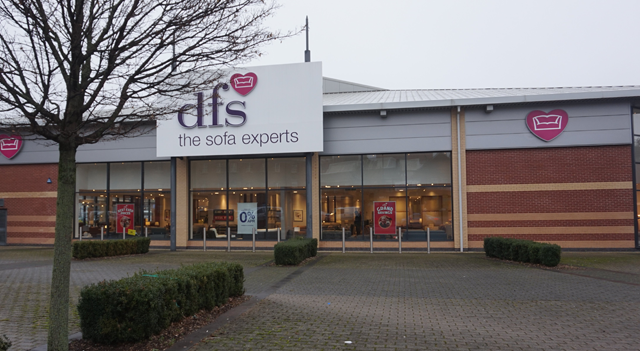
    DFS Furniture plc is the UK’s leading retailer of upholstered furniture, operating an integrated estate of physical showrooms and online channels across the UK and Republic of Ireland under the DFS and Sofology brands. The group specialises in living room furniture, combining exclusive product ranges with in-house UK manufacturing and third-party suppliers in the UK, Europe and the Far East. Its vertically integrated model includes a dedicated final-mile delivery network, supported by national marketing, product design innovation and accessible consumer finance options.