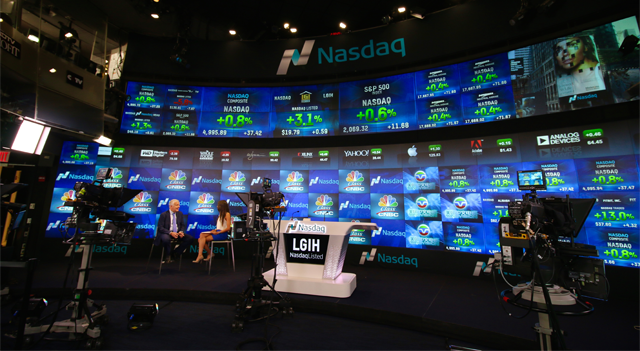
Wall Street appeared set for a higher opening on Monday, with US stock index futures advancing as falling crude oil prices and renewed interest in artificial intelligence supported market sentiment.
The gains followed a mixed session on Friday, when strength in semiconductor shares helped the Nasdaq Composite and S&P 500 finish higher, while the Dow Jones Industrial Average declined.
Dow futures rose 0.87%, S&P 500 futures gained 0.71% and Nasdaq futures advanced 1.1%.
Investors were also monitoring developments in the Middle East ahead of diplomatic meetings scheduled during this week’s United Nations General Assembly.
Oil Falls Below $100 as Investors Monitor Diplomatic Efforts
US crude oil futures dropped below $100 a barrel amid expectations that diplomatic initiatives could help ease tensions in the Middle East.
The decline provided some relief from concerns about elevated energy costs and their potential contribution to inflation.
US President Donald Trump was due to meet Gulf-state leaders on the sidelines of the UN General Assembly. Ahead of the discussions, he warned that Iran could face severe economic consequences if it failed to reach an agreement and raised the possibility of military action against its leadership.
Trump also indicated that a meeting with Iranian President Masoud Pezeshkian in New York was possible, suggesting that significant developments could occur soon.
He described himself as being in a “deciding mode” over whether to pursue military action, maintain economic pressure or seek a negotiated settlement.
The prospect of diplomatic progress helped support sentiment, although uncertainty surrounding the conflict continued to influence financial markets.
Semiconductor Rally Supports Nasdaq’s Friday Gains
US equities experienced a volatile session on Friday, with the major indices repeatedly moving between positive and negative territory before closing mixed.
The Nasdaq Composite advanced 104.25 points, or 0.4%, to 26,522.55.
The S&P 500 added 12.74 points, or 0.2%, to finish at 7,650.50.
The Dow Jones Industrial Average declined 95.40 points, or 0.2%, to 51,682.64.
For the week, the Nasdaq gained 0.7%, while the S&P 500 slipped 0.1% and the Dow lost 1.7%.
Semiconductor stocks provided support for the technology-heavy Nasdaq, with the Philadelphia Semiconductor Index surging 2.8%.
Brokerage shares also performed strongly, lifting the NYSE Arca Broker/Dealer Index by 1.1%.
Utilities, telecommunications and housing stocks moved lower as interest rate-sensitive sectors came under pressure.
Treasury Yields Climb as Interest Rate Concerns Persist
Trading on Friday was influenced by contrasting movements in crude oil prices and US Treasury yields.
Although oil futures declined sharply, Treasury yields rose as investors continued to assess the outlook for Federal Reserve interest rates.
Higher yields can increase borrowing costs and reduce the relative appeal of equities, particularly in sectors sensitive to financing conditions.
Overall trading activity remained subdued as market participants evaluated the outlook following recent price fluctuations.
The divergence between falling oil prices and rising bond yields highlighted the competing factors influencing investor sentiment.
US Industrial Output Misses August Expectations
Economic data released by the Federal Reserve showed that US industrial production was unchanged in August, compared with economists’ expectations for a 0.3% increase.
The result followed an unrevised 0.2% rise in July.
Higher utilities output offset a decline in manufacturing production, leaving the overall industrial production index flat for the month.
The figures added to the information available to investors assessing the strength of the US economy and the potential direction of monetary policy.
With Wall Street futures pointing higher, attention remained on energy prices, Treasury yields, geopolitical developments and the outlook for interest rates.
Leave a Reply