Author: Fiona Craig

  • Pulsar Group Forecasts FY2026 Revenue of £65 Million and Considers £5 Million Fundraise

    Pulsar Group Forecasts FY2026 Revenue of £65 Million and Considers £5 Million Fundraise

    Pulsar Group Plc (LSE:PULS) has forecast revenue of approximately £65 million for the financial year ending 30 November 2026, compared with £61.2 million in the previous year, while announcing that it is assessing investor demand for a potential fundraising of up to £5 million.

    The AIM-listed audience intelligence and Software-as-a-Service (SaaS) provider reported annual recurring revenue (ARR) of £67.7 million at 30 September 2026, representing an increase of £1.7 million, or 2.6%, on a constant currency basis since the beginning of the financial year.

    However, investment in infrastructure to support enterprise customers, higher third-party data costs and changes in customer billing arrangements have affected margins and cash generation.

    The company has also introduced a Capital Access Window, temporarily pausing trading in its ordinary shares while it assesses the proposed fundraising.

    Annual Recurring Revenue Reaches £67.7 Million

    Pulsar reported ARR of £67.7 million at 30 September 2026, an increase of £1.7 million on a constant currency basis since 30 November 2025.

    The increase represents growth of 2.6% during the financial year to date.

    ARR rose by £1.2 million during the first half of FY2026, followed by a further £0.5 million in the four months to 30 September.

    The company attributed the growth to new customer contracts and additional sales to existing large enterprise customers.

    Pulsar said these contracts contributed to second-half trading activity, although the investment required to support larger customers has affected short-term profitability and cash generation.

    FY2026 Revenue Expected to Rise While Adjusted EBITDA Declines

    The board expects Pulsar to report approximately £65 million in revenue for FY2026, compared with £61.2 million in FY2025.

    This represents an anticipated increase of approximately 6.2%.

    Adjusted EBITDA is expected to be approximately £10 million, compared with £10.4 million in the previous financial year.

    The projected decline in adjusted EBITDA comes despite the expected increase in revenue.

    Pulsar attributed the difference partly to expenditure on infrastructure and operational capacity required to serve larger enterprise customers.

    Higher costs associated with third-party data have also affected gross margins.

    The company said the necessary infrastructure investment is now in place and that its continuing cost reduction programme is intended to offset some of the additional expenditure.

    Gross Margins Affected by Infrastructure and Data Costs

    Pulsar expects its gross margin to be lower year on year, reflecting changes in the cost structure of its business.

    The company has invested in infrastructure and capacity to support contracts with large enterprise customers.

    At the same time, third-party data costs have increased.

    These expenses have affected profitability during FY2026, despite growth in annual recurring revenue and anticipated full-year sales.

    Management expects its cost reduction programme to help offset the additional costs.

    However, the trading update did not provide a specific gross margin forecast or quantify the expected savings from the programme.

    Workforce Reduced by 7% During FY2026

    Pulsar has continued implementing measures intended to reduce its operating cost base.

    The company reported that full-time equivalent headcount declined from 755 at 30 November 2025 to 702 at 30 September 2026.

    This represents a reduction of 53 positions, or approximately 7%, during the financial year to date.

    The workforce reduction forms part of the group’s wider cost reduction programme.

    Pulsar said it has incurred additional one-off restructuring costs associated with these measures, contributing to lower-than-anticipated cash generation.

    The company did not disclose the total restructuring expenditure or provide a revised target for future workforce reductions.

    Net Debt Increases to £6.4 Million

    Pulsar reported net debt of £6.4 million at 30 September 2026, compared with £6.0 million at 31 May 2026 and £5.6 million at 30 November 2025.

    Net debt therefore increased by £0.4 million during the four months to September and by £0.8 million since the beginning of the financial year.

    The company said operating cash performance had improved significantly compared with the previous year, while investing cash outflows had declined.

    Nevertheless, overall cash generation was below management’s expectations.

    Pulsar identified additional restructuring expenditure, changes in billing arrangements and slower customer collections as contributing factors.

    Enterprise Customer Billing Changes Affect Cash Generation

    Pulsar said changes in its customer mix have affected the timing of cash receipts.

    As the business has secured additional large enterprise customers, a smaller proportion of contracts has been paid annually in advance.

    This shift has reduced the level of upfront cash received from customers compared with previous billing arrangements.

    The company also reported slower collections, resulting in an increase in debtor days.

    Management expects the collection position to recover, although no specific timetable was provided.

    These factors, together with restructuring costs, have contributed to the increase in net debt despite improved operating cash performance.

    Pulsar Considers Fundraising of Up to £5 Million

    Alongside its trading update, Pulsar announced that it is assessing investor demand for a potential fundraising of up to £5 million.

    The company has not yet confirmed whether the fundraising will proceed.

    Its final size, structure, issue price and other terms remain undetermined.

    Any fundraising would require shareholder approval at a general meeting.

    Pulsar said it would provide further details in subsequent announcements, including the full terms and conditions if the transaction proceeds.

    The company did not specify the intended allocation of the potential proceeds.

    Trading Paused Under AIM Capital Access Window

    Pulsar has elected to use a Capital Access Window in connection with the proposed fundraising, following recent changes to the AIM Rules for Companies.

    The arrangement provides for a voluntary pause in trading of the company’s ordinary shares while it engages with potential investors.

    Pulsar said the measure is intended to facilitate access to a broader range of investors during the fundraising process.

    The Capital Access Window commenced at 7:30 a.m. on 28 October 2026.

    Trading will remain paused until the company makes a further announcement detailing the outcome of the proposed fundraising.

    Pulsar expects to announce the result as soon as practicable.

    The introduction of the Capital Access Window does not mean that the fundraising has been completed or that its terms have been agreed.

    Outlook for the Remainder of FY2026

    Pulsar enters the final part of FY2026 with annual recurring revenue of £67.7 million and a full-year revenue forecast of approximately £65 million.

    The company expects adjusted EBITDA of around £10 million, reflecting higher infrastructure and data costs alongside its investment in enterprise customer capacity.

    Management continues to implement operating cost reductions, with headcount already reduced by 7% during the financial year.

    The board remains confident in the group’s prospects, citing growth in enterprise customer contracts and the infrastructure now available to support additional business.

    Near-term financial developments will include the outcome of the proposed fundraising, changes in working capital and customer collections, and the effect of the cost reduction programme on profitability.

    The company has not provided further financial guidance beyond its FY2026 revenue and adjusted EBITDA estimates.

    More About Pulsar Group

    Pulsar Group Plc is an AIM-listed audience intelligence business providing Software-as-a-Service solutions to the global marketing and communications industries.

    Its technology supports organisations in analysing audiences and using data to inform marketing and communications activities.

    The group serves enterprise customers and generates recurring revenue through its software platforms.

    For FY2026, Pulsar expects revenue of approximately £65 million and adjusted EBITDA of approximately £10 million, while assessing a potential fundraising of up to £5 million.

  • Pantheon Resources: Experienced Leadership and Major Resource Potential Put Alaska in Focus

    Pantheon Resources: Experienced Leadership and Major Resource Potential Put Alaska in Focus

    Pantheon Resources (LSE:PANR) (USOTC:PTHRF) is positioning itself at the centre of renewed interest in Alaska’s North Slope, with CEO Dave Wilkins bringing more than 40 years of oil and gas industry experience to the company’s Kodiak and Ahpun projects.

    When an experienced oil and gas executive comes out of retirement to lead a company, investors naturally want to understand what has captured his attention. For Dave Wilkins, the answer lies in Pantheon Resources’ substantial resource base, advances in seismic technology and the growing strategic importance of Alaska’s energy infrastructure.

    In an interview with ADVFN, Wilkins explained that his decision to join Pantheon followed a detailed examination of its technical data, seismic information, historical work and development plans. Having spent more than four decades evaluating opportunities and delivering projects across the industry, he said the quality of the assets and the strength of the team convinced him that Pantheon had the potential to progress to its next stage of development.

    Wilkins initially joined the board in March before subsequently taking on the role of CEO. His enthusiasm for the opportunity is clear, with his experience bringing an important perspective as the company advances its strategy.

    A Substantial Resource Base

    At the heart of Pantheon Resources’ investment proposition is its significant acreage position on Alaska’s North Slope.

    According to Wilkins, the company holds approximately 258,000 acres associated with more than three billion barrels of oil equivalent in contingent resources (2C). This provides a substantial resource base across its Alaskan portfolio, with the Kodiak and Ahpun projects central to its development plans.

    A key factor in understanding the opportunity is the improvement in seismic technology. Wilkins explained that earlier seismic data, including a dataset from 2016, had been difficult to interpret clearly. Advances in technology and the reprocessing of this information have improved the company’s understanding of the subsurface, helping to identify potential resource locations and inform future well planning.

    This improved technical understanding is an important part of Pantheon’s strategy. Better interpretation of the available data can help the company refine its development plans and make more informed decisions as it evaluates how to progress its assets.

    For investors, the combination of a large acreage position and improved subsurface imaging provides important context for understanding the scale of the opportunity Pantheon is pursuing.

    Alaska Attracts Renewed Industry Interest

    Wilkins believes the timing is particularly attractive for companies operating in Alaska, pointing to several developments that are bringing the region back into focus.

    One factor is the oil and gas industry’s continuing search for substantial resource opportunities. After a decade of significant activity in shale plays, Wilkins believes companies are increasingly looking towards the longer-term potential of other regions capable of supporting future energy production.

    Alaska’s North Slope offers that potential, with Pantheon holding a significant acreage position in an established energy-producing region.

    Technological improvements are also helping unlock a better understanding of Alaska’s resources. As seismic interpretation becomes more sophisticated, companies can reassess previously identified opportunities and improve their understanding of the geology.

    For Pantheon, these developments reinforce the importance of its technical work and the potential value of its extensive acreage.

    Infrastructure Could Be a Strategic Advantage

    Another important element of the story is the proposed Alaska LNG project, which Wilkins highlighted as a significant development for the region.

    The project, associated with Glenfarne, is intended to help bring Alaska’s substantial natural gas resources to market, supporting energy supply for both domestic and international customers.

    Wilkins noted that the proposed pipeline route passes through Pantheon’s acreage, potentially providing an important infrastructure connection for the company’s assets.

    Access to suitable infrastructure is a key consideration for oil and gas developments, particularly in remote regions where transporting resources to market can be challenging. The prospect of additional infrastructure in Alaska therefore represents an important part of the wider regional opportunity.

    While the commercial implications for Pantheon will depend on the development of the project and the company’s own plans, the proposed pipeline route highlights the strategic relevance of its acreage within the evolving North Slope energy landscape.

    The combination of improved seismic data, substantial resources and potential access to new infrastructure gives investors several important factors to consider when evaluating Pantheon’s position in Alaska.

    Experienced Leadership Focused on the Next Stage

    Wilkins’ appointment also brings a renewed focus on execution and the development of Pantheon’s strategy.

    His decision to return from retirement followed a direct assessment of the company’s technical position and the people responsible for advancing its projects. He was particularly encouraged by the quality of the team, describing it as comparable to, or better than, others he had worked with throughout his career.

    That endorsement is significant because the next stage of Pantheon’s progress will require the company to translate its technical understanding into a clear and disciplined development strategy.

    Wilkins brings extensive industry experience to that challenge, alongside an enthusiasm for the company’s assets and the broader outlook for Alaska.

    His comments suggest that Pantheon’s opportunity is not simply about the scale of its resource base, but also about how technological advances, infrastructure developments and experienced leadership can combine to support the next phase of its development.

    Pantheon Resources Looks to Alaska’s Next Chapter

    Pantheon Resources is operating at a time when Alaska is attracting renewed attention from the energy industry. Improvements in seismic technology are providing a clearer understanding of its subsurface potential, while proposed LNG infrastructure could help reshape the region’s energy landscape.

    Against this backdrop, Pantheon’s approximately 258,000-acre position and the more than three billion barrels of oil equivalent in resources cited by Wilkins provide a substantial foundation for its strategy.

    For Wilkins, the decision to return to the industry reflects his conviction in the quality of the assets and the team working to develop them.

    The company’s challenge now is to build on its technical work, advance its development plans and establish how its resource base can be progressed commercially.

    With an experienced CEO at the helm and its assets situated within a region attracting fresh industry interest, Pantheon Resources offers investors a story centred on resource potential, technological progress and Alaska’s evolving energy infrastructure.

    For more information visit – https://www.pantheonresources.com/

  • ADVFN Expands Mobile App With Advanced Charts, Options Data, Ownership Information and New Investor Tools

    ADVFN Expands Mobile App With Advanced Charts, Options Data, Ownership Information and New Investor Tools

    ADVFN has introduced a series of updates to its mobile application, expanding the range of financial data, research tools and personalisation features available to investors. The additions include advanced charting capabilities, options data for U.S. equities, company ownership information, insider transaction records, expanded financial data, customisable notifications and Dark Mode.

    The updates are designed to give users access to more detailed market information and company research tools directly from their mobile devices, while improving navigation and control over the app’s functionality.

    Advanced Charting Tools and Full-Screen Analysis

    One of the additions is an enhanced charting experience, providing investors with more ways to examine share price movements and market trends.

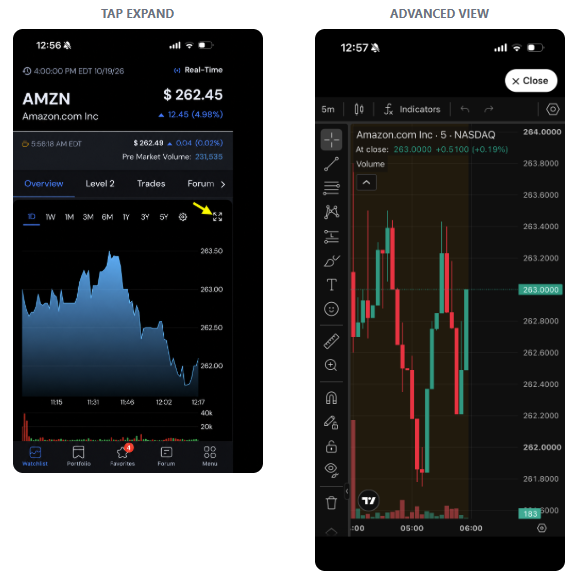
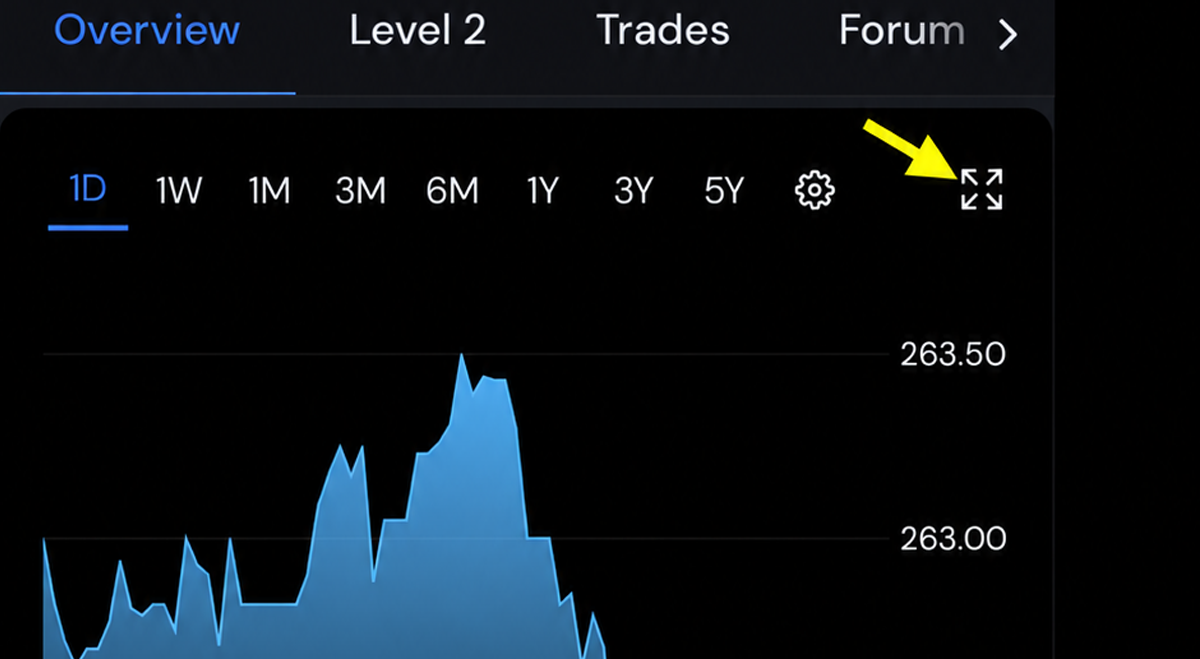
    The updated charts include additional controls and a full-screen advanced chart view, allowing users to explore price activity in greater detail.

    Investors can access the feature by opening a company or financial instrument’s page, selecting the Chart section and tapping the expand icon in the upper-right corner. This opens the advanced chart interface, providing a larger workspace for market analysis.

    ADVFN app charting advanced view

    Options Chain Data for U.S. Equities

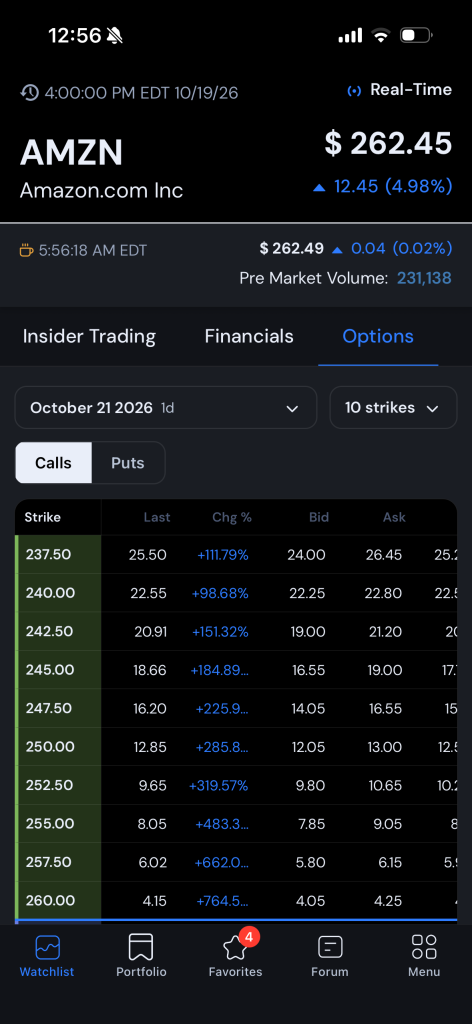
    ADVFN has also introduced options chain information for supported U.S.-listed equities, allowing investors to examine options contracts within the mobile application.

    The new Options section enables users to select expiration dates, switch between call and put options, and review available strike prices and contracts.

    The feature provides access to options information alongside the underlying equity’s market data, reducing the need to navigate between different research platforms.

    To access the information, users can open a supported U.S. stock, select the Options tab and choose the relevant expiration date and contract type.

    ADVFN app options chain

    Company Ownership and Institutional Holdings

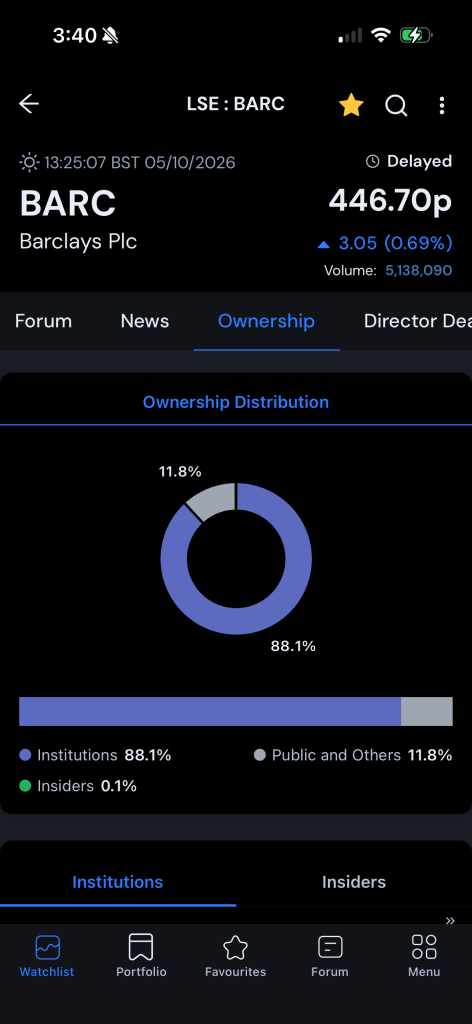
    A new Ownership tab provides additional information about the shareholder structure of companies and other supported securities.

    Investors can review institutional, insider and public ownership information, providing a breakdown of the different categories of shareholders.

    The feature is accessible directly from a symbol’s page by selecting Ownership.

    The addition complements the app’s expanded company statistics, which include institutional holdings data and other measures relevant to company research.

    ADVFN app ownership

    Insider Transactions and Director Dealings

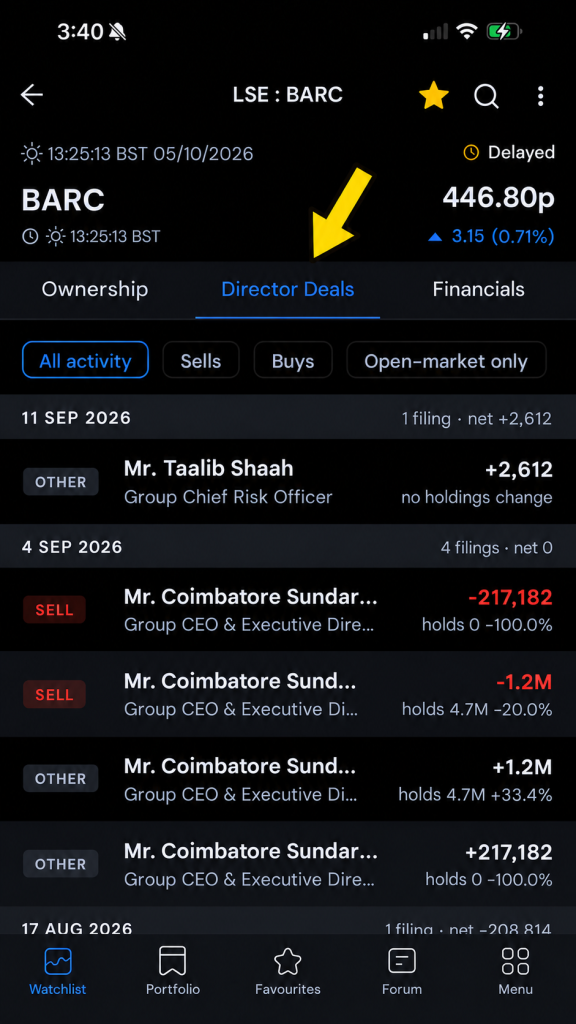
    The updated application also provides access to historical insider transactions, allowing users to review buying and selling activity involving company insiders.

    Available through the Director Deals section of a symbol’s page, the feature includes filtering options for all transactions, purchases, sales and open-market activity.

    This allows investors to examine reported insider dealings separately from other company information and assess transaction histories as part of their research.

    ADVFN app director deals

    Expanded Financial Statements and Company Fundamentals

    ADVFN has increased the amount of company financial information available through the mobile app, adding further fundamental data and key statistics.

    The Financials section provides access to available company financial information directly from individual symbol pages, while the General section includes additional company metrics.

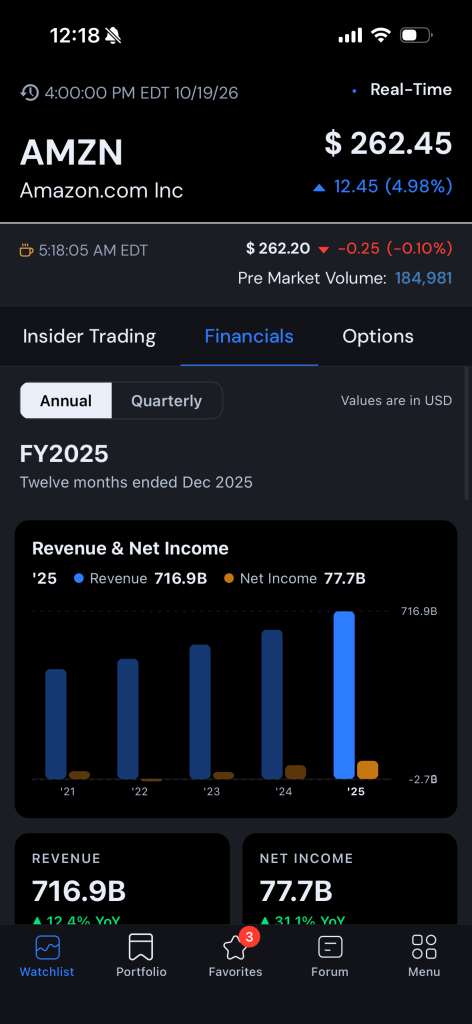
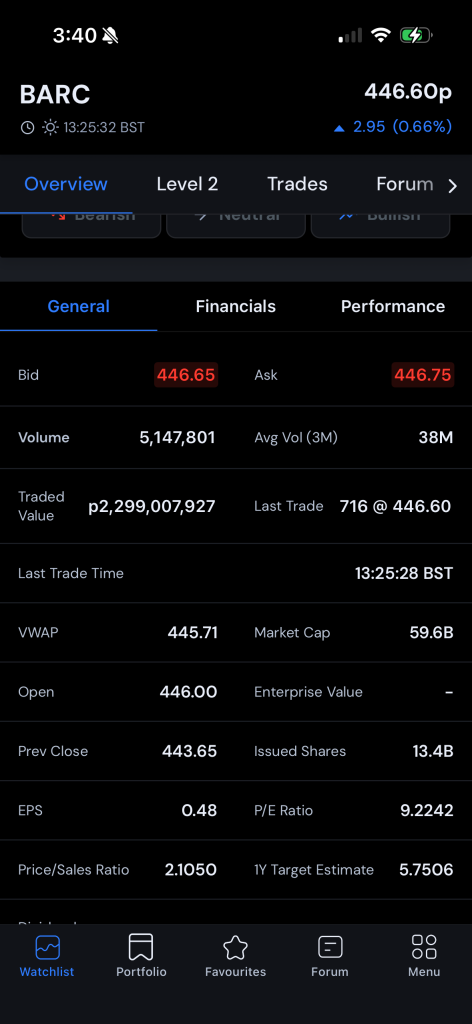
    ADVFN app financials

    Among the expanded data points are Beta, Float, Institutional Holdings and valuation information, alongside other company statistics.

    Beta provides a measure of a security’s historical sensitivity to broader market movements, while Float represents the shares generally available for public trading. Institutional Holdings data offers information about ownership by investment institutions.

    By bringing these metrics together with financial information and market prices, the app allows investors to access multiple aspects of company research within the same interface.

    ADVFN app financial data

    Customisable Notifications and Market Alerts

    The updates also introduce additional control over notifications, allowing users to manage the types of alerts they receive.

    Notification settings cover forum activity, price alerts, private messages and news relating to selected securities.

    Users can enable or disable individual notification categories through Menu, App Settings and Notifications.

    The Manage Symbols function provides additional control over which securities are included in news notifications, allowing investors to tailor updates to the companies and instruments they follow.

    ADVFN app notifications

    Dark Mode and Display Personalisation

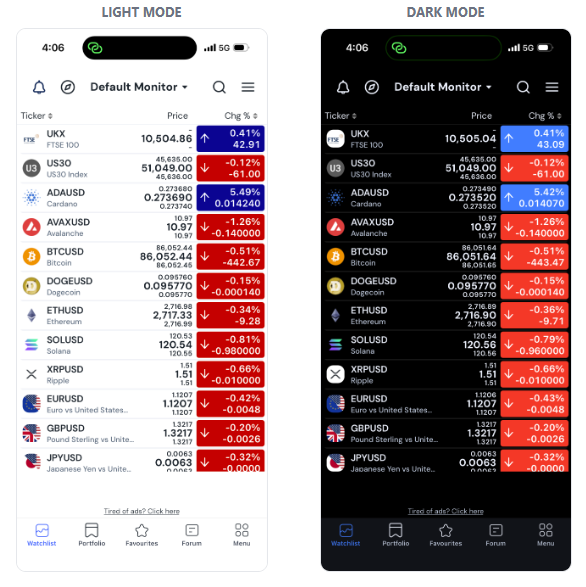
    ADVFN has introduced Dark Mode as an alternative display option within the mobile application.

    The feature allows users to switch between light and dark interfaces according to their viewing preferences.

    Dark Mode can be enabled or disabled directly from the app’s Menu, giving users control over the appearance of the platform without changing their market data or research settings.

    ADVFN app light and dark modes

    Continued Development of ADVFN Mobile

    The combined updates expand several areas of the ADVFN mobile experience, including technical analysis, derivatives information, shareholder research, financial fundamentals and notification management.

    The introduction of advanced charts and U.S. equity options chains extends the app’s market analysis capabilities, while ownership data, insider transactions and additional financial metrics provide more information for company-level research.

    Meanwhile, customisable notifications and Dark Mode give users greater control over how they interact with the platform.

    ADVFN has indicated that further improvements are planned as it continues developing the mobile application, with an emphasis on expanding available market data, research functionality and overall performance. The latest features form part of the company’s ongoing development of its mobile services, bringing additional tools and financial information into a single application for investors monitoring markets and researching securities on the move.

    Get the ADVFN app from the Apple store and Google Play

  • Wall Street Futures Edge Higher as Technology Shares Recover Ahead of Fed Decision: Dow Jones, S&P, Nasdaq

    Wall Street Futures Edge Higher as Technology Shares Recover Ahead of Fed Decision: Dow Jones, S&P, Nasdaq

    U.S. equity futures indicated further gains ahead of Tuesday’s opening bell, following a recovery in the previous session that lifted the Nasdaq Composite, S&P 500 and Dow Jones Industrial Average.

    Developments involving artificial intelligence companies and quarterly earnings announcements provided additional information for investors, while the Federal Reserve’s upcoming interest rate decision remained a focus.

    Anthropic’s public filing for an initial public offering and a new investment agreement involving Nvidia and Meta Platforms contributed to renewed attention on AI-related equities.

    Meanwhile, JetBlue Airways and Corning advanced in premarket trading, while Whirlpool declined following its latest financial announcement.

    Why Are U.S. Stock Futures Moving Higher?

    Futures linked to the principal U.S. equity indices pointed to gains after Monday’s market recovery.

    The advance followed two consecutive sessions of losses late in the previous week, when concerns about debt-financed AI infrastructure spending affected technology shares.

    Investors subsequently returned to selected stocks that had declined during the selloff.

    The recovery coincided with developments involving Anthropic, Nvidia and Meta, alongside a decline in crude oil prices.

    However, the pending Federal Reserve announcement remained a potential constraint on trading activity ahead of Wednesday’s policy decision.

    Anthropic IPO Filing Draws Attention to AI Companies

    Anthropic publicly filed for an initial public offering, adding to investor attention on the artificial intelligence industry.

    The filing followed a period of market concern about the amount of borrowing being used to finance AI infrastructure expansion.

    Investors have been assessing the financial commitments associated with data processing capacity, computing infrastructure and the development of advanced AI systems.

    The IPO announcement provided another development for market participants evaluating the industry’s investment requirements and commercial prospects.

    The news also coincided with renewed buying interest in technology-related shares during Monday’s session.

    Nvidia Announces $3 Billion Investment in Meta

    Nvidia (NASDAQ:NVDA) and Meta Platforms (NASDAQ:META) announced plans to expand their existing collaboration on Muse and related artificial intelligence models.

    Under the arrangement, Nvidia said it would invest $3 billion in Meta.

    The investment forms part of Meta’s plans to raise as much as $95 billion through equity financing.

    The agreement represents an expansion of the companies’ work on artificial intelligence technology.

    It also comes as investors continue to examine the financing structures and spending commitments of businesses developing AI models and supporting infrastructure.

    JetBlue Shares Jump While Corning Also Advances

    JetBlue Airways (NASDAQ:JBLU) shares rose 13.9% in premarket trading after the airline published its third-quarter financial results.

    Although the company reported a larger quarterly loss than analysts had forecast, it also indicated that operating margins were expected to expand further during the fourth quarter.

    Corning (NYSE:GLW) also recorded a notable premarket increase.

    The glass manufacturer reported third-quarter revenue and earnings above analyst consensus estimates.

    The two companies were among those recording gains following their earnings announcements ahead of Tuesday’s regular trading session.

    Whirlpool Falls After Third-Quarter Results

    Whirlpool (NYSE:WHR) shares declined 7.2% before the opening bell.

    The appliance manufacturer reported third-quarter results below Wall Street expectations and lowered its full-year revenue forecast.

    The reduction in guidance accompanied the company’s quarterly earnings announcement and contributed to the information investors were assessing before the session.

    Whirlpool’s decline contrasted with the gains recorded by JetBlue and Corning, demonstrating differing share price reactions during the earnings reporting period.

    Federal Reserve Expected to Keep Interest Rates Unchanged

    The Federal Reserve is scheduled to announce its monetary policy decision on Wednesday.

    Market participants widely expect the central bank to leave interest rates unchanged.

    Attention will therefore extend beyond the decision itself to the accompanying statement, particularly any indications about the future direction of borrowing costs.

    Investors will be assessing the Federal Reserve’s assessment of economic conditions and the factors likely to influence subsequent policy decisions.

    The approaching announcement could contribute to relatively limited trading activity ahead of Wednesday.

    Nasdaq and S&P 500 Recover From Recent Lows

    Wall Street recorded gains on Monday after the principal indices declined during the previous Thursday and Friday.

    The Nasdaq Composite rose 214.04 points, or 0.8%, to 26,169.38.

    The S&P 500 increased 53.09 points, or 0.7%, to 7,676.77.

    The Dow Jones Industrial Average added 146.32 points, or 0.3%, closing at 52,361.58.

    All three indices ended the session higher, although they finished below their intraday highs.

    The rebound followed a decline that had taken the Nasdaq to its lowest closing level since early August and the S&P 500 to its lowest closing level in one month.

    Buying interest included shares that had experienced price declines during the preceding sessions.

    Crude Oil Declines as Saudi Arabia and Iran Hold Talks

    U.S. crude oil futures fell 1.5% amid reports of diplomatic discussions concerning the Middle East conflict.

    Saudi Defense Minister Prince Khalid bin Salman travelled to Tehran to meet senior Iranian officials and discuss efforts to reduce regional tensions.

    The development coincided with a decline in crude oil prices and a recovery in U.S. equities.

    Investors continued to monitor developments affecting the conflict and their implications for energy supplies and prices.

    Technology Sectors Record Broad Gains

    Technology-related stocks contributed to Monday’s market advance.

    The NYSE Arca Networking Index gained 2.9%, while the Philadelphia Semiconductor Index increased 2.8%.

    Computer hardware and software stocks also advanced during the session.

    Oil services companies recorded gains, while brokerage shares declined.

    The sector performance showed renewed buying activity in semiconductor and networking stocks following the technology sector’s losses late in the previous week.

    What Could Influence Wall Street’s Next Trading Session?

    U.S. equity futures suggested that Monday’s recovery could continue into Tuesday’s regular trading session.

    The market backdrop included developments involving Anthropic, Nvidia and Meta, as well as premarket movements following the latest corporate earnings announcements.

    Lower crude oil prices and diplomatic activity in the Middle East were also among the factors being monitored.

    The Federal Reserve’s Wednesday policy announcement remains a principal upcoming event, with investors awaiting both the interest rate decision and any guidance contained in the accompanying statement.

  • European Stocks Mixed as HSBC Earnings and French Protests Weigh on Sentiment: DAX, CAC, FTSE100

    European Stocks Mixed as HSBC Earnings and French Protests Weigh on Sentiment: DAX, CAC, FTSE100

    European stock markets traded in mixed territory on Tuesday as investors assessed quarterly corporate earnings, political unrest in France and new economic data from the United Kingdom.

    London’s FTSE 100 declined 0.8%, with banking group HSBC among the notable fallers following its third-quarter earnings announcement. Germany’s DAX advanced 0.4%, while France’s CAC 40 gained 0.5%.

    Investor attention also turned to continuing demonstrations in France, where student leaders pledged further protests despite government concessions on education. Meanwhile, UK shop price inflation accelerated to its highest level in two and a half years.

    French Consumer Confidence Falls to Lowest Level Since 2013

    France’s national statistics agency, INSEE, reported that consumer confidence declined in October to its lowest level since June 2013.

    The deterioration came amid widespread protests over education, living costs and government policy.

    French student leaders indicated that demonstrations would continue despite concessions announced by the government in an effort to address the unrest.

    The developments added to the economic and political issues facing France, although the CAC 40 advanced 0.5% during Tuesday’s session.

    UK Shop Price Inflation Accelerates to 2.1%

    In the United Kingdom, the British Retail Consortium reported an increase in annual shop price inflation during October.

    Its shop price index rose 2.1% year over year, compared with a 1.4% increase in September.

    The October reading represented the highest rate of shop price inflation in two and a half years.

    The figures provided further evidence of rising retail prices as investors monitored inflation developments and their potential implications for consumer spending.

    HSBC and Reckitt Benckiser Decline Following Earnings Updates

    HSBC (LSE:HSBA) shares moved lower after the banking group reported third-quarter profit slightly below market expectations.

    The results contributed to the decline in London’s FTSE 100, which fell 0.8%.

    Consumer goods group Reckitt Benckiser (LSE:RKT) also recorded a share price decline after reducing its annual sales guidance.

    The company reported third-quarter sales below expectations, citing an unexpected slowdown in its US business.

    The revised outlook reflected weaker trading conditions in that market during the reporting period.

    Beiersdorf and Orange Shares Fall Despite Different Earnings Developments

    German consumer goods manufacturer Beiersdorf (TG:BEI) declined after reporting third-quarter sales below analyst expectations.

    French telecommunications group Orange (EU:ORA) also traded lower, despite announcing higher quarterly revenue and increasing its 2026 core earnings growth target.

    The contrasting financial developments highlighted differing investor responses to corporate results across European markets.

    While Beiersdorf reported a sales shortfall, Orange’s share price declined despite improvements in its reported revenue and annual earnings outlook.

    RWS Holdings Advances Following Return to Organic Revenue Growth

    RWS Holdings (LSE:RWS), the London-listed provider of AI-related solutions, recorded a share price increase after reporting an improvement in organic revenue.

    The company said organic revenue rose approximately 3% for the period ending September 30, following a decline in the preceding year.

    The update indicated a return to organic revenue growth during the reported period.

    RWS was among the London-listed companies trading higher despite the broader decline in the FTSE 100.

    Porsche and Alfa Laval Gain Following Operating Updates

    Porsche (TG:PAH3) shares advanced after the luxury sports car manufacturer reaffirmed its full-year 2026 outlook.

    The company also reported a substantial recovery in operating profit for the first nine months of the year.

    Swedish industrial group Alfa Laval (TG:AA9) moved higher after announcing record order intake during the third quarter.

    The companies’ operating updates coincided with share price increases during Tuesday’s European trading session.

    Novartis Rises After Upgrading Annual Profit Outlook

    Swiss pharmaceutical group Novartis (TG:NOT) recorded a notable share price increase after raising its full-year core operating income guidance.

    The company revised its expectations following third-quarter sales growth and improved core operating profitability.

    Novartis now expects annual core operating income to remain broadly unchanged or increase by a low single-digit percentage at constant currencies, compared with its previous forecast of a low single-digit decline.

    The revised outlook contributed to the company’s share price advance.

    European Markets Reflect Divergent Corporate Results and Economic Conditions

    Tuesday’s European trading session showed differences between national indices and individual company performances.

    The FTSE 100 declined 0.8%, while Germany’s DAX gained 0.4% and France’s CAC 40 advanced 0.5%.

    Corporate earnings announcements influenced individual shares, with HSBC, Reckitt Benckiser, Beiersdorf and Orange declining, while RWS Holdings, Porsche, Alfa Laval and Novartis advanced.

    Investors also assessed France’s decline in consumer confidence, continuing protests and the acceleration of UK shop price inflation.

    These developments formed the economic and corporate backdrop to the mixed performance of European equities.

  • UBS Revises 12-Month Palladium Outlook to $1,100 as Chinese Imports Decline

    UBS Revises 12-Month Palladium Outlook to $1,100 as Chinese Imports Decline

    UBS has lowered its palladium price projection to approximately $1,100 per ounce over the next 12 months, citing changes in investor positioning and increasingly bearish sentiment in the options market.

    The Swiss bank reduced its previous forecasts for December, March and June by between $100 and $200 per ounce as it reassessed conditions affecting the precious metal.

    The revision comes as China’s palladium imports have declined, although the widening price discount relative to platinum could provide an incentive for increased automotive use.

    Investor Positioning Influences UBS Forecast Revision

    UBS identified changes in financial market activity as a factor behind its decision to reduce its palladium price expectations.

    The bank pointed to weakening investor positioning and a more bearish outlook reflected in options market sentiment.

    According to UBS, these developments indicate greater caution among financial market participants regarding palladium’s price prospects.

    Its updated projection of approximately $1,100 per ounce over the coming 12 months represents a reduction of $100 to $200 per ounce from its earlier December, March and June estimates.

    The forecast reflects the bank’s current assessment rather than a confirmed future price level.

    Chinese Palladium Imports Fall by Approximately 60%

    China’s palladium imports declined from nearly 8.6 metric tons in April to 3.4 metric tons in September.

    The decrease represents approximately 5.2 metric tons, equivalent to a reduction of around 60% over the period.

    The import figures provide an additional indicator of developments affecting physical demand for palladium.

    The reduction in Chinese purchases coincides with the changes in investor positioning and options market sentiment identified in UBS’s revised outlook.

    Price Gap With Platinum Creates Potential Automotive Demand Support

    UBS also highlighted a factor that could partially offset the downward pressures reflected in its palladium forecast.

    Palladium is trading at an increasingly large discount to platinum, improving the economic case for substituting palladium for platinum in gasoline vehicle autocatalysts.

    The widening price difference could encourage greater use of palladium in these automotive applications.

    According to the bank’s assessment, this substitution could provide some support to automotive demand, although the extent of any resulting increase has not been established.

    UBS Outlook Reflects Changes in Market Sentiment and Industrial Demand

    The revised UBS forecast reflects a combination of financial market positioning and developments in physical palladium demand.

    The bank identified weakening investor interest and bearish options market sentiment, while Chinese import figures showed a reduction between April and September.

    At the same time, palladium’s widening discount to platinum could improve its competitiveness in gasoline autocatalyst applications.

    UBS’s new 12-month price projection stands at approximately $1,100 per ounce, with the potential for automotive substitution remaining a factor in the bank’s assessment of future demand.

  • OPEC+ Members Likely to Hold December Oil Production Targets as Gulf Exports Recover

    OPEC+ Members Likely to Hold December Oil Production Targets as Gulf Exports Recover

    Seven OPEC+ oil-producing countries are expected to maintain their existing production targets for December when they meet online on Sunday, according to three people familiar with the discussions who spoke to Reuters.

    The anticipated decision comes as the producer alliance prepares for negotiations over its 2027 production quotas, while Gulf producers continue increasing oil exports following disruptions associated with the conflict involving Iran.

    The countries participating in Sunday’s meeting are Saudi Arabia, Russia, Iraq, Kuwait, Algeria, Kazakhstan and Oman.

    December Output Targets Expected to Remain Unchanged

    The three people familiar with the matter indicated that OPEC+ members are likely to retain their current December production targets rather than introduce adjustments at Sunday’s meeting.

    However, all three sources requested anonymity and confirmed that no final decision had been reached.

    The expected outcome therefore remains provisional until the participating countries complete their discussions.

    The meeting takes place as attention within the producer group shifts towards negotiations concerning production allocations for 2027.

    Gulf Oil Exports Increase Following Iran War Disruptions

    Oil producers in the Gulf have been increasing exports after months of disruption linked to the war involving Iran.

    Despite the increase in export volumes, most Gulf producers continue to pump oil at levels substantially below their existing production targets.

    The gap between actual production and established targets remains part of the operating conditions facing the group as it considers its December output policy.

    The reported expectation of unchanged targets comes against this backdrop of recovering exports and production levels that remain below agreed allocations.

    Seven OPEC+ Countries to Participate in Online Meeting

    Sunday’s virtual meeting will bring together Saudi Arabia, Russia, Iraq, Kuwait, Algeria, Kazakhstan and Oman.

    OPEC+ consists of the Organization of the Petroleum Exporting Countries and allied oil-producing nations, including Russia.

    The participating countries are expected to address December production targets as the wider alliance turns its attention towards determining production quotas for 2027.

    According to the people cited by Reuters, maintaining current targets is the anticipated decision, although discussions have not yet produced a final agreement.

    OPEC and Russian authorities did not immediately respond to requests for comment.

    Focus Turns to 2027 Production Quota Negotiations

    The upcoming meeting comes as OPEC+ prepares to negotiate its production allocations for 2027.

    The group is considering its December targets while Gulf producers continue restoring export activity following months of disruption.

    With no final decision announced, the outcome of Sunday’s meeting remains subject to discussions among the participating countries.

    The meeting will determine whether the seven producers retain their existing December targets as preparations for the 2027 quota negotiations continue.

  • Gold Trades Below $4,000 as Fed Rate Outlook and Iran Diplomacy Shape Market Attention

    Gold Trades Below $4,000 as Fed Rate Outlook and Iran Diplomacy Shape Market Attention

    Gold prices moved lower on Tuesday, briefly falling beneath the $4,000-per-ounce level as investors prepared for the Federal Reserve’s upcoming interest-rate decision and assessed diplomatic efforts involving the United States and Iran.

    At 05:58 ET (09:58 GMT), spot gold declined 0.5% to $3,998.23 per ounce, while U.S. gold futures were down 0.6% at $4,013.17 per ounce.

    The decline followed a 0.5% increase in the previous session, with traders evaluating the likelihood that the Federal Reserve will maintain its current interest-rate settings when policymakers announce their decision on Wednesday.

    Markets Assign 10% Probability to Immediate Fed Rate Increase

    Market pricing suggests an approximately 10% chance that the Federal Reserve will raise interest rates at this week’s meeting.

    The central bank increased borrowing costs in September for the first time since 2023, with subsequent economic data influencing expectations for additional policy adjustments.

    U.S. inflation figures that exceeded forecasts initially prompted traders to increase expectations for another rate increase in October.

    However, comments from Federal Reserve officials indicating that further monetary tightening was not immediately necessary subsequently reduced those expectations.

    Despite the relatively low probability assigned to an increase this week, elevated energy prices have sustained expectations that the central bank could raise rates again before the end of the year.

    Investors are awaiting Wednesday’s announcement for further information about policymakers’ assessment of inflation and the potential timing of future interest-rate changes.

    Oil Price Movements Remain Relevant to Inflation Outlook

    Oil prices increased during volatile trading on Tuesday, even as diplomatic initiatives involving Iran raised expectations that further military escalation could be avoided.

    Energy prices remain elevated, contributing to inflation concerns and influencing market expectations regarding the Federal Reserve’s future policy decisions.

    A reduction in tensions between the United States and Iran could help contain energy costs, although the outcome of the diplomatic efforts remains uncertain.

    At the same time, inflation remaining elevated could maintain the possibility of additional interest-rate increases later in the year.

    The interaction between energy costs and inflation expectations remains a factor in assessments of the monetary policy outlook.

    Diplomatic Efforts Involving Iran Continue

    Investors are also following developments in diplomatic discussions aimed at reducing tensions surrounding the conflict between the United States and Iran.

    The latest diplomatic initiatives have raised expectations that further military escalation might be prevented, although no definitive outcome has been established.

    Oil markets have continued to experience price fluctuations despite these developments, reflecting the combination of ongoing diplomatic activity and uncertainty surrounding regional tensions.

    Changes in the geopolitical situation could influence energy prices, which remain relevant to inflation expectations and the outlook for U.S. monetary policy.

    Gold Investors Await Wednesday’s Fed Announcement

    Gold’s move below $4,000 per ounce comes as markets reassess the prospects for U.S. borrowing costs following September’s interest-rate increase and subsequent inflation data.

    The Federal Reserve’s upcoming announcement will provide an updated policy decision as investors consider whether additional monetary tightening could occur before the end of 2026.

    While current market pricing indicates limited expectations for an immediate increase, the possibility of further adjustments remains part of the outlook amid elevated energy prices.

    Gold market participants are monitoring Wednesday’s Federal Reserve decision alongside developments in U.S.-Iran diplomacy and their potential implications for inflation and monetary policy.

  • Brent Climbs to $116.38 as Iran Talks Continue and Houthis Claim Saudi Infrastructure Attacks

    Brent Climbs to $116.38 as Iran Talks Continue and Houthis Claim Saudi Infrastructure Attacks

    Oil futures advanced on Tuesday after reversing earlier losses, with investors assessing negotiations involving Iran and regional governments alongside reported attacks on Saudi Arabian infrastructure.

    At 04:10 ET (08:10 GMT), Brent crude futures were up 0.5% at $116.38 per barrel, while U.S. West Texas Intermediate (WTI) futures increased 0.6% to $102.35 per barrel.

    Both contracts had declined earlier in the session. Brent reached a six-month high last week as concerns about potential attacks on energy facilities and commercial shipping in the Middle East affected trading.

    Iran Holds Talks With Regional Governments

    Diplomatic efforts involving Iran, Saudi Arabia, Turkey and Pakistan continued this week as regional officials sought to address tensions surrounding the conflict involving the United States, Israel and Iran.

    Senior representatives from Saudi Arabia, Turkey and Pakistan met Iranian officials in Tehran on Monday to discuss regional security and possible avenues for negotiations.

    Qatar has also engaged with Iranian authorities as part of efforts to limit the geographical spread of the conflict.

    According to reports, the discussions addressed several issues, including attacks attributed to Iran-backed Houthi forces in Yemen, potential negotiations between the United States and Iran, shipping disruptions in the Strait of Hormuz and the American blockade of Iranian ports.

    The diplomatic activity has reduced some immediate concerns about additional military escalation, although the outcome of the discussions remains uncertain.

    U.S. President Donald Trump has continued to leave open the possibility of further military operations against Iran.

    Iranian authorities have indicated that negotiations with Washington would require concessions, including an end to the blockade of Iranian ports and the removal of sanctions affecting the country’s oil exports.

    Capital Economics Examines Impact of U.S. Blockade

    Analysts at Capital Economics have assessed the economic consequences of the U.S. naval blockade and the factors that could determine Iran’s response to diplomatic negotiations.

    “The U.S. naval blockade that has now been in place for more than 100 days is imposing severe pain on Iran’s economy, with the rial tumbling and inflation at close to 90% y/y. But the extent to which this affects Iran’s negotiating position depends on which faction of the regime is in the ascendency as well as the degree of control that Iran can exert over the Strait of Hormuz,” analysts at Capital Economics said in a note.

    The assessment identifies internal political dynamics and Iran’s control over the Strait of Hormuz as factors influencing its negotiating position.

    The blockade and restrictions affecting oil exports remain among the issues raised by Tehran in connection with potential talks with Washington.

    Houthi Forces Report Attacks on Saudi Oil Pipeline

    Houthi forces said on Monday that they had carried out attacks targeting pumping stations on Saudi Arabia’s East-West crude oil pipeline and Riyadh airport.

    Saudi Arabian authorities had not immediately verified the reported incidents.

    The kingdom has separately reported intercepting missiles and drones in recent days, as regional military activity continues alongside diplomatic discussions.

    The East-West pipeline and shipping routes through the Strait of Hormuz remain relevant to assessments of regional oil transportation and supply conditions.

    Reports of attacks on energy infrastructure have continued to feature in oil market developments, alongside the potential effects of restrictions on commercial shipping.

    IEA Expects Energy Market Disruption to Extend Into 2027

    International Energy Agency Executive Director Fatih Birol said on Monday that energy markets were unlikely to return to their pre-conflict conditions during 2027.

    His comments addressed the potential duration of changes affecting global energy supply chains following the conflict.

    Separately, Saudi Aramco plans to establish crude oil storage operations in Singapore during the second half of 2027.

    The arrangement was announced by energy ministers from Saudi Arabia and Singapore and is intended to improve the resilience of Aramco’s regional supply chain.

    The planned storage operations form part of the company’s arrangements for managing crude oil supplies in the region.

    Oil Traders Assess Supply Conditions and Diplomatic Developments

    The latest increase in Brent and WTI futures follows fluctuations in prices as market participants monitor diplomatic discussions and developments affecting Middle Eastern energy infrastructure.

    Negotiations involving Iran and neighbouring governments are continuing while restrictions on maritime transport and the U.S. blockade remain unresolved.

    Market attention remains focused on whether diplomatic efforts result in changes to shipping access, sanctions on Iranian oil exports or the regional security environment.

    The combination of ongoing negotiations, reported attacks and uncertainty surrounding shipping routes continues to shape developments in international crude oil markets.

  • US Markets Assess Anthropic IPO Plans, Boeing Results and Fed Policy as Stock Futures Slip: Dow Jones, S&P, Nasdaq, Wall Street

    US Markets Assess Anthropic IPO Plans, Boeing Results and Fed Policy as Stock Futures Slip: Dow Jones, S&P, Nasdaq, Wall Street

    US equity futures moved modestly lower on Tuesday, 27 October 2026, following gains in the previous trading session that were accompanied by advances in artificial intelligence-related shares. Anthropic’s initial public offering filing drew attention to revenue growth in the AI industry, while investors prepared for Boeing’s quarterly results and the Federal Reserve’s latest monetary policy meeting.

    At 03:56 ET (07:56 GMT), S&P 500 futures were down 11 points, or 0.1%, and Nasdaq futures had declined 125 points, equivalent to 0.4%. Dow Jones futures showed little movement.

    The previous session had ended with gains across Wall Street’s major benchmarks. The Nasdaq Composite rose 0.83%, the S&P 500 increased 0.7% and the Dow Jones Industrial Average advanced 0.3%.

    Technology and semiconductor shares contributed to those increases after Anthropic (NASDAQ:ANT) disclosed first-half revenue of $1.16 billion in documents submitted for its proposed stock market listing.

    The market was also awaiting earnings from Boeing (NYSE:BA), Coca-Cola, Corning, Visa and Seagate Technology, alongside developments involving US monetary policy, international elections and energy markets.

    US Equity Futures Indicate a Lower Opening

    Futures linked to the main US stock indices declined slightly in early Tuesday trading.

    S&P 500 futures fell 0.1%, while contracts tracking the Nasdaq dropped 0.4%. Dow Jones futures remained broadly unchanged.

    The movements followed a session in which technology shares contributed to gains in the main US indices.

    The Nasdaq Composite advanced 0.83% on Monday, compared with increases of 0.7% for the S&P 500 and 0.3% for the Dow Jones Industrial Average.

    The latest trading activity came ahead of several corporate earnings announcements and the Federal Reserve’s two-day policy meeting.

    Market participants expected the central bank to maintain its current interest rate settings.

    Attention was also directed toward the Fed’s comments on inflation, economic conditions and the possible direction of monetary policy at subsequent meetings.

    Anthropic Discloses $1.16 Billion in First-Half Revenue

    Anthropic (NASDAQ:ANT) released financial and operational information as part of its preparations for an initial public offering.

    The San Francisco-based company, which develops the Claude artificial intelligence chatbot, reported revenue of $1.16 billion for the six months ended June 2026.

    The amount represented an increase of 1,304% compared with the same period in 2025.

    The approximately 400-page filing provided details about the company’s business model, financial performance and operational risks.

    Anthropic remained unprofitable, reflecting expenditure associated with developing and operating advanced AI systems.

    Analysts suggested that the company could complete its public offering as soon as November.

    Reports indicated a potential valuation of between $1.5 trillion and $2 trillion, although neither the final valuation nor the listing date had been established.

    The proposed transaction attracted attention because of the company’s reported revenue growth and the scale of its potential entry into public equity markets.

    Semiconductor Companies Record Gains

    Shares of semiconductor manufacturers and related businesses advanced following Anthropic’s filing.

    The iShares Semiconductor ETF gained almost 3% on Monday, while the Philadelphia Semiconductor Index increased 2.82%.

    Nvidia, Broadcom, Advanced Micro Devices and Micron were among the companies whose shares finished higher.

    The gains coincided with renewed investor attention to businesses supplying the computing infrastructure used in artificial intelligence applications.

    Semiconductors are essential components in data centres and other systems used to train and operate AI models.

    The sector had experienced volatility during the previous week as investors assessed the financing requirements associated with expanding AI infrastructure.

    Anthropic’s filing provided additional financial information about a company operating in this market, although it also identified risks associated with the technology.

    These included the possibility of AI systems operating beyond human control and limitations in obtaining insurance coverage for certain potential events.

    Anthropic Listing Could Influence Future AI Offerings

    Evercore ISI analysts commented on the potential implications of Anthropic’s proposed public listing.

    “A successful listing could also encourage more AI companies to test the public markets, accelerate broader IPO momentum, and reinforce the view that the AI trade still has room to run,” the analysts wrote.

    Their assessment focused on the possibility that Anthropic’s transaction could provide a reference point for other artificial intelligence businesses considering public market financing.

    The proposed listing comes as investors evaluate the relationship between rapid revenue growth, operating losses and capital requirements across the AI industry.

    A completed offering could provide additional information about the valuation that public market investors assign to a company focused on developing large artificial intelligence models.

    However, the transaction’s final terms and timing remained unconfirmed.

    AI Infrastructure Financing Remains in Focus

    Separate announcements from Meta Platforms and SpaceX highlighted additional financing activity associated with artificial intelligence.

    Meta Platforms said it planned to raise $95 billion to support its AI objectives.

    SpaceX Chief Executive Elon Musk disclosed that the company had reached a $40 billion debt agreement related to purchasing AI chips.

    The announcements concern investments in the computing infrastructure required to support artificial intelligence operations.

    Companies developing and operating AI systems require substantial processing capacity, including specialised semiconductors and data centre facilities.

    The associated spending has become an important consideration for investors assessing capital expenditure, borrowing requirements and future financial returns.

    The source did not provide detailed financing terms or implementation schedules for the two announcements.

    Boeing Earnings Expected Before Market Open

    Boeing (NYSE:BA) was scheduled to release its third-quarter results before the opening of US stock markets.

    According to LSEG estimates cited by Reuters, analysts expected the aircraft manufacturer to report a loss of $0.21 per share.

    Investors were preparing to examine the company’s free cash flow, production performance and plans for additional defence manufacturing facilities.

    During the third quarter, Boeing secured the US Navy’s sixth-generation F/A-XX fighter aircraft contract.

    The company also received certification for the final two versions of its 737 MAX aircraft.

    Boeing delivered 363 737 MAX aircraft during the first nine months of 2026, its highest delivery pace for that period.

    These operational developments formed part of the information available ahead of the earnings release.

    Free cash flow was expected to receive particular attention because it provides an indication of the company’s cash generation after capital expenditure.

    The results were also expected to offer further details about Boeing’s manufacturing and investment priorities.

    Additional Earnings Reports Scheduled Throughout Tuesday

    Several other major US companies were scheduled to publish quarterly financial results.

    Coca-Cola and Corning were expected to report before the opening bell.

    Visa and Seagate Technology were scheduled to release their figures after regular trading ended.

    The companies operate across different industries, providing investors with information about consumer spending, industrial technology, payments and data storage.

    Their financial statements will offer updated measures of revenue, profitability and business activity.

    The earnings calendar coincides with the Federal Reserve meeting, making corporate performance and monetary policy two important areas of attention during the week.

    Brazilian Equities React to Presidential Election Result

    International political developments also featured in market trading.

    Brazilian stocks declined following the re-election of President Luiz Inácio Lula da Silva.

    The result prompted investors to assess the country’s fiscal outlook and the potential implications of government economic policy.

    Brazil’s public finances remained an area of attention as market participants considered the direction of future fiscal measures.

    The source did not provide a specific percentage decline for Brazilian equity benchmarks.

    The election result occurred during a period in which investors were also monitoring political events in Israel and the approaching US midterm elections.

    Israeli Election Takes Place During Middle East Conflict

    Israel held parliamentary elections on Tuesday, with debate focused partly on Prime Minister Benjamin Netanyahu’s leadership and national security policy.

    The vote was the first since the Hamas attack of 7 October 2023.

    It also took place during the eighth month of the conflict involving Israel, the United States and Iran.

    The election attracted international attention because of its possible implications for regional security and diplomatic relations.

    Opposition figure Gadi Eisenkot criticised Netanyahu’s approach, saying the prime minister was offering “eternal war.”

    Netanyahu’s supporters defended the government’s military operations involving Iran, Hamas and Hezbollah in Lebanon.

    The outcome remained undetermined at the time of the report.

    Political developments in Israel were among several international events being monitored alongside the US midterm elections scheduled for the following week.

    Brent and WTI Crude Prices Move Higher

    Oil prices increased during early Tuesday trading as investors assessed diplomatic developments in the Middle East.

    At 03:52 ET, Brent crude futures were up 0.4% at $116.28 per barrel.

    West Texas Intermediate futures gained 0.5% to $102.24 per barrel.

    The increases followed declines in oil prices during Monday’s session.

    Brent had reached a six-month high the previous week amid concerns about attacks on energy infrastructure and commercial shipping.

    The latest movements reflected continued uncertainty surrounding the conflict involving Iran and the possible effects on regional energy supplies.

    Diplomatic initiatives aimed at reducing tensions were also being assessed by market participants.

    Regional Diplomatic Talks Continue

    Senior officials from Saudi Arabia, Turkey and Pakistan met Iranian leaders in Tehran on Monday.

    The discussions were intended to reduce tensions and establish channels for further negotiations.

    Qatari officials were also engaging with Tehran as part of efforts to prevent a broader regional escalation.

    The diplomatic activity took place during continuing military operations and concerns about the security of energy infrastructure and shipping routes.

    The source did not identify a formal agreement resulting from the latest meetings.

    For energy markets, the progress of negotiations remains relevant because developments in the region can influence expectations for oil production, transportation and international supply.

    Outlook for Wall Street and Global Markets

    US equity futures traded modestly lower following a session of gains in technology and semiconductor shares.

    Anthropic’s proposed IPO remained a focus after the company disclosed revenue growth of 1,304% to $1.16 billion for the first half of 2026.

    Investors were also preparing for Boeing’s earnings release, other major corporate reports and the Federal Reserve’s policy meeting.

    Political developments in Brazil and Israel, the upcoming US midterm elections and diplomatic efforts involving Iran added to the range of events being monitored.

    Brent crude futures traded at $116.28 per barrel and WTI at $102.24 per barrel during early Tuesday trading.

    Further corporate earnings, monetary policy announcements and international developments will provide additional information for investors during the remainder of the week.