Category: Top Story

  • NatWest Delivers Strong Q1 2026 Performance and Lifts Income Guidance

    NatWest Delivers Strong Q1 2026 Performance and Lifts Income Guidance

    NatWest Group (LSE:NWG) reported a strong start to 2026, with total income excluding notable items reaching £4.2 billion and operating profit rising to £2.0 billion, both ahead of the same period last year. Attributable profit came in at £1.4 billion, while earnings per share increased 15.5% to 17.9 pence. Return on Tangible Equity stood at 18.2%, reflecting robust capital generation and contributing to a higher tangible net asset value per share.

    Balance Sheet Growth and Operational Improvements

    The bank recorded broad-based expansion across its balance sheet, with net loans increasing by £7.2 billion and customer deposits rising by £3.1 billion. Growth was driven by mortgage lending and stronger commercial balances, partially offset by weaker market-driven valuations in asset management. Management highlighted over £100 million in additional cost savings and an improved cost-to-income ratio, alongside active management of risk-weighted assets. The CET1 capital ratio strengthened to 14.3%, and the bank upgraded its income guidance to the top end of its previous range, signalling confidence despite ongoing macroeconomic uncertainty.

    Outlook and Market Considerations

    NatWest’s outlook is supported by strong profitability, improved guidance, and ongoing capital returns, combined with an attractive valuation profile. However, these positives are partly offset by volatile cash flow trends, including in the most recent financial year, and softer short-term technical momentum.

    More about NatWest Group

    NatWest Group is one of the UK’s leading banking and financial services providers, serving around 20 million customers. Its operations span retail banking, private banking and wealth management, and commercial and institutional banking. The group offers a wide range of services including lending, deposits, and advisory solutions, with an increasing focus on digital banking and AI-driven capabilities within its core UK market.

  • MJ Gleeson Reports Steady Trading While Advancing Restructuring and Addressing Legacy Costs

    MJ Gleeson Reports Steady Trading While Advancing Restructuring and Addressing Legacy Costs

    MJ Gleeson (LSE:GLE) reported resilient performance at its Gleeson Homes division during the 11 weeks to 24 April 2026, with net reservation rates slightly ahead of the prior year and selling prices largely stable despite modest build cost inflation. The company continues to prioritise margin protection while progressing its efficiency programme, Project Transform, which includes regional restructuring aimed at focusing investment on higher-return land opportunities and improving operational efficiency.

    Regional Restructuring and Cost Implications

    From 1 July, MJ Gleeson will combine its Yorkshire East region with Yorkshire South and West, while reallocating certain sites to the Midlands. The changes are expected to generate around £0.9 million in annual overhead savings but will result in up to £3.1 million in exceptional restructuring and land impairment costs. Additionally, new management has identified legacy issues at previously completed sites, mainly in Yorkshire, leading to remedial cost provisions estimated between £5.2 million and £7.1 million over the next three to four years. These costs are expected to be excluded from adjusted earnings.

    Land Sales Progress and Outlook

    Gleeson Land is advancing the sale of five sites, including one significant development accounting for roughly half of the plots expected to be sold this year. A key technical solution for this site has been approved by the highways authority, with final consent set to determine the timing of completion. Assuming this major transaction proceeds and with improved visibility following the spring selling season, the board expects adjusted profit before tax for the year ending 30 June 2026 to align with market expectations. However, management has adopted a cautious tone, citing geopolitical uncertainty, planning constraints, and cost pressures.

    Financial Performance and Market Signals

    The company’s outlook is weighed down by weak technical indicators, with the share price trading below key moving averages and showing a bearish MACD alongside very low RSI levels. Financially, the picture is mixed: while the balance sheet remains strong and revenue growth is modest, margin pressure and negative recent operating and free cash flow reduce overall confidence. Valuation also appears demanding, with a relatively high price-to-earnings ratio.

    More about MJ Gleeson PLC

    MJ Gleeson plc is a UK-based housebuilder and land promoter operating through its Gleeson Homes and Gleeson Land divisions. Gleeson Homes focuses on delivering affordable housing, primarily in regions such as Yorkshire and the Midlands, while Gleeson Land specialises in promoting residential land with planning potential for sale to other developers.

  • Santander UK Finalises £2.65bn TSB Deal to Expand Retail Banking Presence

    Santander UK Finalises £2.65bn TSB Deal to Expand Retail Banking Presence

    Santander UK (LSE:BNC) has finalised its all-cash purchase of TSB Banking Group from Banco de Sabadell for £2.65 billion, alongside an estimated £213 million adjustment tied to tangible net asset value. The transaction was funded using internal cash resources, supplemented by backing from its parent, Banco Santander. With approvals now secured from the Prudential Regulation Authority and the European Central Bank, the acquisition significantly strengthens Santander UK’s position in the domestic retail banking market.

    Integration Plans and Expected Financial Impact

    The group intends to absorb TSB Bank through a Part VII transfer of banking operations, expected to take place in the first half of 2027, pending court approval and final regulatory clearance. Once completed, Santander UK is projected to become the UK’s third-largest bank in terms of personal current account balances and rank fourth in the mortgage market. Management anticipates at least £400 million in cost synergies, alongside a targeted return on tangible equity of 16% by 2028, while maintaining a CET1 ratio of 14%.

    Financial Signals and Market Performance Concerns

    Despite reporting solid profitability, Santander UK’s broader financial profile shows some strain. Several years of negative operating and free cash flow, combined with increasing leverage, weigh on overall financial quality. Market indicators also remain weak, with the stock trading below key moving averages and showing a negative MACD trend. While the dividend yield offers some appeal, assessing valuation remains difficult due to the lack of a usable price-to-earnings ratio.

    More about Santander UK

    Santander UK is a leading retail and commercial banking institution in Britain and part of the global Banco Santander network. The bank provides a wide range of services, including current accounts, mortgages, personal loans, and business banking solutions. Focused on serving mass-market consumers and small to medium-sized enterprises, it competes directly with the UK’s largest high-street banks across core lending and deposit segments.

  • European stocks fall as oil surge and central bank decisions weigh on sentiment: DAX, CAC, FTSE100

    European stocks fall as oil surge and central bank decisions weigh on sentiment: DAX, CAC, FTSE100

    European equities moved lower in early trading on Thursday, pressured by a sharp rise in oil prices to their highest intraday levels since the start of the Iran conflict, while investors prepared for key interest rate decisions from major central banks.

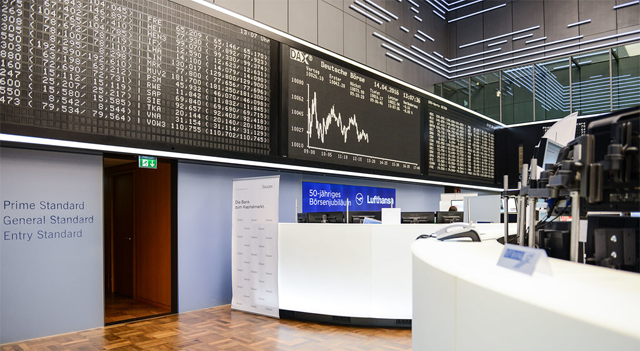
    By 07:00 GMT, the Stoxx 600 was down 0.5%, Germany’s DAX had fallen 1.0%, France’s CAC 40 dropped 1.3%, and the UK’s FTSE 100 slipped 0.1%.

    Oil spike fuels market concerns

    Brent crude, the global benchmark, surged above $125 per barrel overnight after reports that Donald Trump is set to receive a briefing on potential new military strikes against Iran.

    The move has been described as a possible way to break a deadlock in negotiations with Tehran over its nuclear programme, according to Axios.

    Trump also wrote on social media: “Iran can’t get their act together. They don’t know how to sign a nonnuclear deal. They better get smart soon!”

    Analysts at Deutsche Bank said the combination of escalating tensions and the continued closure of the Strait of Hormuz has “fed growing fears about an extended stagflationary shock” driven by rising energy costs. They noted that these concerns have already weighed on Asian markets and are now spilling over into Europe and U.S. futures.

    Central banks in focus

    With geopolitical risks intensifying and oil prices elevated, attention is turning to policy decisions from the European Central Bank and the Bank of England later in the day.

    The ECB is widely expected to leave its deposit rate unchanged at 2%, though Deutsche Bank analysts suggested markets are increasingly pricing in a rate hike at the next meeting in June due to Europe’s sensitivity to higher energy costs.

    “[S]o the question today is whether the ECB validates that view,” the Deutsche Bank analysts wrote.

    For the Bank of England, policymakers are also expected to hold rates steady at 3.75%, while signaling concerns over slowing economic growth alongside rising inflation pressures.

    Federal Reserve decision highlights divisions

    The Federal Reserve also kept interest rates unchanged on Wednesday, as expected, though the decision marked one of the most divided outcomes in decades.

    Fed Chair Jerome Powell said he intends to remain on the central bank’s board after his term as chair ends in May, a break from past practice that could complicate the transition to Kevin Warsh, who has been nominated by Trump to take over the role.

  • FTSE 100 mixed as Iran tensions and oil surge weigh; ECB, BoE in focus

    FTSE 100 mixed as Iran tensions and oil surge weigh; ECB, BoE in focus

    British stocks traded mixed on Thursday in volatile conditions, as investors assessed escalating geopolitical risks tied to Iran alongside a surge in oil prices, while awaiting key central bank decisions.

    At 07:30 GMT, the FTSE 100 was up 0.13%, while Germany’s DAX fell 0.33% and France’s CAC 40 dropped 1.11%. Sterling edged higher against the dollar, with GBP/USD at 1.3488.

    Geopolitical tensions and oil dominate sentiment

    Investor confidence remained fragile after reports that United States Central Command is preparing to brief Donald Trump on potential military options involving Iran. The developments have heightened fears of renewed conflict and prolonged disruption to global energy markets.

    Oil prices were a central driver of market moves, as concerns intensified over possible blockades affecting Iranian ports and broader instability across the region.

    Central banks in focus

    Attention now turns to policy decisions from the European Central Bank and the Bank of England later in the session. Both are widely expected to keep rates unchanged, though investors will be closely watching for signals on future policy direction as energy-driven inflation risks build.

    This follows a divided outcome from the Federal Reserve, which held rates steady but saw three policymakers vote to remove its easing bias. Chair Jerome Powell said he will remain in his role for now, while Kevin Warsh moves closer to confirmation.

    UK roundup

    SIG (LSE:SHI) warned of lower first-half profit after a 5% decline in Q1 like-for-like sales, impacted by poor weather and continued weakness in European construction demand.

    Glencore (LSE:GLEN) reported a 19% increase in first-quarter copper production to 199,600 tonnes, driven by stronger African grades, with its marketing division expected to outperform full-year guidance.

    United Utilities (LSE:UU.) expects annual revenue growth and has submitted a £1.4 billion investment plan to Ofwat, targeting up to 4,000 supply chain jobs.

    Whitbread (LSE:WTB) said it will overhaul its restaurant estate, replacing remaining branded sites and warning of up to 3,800 job cuts across the UK and Ireland.

    Rolls-Royce (LSE:RR.) reaffirmed its full-year outlook, stating it expects to offset disruption linked to Middle East tensions.

    Persimmon (LSE:PSN) highlighted rising supply chain costs tied to higher UK energy prices, with pressure expected to build into 2027.

    Metro Bank (LSE:MTRO) maintained its 2026 outlook after reporting a 52% increase in Q1 lending to £5.5 billion, driven by strength in corporate and SME segments.

    Unilever (LSE:ULVR) beat first-quarter sales expectations with 3.8% underlying growth, supported by strong demand for its core brands, while maintaining full-year guidance despite macroeconomic uncertainty.

  • Rolls-Royce shares rise as guidance holds despite Middle East disruption

    Rolls-Royce shares rise as guidance holds despite Middle East disruption

    Rolls-Royce (LSE:RR.) shares moved higher after the company said it expects to fully offset the impact of disruption linked to the Middle East conflict, while reaffirming its financial outlook for 2026.

    The Rolls-Royce maintained its forecast for underlying operating profit of £4.0 billion to £4.2 billion and free cash flow of £3.6 billion to £3.8 billion for the year.

    “The conflict in the Middle East has created uncertainty for the industry. We are taking the necessary actions to support our employees, customers, and suppliers,” the company said.

    Shares rose 2.4% in early London trading following the update.

    Civil Aerospace delivers strong start to the year

    The Civil Aerospace division reported solid momentum, with large engine flying hours reaching 115% of 2019 levels in the first quarter, up 5% year over year. Deliveries of large original equipment engines increased 18%, while business aviation flying hours exceeded internal expectations.

    Rolls-Royce continues to project full-year large engine flying hours at between 115% and 120% of 2019 levels, indicating sustained recovery in long-haul travel demand.

    Defence segment supports growth momentum

    The Defence division also showed strong performance, with improved aftermarket activity and original equipment deliveries rising more than 20% compared to the prior year.

    The company noted continued robust demand across both established and newer defence programmes.

    “We remain strongly positioned to deliver our mid-term targets, with substantial growth beyond the mid-term from both our existing and new businesses,” Rolls-Royce added.

    More about Rolls-Royce

    Rolls-Royce is a UK-based engineering group specialising in power and propulsion systems for aerospace, defence, and energy markets. The company’s Civil Aerospace division is a major supplier of aircraft engines for long-haul travel, while its Defence segment supports military aviation and naval programmes globally.

  • Unilever posts volume-driven Q1 growth as it sharpens focus on home and personal care

    Unilever posts volume-driven Q1 growth as it sharpens focus on home and personal care

    Unilever (LSE:ULVR) reported underlying sales growth of 3.8% for the first quarter of 2026, largely driven by a 2.9% increase in volumes. Growth was broad-based across all business segments, with strong contributions from its Power Brands portfolio.

    Emerging markets were the main engine of expansion, particularly India and a recovering Latin America. However, reported turnover declined 3.3% to €12.6 billion, reflecting a significant negative impact from currency movements.

    Outlook maintained as productivity gains support margins

    Unilever reaffirmed its full-year 2026 guidance, expecting sales growth toward the lower end of its 4%–6% target range, alongside modest margin improvement.

    This outlook is supported by a cost-efficiency programme that has already delivered €750 million of its planned €800 million in savings, helping offset inflationary pressures and support profitability.

    Strategic shift toward core HPC business accelerates

    The company is advancing a major strategic repositioning to focus more heavily on home and personal care. This includes plans to combine its Foods division with McCormick, alongside a series of disposals and the acquisition of U.S. supplements brand Grüns.

    Unilever is also enhancing shareholder returns, with a higher dividend and the launch of a €1.5 billion share buyback programme.

    Balanced outlook with supportive fundamentals

    Unilever’s outlook is underpinned by stable profitability and consistent free cash flow generation, although leverage has increased somewhat.

    Technical indicators remain supportive, with the stock trading above key moving averages and showing positive momentum, though some measures suggest it may be overbought in the near term. Valuation appears relatively elevated at around 22.7 times earnings, but this is partly offset by a dividend yield of approximately 3.44% and ongoing capital return initiatives.

    More about Unilever

    Unilever is a global fast-moving consumer goods company with leading positions in home and personal care, beauty and wellbeing, and food products. Its portfolio includes major brands such as Dove, Vaseline, and Hellmann’s, alongside a wide range of home care products. The company has a strong presence in emerging markets, including India, Latin America, China, and Indonesia, which remain key drivers of its long-term growth.

  • Space Technology’s Defining Moment: Inside the Opportunity with Seraphim Space Investment Trust

    Space Technology’s Defining Moment: Inside the Opportunity with Seraphim Space Investment Trust

    The global space industry is no longer a distant dream; it is rapidly becoming one of the most transformative forces shaping the modern economy. At the forefront of this evolution is the Seraphim Space Investment Trust (LSE:SSIT), led by Chief Executive Mark Boggett, providing exposure to the rapidly evolving space technology sector.

    SSIT’s objective seeks to generate capital growth over the long term through investment in a diversified, international portfolio of predominantly unquoted spacetech businesses with the potential to scale globally.

    As the world’s first publicly listed fund dedicated entirely to space tech, SSIT provides diversified access to a carefully curated portfolio of around 25 of the most innovative space companies globally. Backed by over a decade of specialist experience, Seraphim has built a reputation as a pioneer in the sector, launching the first space-tech venture fund, operating the world’s largest space accelerator, and supporting approximately 150 companies across more than 30 countries.

    Through its accelerator and venture platform, Seraphim maintains access to early-stage category leaders in spacetech, creating a multi-stage pipeline from incubation through venture funding to listed exposure via SSIT. This singular focus has positioned Seraphim as a leader in identifying and nurturing high-potential space ventures. The timing is particularly compelling. According to a report by the World Economic Forum and McKinsey, the space economy is expected to grow from approximately $630bn in 2023 to $1.8trn by 2035.

    Over the past decade, the economics of space have fundamentally shifted. Launch costs have fallen dramatically, by nearly 100-fold, thanks to innovations such as reusable rockets. Satellites, once the size of buses, are now compact, cost-efficient systems no larger than a shoebox. By 2025, rocket launches are expected to occur roughly every 27 hours worldwide.

    These advancements have given rise to a powerful new “digital infrastructure in the sky.”

    Satellite constellations are delivering real-time data, global broadband connectivity, and high-resolution imaging that is revolutionising industries ranging from agriculture and insurance to defence and energy.

    Public market investors are increasingly recognising that space infrastructure is no longer speculative, but foundational to modern economies. From defence and sovereign Earth observation to navigation, logistics, financial systems, autonomous technologies, and climate monitoring, space-enabled technologies are becoming embedded in critical infrastructure.

    Looking ahead, the next wave of innovation promises even greater disruption. Breakthroughs such as ultra-low-cost launch systems could enable orbital data centres and space-based solar power, while space infrastructure itself is becoming a critical backbone for the artificial intelligence revolution.

    SSIT’s recent performance reflects the strength of this opportunity. Over the past 12 months, the trust has delivered share price performance, with its share price rising more than 150%. Its portfolio of private holdings has also doubled in value, underscoring the accelerating momentum within the sector.

    The SSIT portfolio spans satellite constellation operators, data-driven software businesses, connectivity providers, in-orbit services (including orbital logistics and satellite servicing), and space situational awareness and debris tracking technologies.

    Several portfolio companies have already emerged as global leaders. For instance, AST SpaceMobile, an early investment for SSIT, has grown from a $300 million valuation to a $35 billion NASDAQ-listed company, pioneering space-based cellular connectivity directly to standard smartphones. Meanwhile, ICEYE, which began without a single satellite, now operates the world’s largest radar satellite constellation and has secured major international contracts, including a landmark agreement with the German government.

    Investment into next-generation spacetech companies increased by 48% year-on-year to approximately $12.4bn in 2025, according to the Seraphim Space Index report, highlighting sustained investor appetite for the sector.

    The trust’s investment focus aligns with some of the most significant global trends: rising defence and security spending, the urgent need for climate and sustainability solutions, and the convergence of artificial intelligence with next-generation infrastructure. Within this, SSIT is particularly focused on areas where space technology is becoming critical to secure and reliable infrastructure, including next-generation positioning systems, resilient navigation, sovereign Earth observation capabilities, and dual-use technologies supported by long-term government demand and increasing commercial adoption.

    Space technology sits uniquely at the intersection of these forces, making it one of the most significant themes of the coming decade.

    After ten years of building expertise, networks, and a proven track record, Seraphim believes the industry is approaching a critical inflection point. The opportunity ahead is vast, with the potential for multiple companies to grow into multi-billion-dollar leaders.

    For investors, SSIT represents exposure to an early-stage transformative global shift. The journey into the space economy has only just begun, and the future is closer than ever.

    For more information visit: https://investors.seraphim.vc
  • Ariana Resources progresses Dokwe and Tavşan projects with strong drilling and record revenue

    Ariana Resources progresses Dokwe and Tavşan projects with strong drilling and record revenue

    Ariana Resources (LSE:AAU) reported a quarter marked by intensive drilling activity and continued project development, highlighted by a 31-hole reverse circulation programme at the Dokwe Gold Project in Zimbabwe. The campaign delivered multiple high-grade gold intercepts and confirmed the potential to expand near-surface oxide resources beyond the current resource boundaries.

    A follow-up diamond drilling programme is now underway to refine geological models, test extensions at depth and along strike, and support an updated mineral resource estimate expected in the second half of 2026. At the same time, the company is advancing an updated Pre-Feasibility Study, incorporating technical input from Xinhai to help de-risk and accelerate the development timeline for Dokwe.

    Türkiye operations deliver record revenue and production growth

    In Türkiye, Ariana’s associate Zenit Mining Operations produced 4,533 ounces of gold and 10,305 ounces of silver during the first quarter, generating record quarterly revenue supported by strong gold prices and continued ramp-up at the Tavşan heap-leach operation.

    Expanded drilling at Tavşan exceeded initial targets, confirming continuity of mineralisation and extensions across both the Main and South zones. These results are expected to underpin a future resource update and support the mine’s planned eight-year lifespan, reinforcing Ariana’s broader strategy of combining production with growth.

    Financial constraints and valuation remain challenges

    Despite operational progress, the company’s outlook remains constrained by weak operating fundamentals, including limited revenue, recurring losses, and ongoing negative operating and free cash flow, which raise concerns about long-term sustainability.

    However, Ariana maintains a relatively low-leverage balance sheet, providing some financial stability. Technical indicators suggest neutral momentum, while valuation appears stretched due to a high price-to-earnings ratio and the absence of a dividend.

    More about Ariana Resources

    Ariana Resources is a mineral exploration and development company focused on gold assets across Africa and Europe. Its flagship Dokwe Gold Project in Zimbabwe is complemented by a portfolio of interests in Türkiye. Through its stake in Zenit Mining Operations, the company has exposure to producing assets at the Tavşan and Kiziltepe gold-silver mines, positioning it across both development and cash-generating segments of the precious metals sector.

  • Whitbread keeps profits stable while launching margin-focused five-year strategy

    Whitbread keeps profits stable while launching margin-focused five-year strategy

    Whitbread (LSE:WTB) reported flat statutory revenue of £2.92 billion for FY26, with adjusted profit before tax holding steady at £483 million. Strong accommodation sales in both the UK and Germany, along with a return to profitability at Premier Inn Germany, helped offset weaker restaurant performance and ongoing inflationary pressures.

    Statutory profit and earnings declined due to impairments tied to its Accelerating Growth Plan. Despite this, the company maintained its dividend, completed a £250 million share buyback, and continued to outperform the midscale and economy hotel segments. Whitbread also highlighted a solid balance sheet, even as net debt increased.

    Five-year plan targets higher margins and improved returns

    The group unveiled a new five-year strategy aimed at significantly boosting margins and returns by FY31. A key element of the plan is the expansion of its Accelerating Growth Plan, which will see all remaining branded restaurants replaced with integrated, more efficient food and beverage formats.

    This transition is expected to temporarily reduce food and beverage revenue and profitability in FY27 as sites are either exited or converted. However, management believes the move will lower capital intensity, allow for reinvestment into higher-growth opportunities, and strengthen Whitbread’s competitive position across its UK and German hotel operations.

    Strong fundamentals offset by weaker technical signals

    Whitbread continues to demonstrate solid financial health, supported by stable earnings, a resilient balance sheet, and an attractive valuation profile.

    However, technical indicators suggest bearish momentum in the near term, which may weigh on the stock’s performance. While recent corporate actions, including capital returns and strategic initiatives, support investor confidence, these positives are partially offset by weaker technical trends.

    More about Whitbread

    Whitbread PLC is a UK-based hospitality group best known for its Premier Inn budget hotel chain. The company operates primarily in the midscale and economy accommodation segments across the UK and Germany, offering integrated food and beverage services alongside its hotels. Whitbread has been actively reshaping its restaurant estate to focus on more efficient formats and higher-return assets, aligning its strategy with long-term growth and profitability objectives.