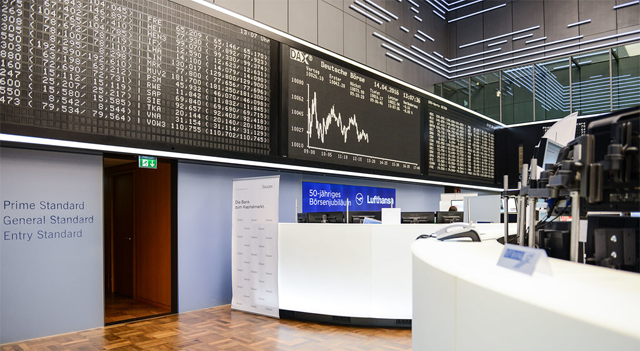
European equities moved lower in early trading on Thursday, pressured by a sharp rise in oil prices to their highest intraday levels since the start of the Iran conflict, while investors prepared for key interest rate decisions from major central banks.
By 07:00 GMT, the Stoxx 600 was down 0.5%, Germany’s DAX had fallen 1.0%, France’s CAC 40 dropped 1.3%, and the UK’s FTSE 100 slipped 0.1%.
Oil spike fuels market concerns
Brent crude, the global benchmark, surged above $125 per barrel overnight after reports that Donald Trump is set to receive a briefing on potential new military strikes against Iran.
The move has been described as a possible way to break a deadlock in negotiations with Tehran over its nuclear programme, according to Axios.
Trump also wrote on social media: “Iran can’t get their act together. They don’t know how to sign a nonnuclear deal. They better get smart soon!”
Analysts at Deutsche Bank said the combination of escalating tensions and the continued closure of the Strait of Hormuz has “fed growing fears about an extended stagflationary shock” driven by rising energy costs. They noted that these concerns have already weighed on Asian markets and are now spilling over into Europe and U.S. futures.
Central banks in focus
With geopolitical risks intensifying and oil prices elevated, attention is turning to policy decisions from the European Central Bank and the Bank of England later in the day.
The ECB is widely expected to leave its deposit rate unchanged at 2%, though Deutsche Bank analysts suggested markets are increasingly pricing in a rate hike at the next meeting in June due to Europe’s sensitivity to higher energy costs.
“[S]o the question today is whether the ECB validates that view,” the Deutsche Bank analysts wrote.
For the Bank of England, policymakers are also expected to hold rates steady at 3.75%, while signaling concerns over slowing economic growth alongside rising inflation pressures.
Federal Reserve decision highlights divisions
The Federal Reserve also kept interest rates unchanged on Wednesday, as expected, though the decision marked one of the most divided outcomes in decades.
Fed Chair Jerome Powell said he intends to remain on the central bank’s board after his term as chair ends in May, a break from past practice that could complicate the transition to Kevin Warsh, who has been nominated by Trump to take over the role.
Leave a Reply