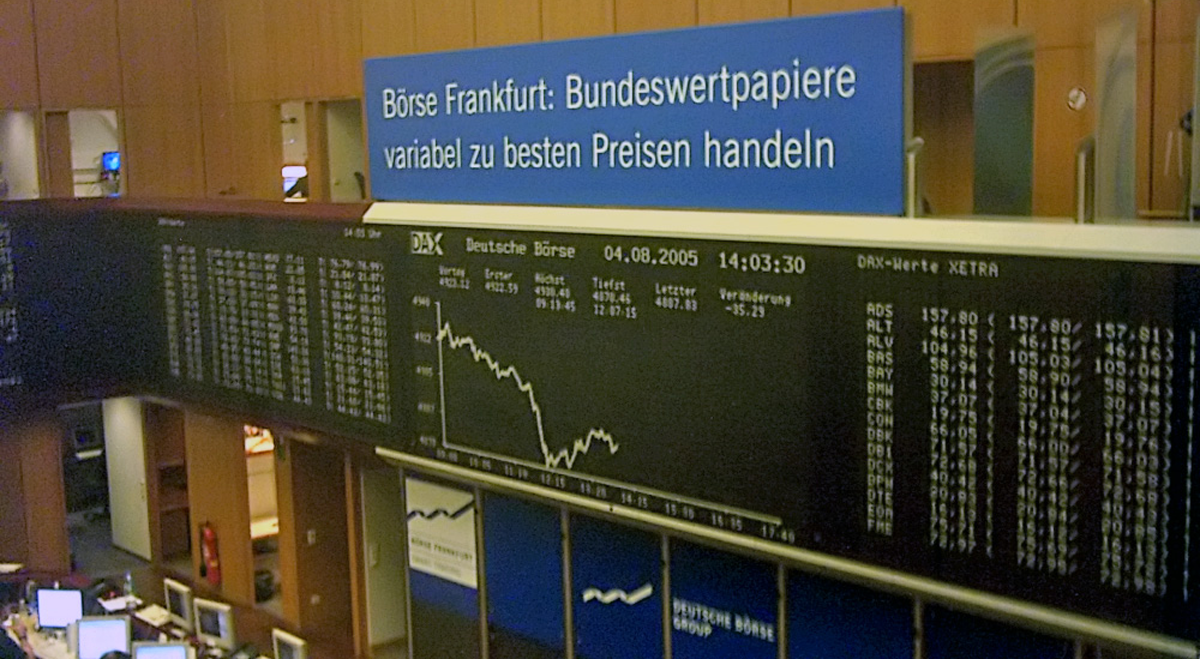
European equities were broadly flat on Wednesday after several major indexes closed at their lowest levels in more than a month in the previous session, as investors continued to assess elevated government bond yields and their implications for equity valuations and corporate financing costs.
Germany’s DAX and France’s CAC 40 both closed on Tuesday at their lowest levels in more than a month. London’s FTSE 100 also moved towards a one-month low as markets responded to volatility in global government bond yields.
German 10-year Bund yields were trading around 3.35%, near levels last seen in 2011, while U.S. 10-year Treasury yields moved above 4.78%.
Higher Bond Yields Affect Equity Valuations
Higher sovereign bond yields can affect equities through several channels. As returns available from government debt increase, the relative return investors receive for taking additional equity-market risk can decline.
Bond yields are also commonly incorporated into the discount rates used to calculate the present value of projected corporate cash flows. Higher discount rates reduce the present value assigned to future earnings, with the effect generally more significant for companies whose valuations depend heavily on earnings expected further into the future.
Rate-sensitive sectors can therefore face greater valuation pressure when long-term yields increase.
Higher borrowing costs can also increase financing and refinancing expenses for companies, potentially affecting profit margins and analysts’ earnings estimates.
Oil Prices Add to Inflation and Interest-Rate Focus
Crude oil prices moved above $90 a barrel following direct U.S.-Iranian strikes in the Persian Gulf, adding to market attention around the outlook for energy-driven inflation.
Traders were pricing an approximately 60% to 65% probability of a 25-basis-point interest-rate increase at the Federal Reserve’s 16 September meeting following comments from Chair Kevin Warsh at Jackson Hole.
In the eurozone, preliminary August data showed core inflation easing to 2.4%, while headline inflation increased to 3.3%, with energy costs contributing to the rise. Investors are assessing what the figures could mean for the European Central Bank’s 10 September policy meeting.
These market-implied probabilities and expectations remain subject to changes in economic data and central-bank policy signals.
DAX Declines While CAC 40 Trades Flat
Germany’s DAX fell 0.2% on Wednesday, while France’s CAC 40 was broadly unchanged.
Cyclical stocks, automakers and technology companies were among the areas facing pressure, alongside capital goods and consumer discretionary shares.
London’s FTSE 100 was broadly flat. Its weighting towards integrated energy companies provided some support as crude oil prices remained elevated.
Shell (LSE:SHEL) and BP (LSE:BP.) are among the major oil companies represented in the index.
BP shares rose 1.3% after the company appointed Ian Tyler as chairman.
Leave a Reply