URU Metals (LSE:URU) has started line clearing and preparation for a ground-based geophysical survey at its Zeb Nickel Project in South Africa, initiating the next stage of exploration at the site. The programme follows earlier airborne surveys and aims to improve both safety and accuracy during data collection along gravity and frequency-domain electromagnetic survey lines.
The planned ground surveys will focus on two high-priority target zones and are expected to generate higher-resolution data than previous airborne work. This enhanced detail should help refine the interpretation of existing electromagnetic, magnetic and gravity datasets collected across the project area.
By improving the definition of conductive zones and dense ultramafic rock units, URU aims to better identify potential zones of semi-massive to massive nickel sulphide mineralisation. The results are expected to guide future drill targeting, potentially lowering exploration risk and strengthening the company’s positioning in the critical metals exploration sector ahead of its next drilling phase.
Despite progress on the exploration front, URU’s overall outlook remains constrained by weak underlying fundamentals typical of early-stage exploration companies, including a lack of revenue, ongoing cash burn and negative equity. Technical indicators also remain subdued, with the share price trading below key short-term moving averages and a negative MACD signal. Recent corporate developments—including securing a mining right and completing an oversubscribed financing—provide some positive counterbalance.
More about URU Metals
URU Metals is a mineral exploration and development company focused on critical metals projects in South Africa. The company seeks to advance high-potential assets such as the Zeb Nickel Project while emphasising responsible mining practices, regulatory compliance and engagement with local stakeholders as it develops resources within the country’s growing critical minerals sector.
Dotdigital (LSE:DOTD) has agreed to purchase Alia Software, a rapidly expanding U.S.-based SaaS provider that uses AI-powered pop-ups and interactive website tools to convert anonymous visitors into email and SMS subscribers for Shopify merchants. The transaction, valued at up to $60 million and financed entirely from the company’s existing cash reserves, adds Alia’s lead-capture capabilities and its customer base of around 2,700 merchants to Dotdigital’s customer experience and data platform (CXDP).
The acquisition is expected to deepen Dotdigital’s integration within the Shopify ecosystem while supporting higher-margin recurring revenue through cross-selling opportunities and international expansion. By incorporating Alia’s technology into its CXDP offering, Dotdigital aims to help brands capture and convert more first-party customer data, improving engagement across marketing channels.
Founded in 2022, Alia has quickly built traction and is currently generating more than $8 million in forward-looking annual recurring revenue while operating with positive cash EBITDA. The business will continue to operate from its New York headquarters under its existing leadership team, with integration into Dotdigital’s platform planned in stages to maintain continuity for customers.
The deal follows Dotdigital’s earlier acquisitions of Fresh Relevance and Social Snowball. Together, these transactions have significantly expanded the company’s scale, increasing forward-looking annual recurring revenue from £48.9 million to over £81 million. The acquisitions have also helped grow partner-driven sales and revenue originating from the United States, supporting the company’s strategy of evolving into a multi-product global marketing technology platform while maintaining strong profitability.
Dotdigital’s broader outlook remains supported by steady revenue growth and solid profitability metrics. Technical indicators suggest moderately positive momentum in the shares, while valuation metrics point to a relatively balanced investment profile. The lack of recent earnings call disclosures or major corporate events does not materially affect the overall assessment.
More about Dotdigital
Dotdigital Group is a London-based provider of AI-powered customer experience and data platforms used by more than 4,000 brands across 150 countries. Its CXDP software enables marketers to unify and analyse customer data, build targeted audience segments and deliver personalised marketing campaigns across channels including email, SMS and other digital touchpoints to increase engagement, conversions and long-term customer loyalty.
Faron Pharmaceuticals (LSE:FARN) has issued its Annual Report for 2025, providing shareholders with detailed updates on the company’s financial results, governance framework and progress across its clinical development programmes. The report includes the Board of Directors’ report, audited financial statements and the remuneration report.
The document also outlines developments related to Faron’s lead immunotherapy candidate, bexmarilimab, including progress in the ongoing Phase I/II BEXMAB clinical study targeting aggressive blood cancers. The annual report is available in both English and Finnish on the company’s website, offering investors broader access to information on the company’s strategy and research progress.
Publishing the full report in two languages reflects Faron’s commitment to transparency and regulatory compliance across its dual listings on the AIM market in London and Nasdaq First North. The disclosures provide stakeholders with greater visibility into the company’s operations as it continues to advance its oncology pipeline.
Faron hopes the detailed reporting will help maintain engagement with existing shareholders while also supporting interest from potential investors as it works to strengthen its position within the competitive field of cancer immunotherapy development.
More about Faron Pharmaceuticals Oy
Faron Pharmaceuticals Ltd, headquartered in Turku, Finland, is a clinical-stage biopharmaceutical company developing new immunotherapies designed to activate the body’s immune system against cancer. Its lead programme, bexmarilimab, is being tested in several clinical studies for hematological cancers such as acute myeloid leukemia and myelodysplastic syndrome, as well as in solid tumors, often alongside established treatment regimens.
Mila Resources (LSE:MILA) reported a busy six months of exploration activity for the period ended 31 December 2025, highlighted by the acquisition of full ownership of its Yarrol, Mount Steadman and Monal licences and increased exploration across its Queensland gold and copper portfolio.
At the Yarrol project, the company completed a 1,451-metre diamond drilling programme that confirmed the extension of gold-bearing structures beyond the boundaries of the historical resource. Results suggest the strongest near-term exploration potential lies in shallow mineralised zones along strike from the existing deposit. In response, Mila has planned a 1,600-metre reverse circulation drilling campaign designed to test step-out targets adjacent to the current resource area.
Exploration efforts are also progressing at the Mount Steadman and Monal licences, where Mila is evaluating regional gold and copper prospects. The company aims to expand on historic non-JORC resource estimates while also investigating potential porphyry-style mineralisation similar to nearby discoveries in the region.
Operational capacity has been strengthened with the expansion of the technical team, including the promotion of Alastair Goodship to Chief Operating Officer. The leadership change is intended to support the company’s accelerating exploration programme across its Queensland assets.
Financially, Mila recorded an interim loss of £239,046 during the period while capitalising approximately £406,000 in exploration spending. The company also raised £1.05 million through new equity issuance and warrant exercises, finishing the period with £636,903 in cash to fund ongoing drilling and portfolio advancement.
Despite maintaining a low-debt structure and a strengthened equity base, Mila’s overall outlook remains constrained by its early-stage profile. The company continues to report no revenue and negative free cash flow, while technical indicators show weak momentum with the share price trading below key moving averages and a negative MACD. Valuation metrics remain limited given the negative earnings profile and absence of a dividend.
More about Mila Resources
Mila Resources is a London-listed exploration company focused on gold and copper opportunities in Queensland, Australia. Its portfolio includes the Yarrol, Mount Steadman and Monal licences within the South-Eastern Goldfield. The company positions itself as a post-discovery exploration accelerator, targeting projects with the potential to deliver scalable gold and copper resources.
Raspberry Pi Holdings plc (LSE:RPI) will hold a live hybrid presentation of its results for the year ended 31 December 2025 at 09:30 GMT on 31 March 2026 in London, aimed primarily at analysts and institutional investors. Later the same day, management will host a separate online presentation and Q&A session at 14:00 GMT, providing broader access for investors and market participants interested in the company’s financial performance and strategy.
The sessions will be led by Chief Executive Officer Eben Upton and Chief Financial Officer Richard Boult. Hosting both in-person and virtual formats reflects Raspberry Pi’s effort to widen investor engagement as the company’s profile in public markets continues to grow following strong worldwide uptake of its compact and affordable computing platforms.
By offering multiple opportunities for investors to interact with management, the company aims to strengthen transparency around its results and outlook while reaching a wider shareholder base. The approach may also help support liquidity in its shares as Raspberry Pi positions itself as a significant participant in markets spanning industrial computing, education technology and semiconductor applications.
Fundamentally, the company benefits from strong revenue expansion and a healthy balance sheet. However, recent declines in margins and negative free cash flow remain areas of concern. Market indicators also appear cautious, with the share price trading below key long-term moving averages and a negative MACD reading. In addition, a relatively high price-to-earnings ratio and the absence of a dividend weigh on the stock’s overall investment profile.
More about Raspberry Pi Holdings plc
Raspberry Pi Holdings plc, headquartered in Cambridge, United Kingdom, develops and sells low-cost, high-performance computing platforms used by engineers, educators and technology enthusiasts around the world. The company operates as a vertically integrated engineering organisation, spanning semiconductor intellectual property, hardware and software development, and regulatory compliance. Its products serve industrial and embedded systems, the enthusiast community and the education sector, with more than 75 million devices shipped globally.
Barratt Redrow (LSE:BTRW) has announced that Dean Banks will become its next Group Chief Executive, taking over from David Thomas, who plans to step down after more than a decade leading the company. Thomas, who has spent 17 years with the group and 11 as CEO, will remain in the role until Banks joins during the final quarter of 2026.
Banks currently serves as Group Chief Executive of Ventia in Australia and brings over 15 years of senior leadership experience across publicly listed construction and infrastructure companies. Barratt Redrow said his industry background and track record in managing large-scale businesses made him the preferred candidate to guide the company through its next stage of development.
To ensure continuity, Thomas will continue as CEO and board member until Banks formally assumes the role. He will then remain with the company until March 2027 to support the leadership transition and provide a structured handover period.
The board said Banks’ appointment followed an extensive search process carried out with the help of external advisers. Chair Caroline Silver said the company is entering the transition from a position of strategic clarity and financial strength, while Thomas noted that Barratt Redrow’s leadership team and long-term strategy are well established. Banks described the move as an opportunity to build on a strong platform in the UK homebuilding sector.
Barratt Redrow also stated that further regulatory disclosures relating to Banks will be released in accordance with UK listing rules. The company’s next scheduled market update will be a trading statement on 15 April 2026, which investors will watch closely as the leadership succession approaches.
Despite operating in a challenging environment for profitability and cash generation, Barratt Redrow maintains a solid balance sheet and disciplined financial management. The company’s ongoing share buyback programme continues to support shareholder returns, though valuation metrics and technical signals suggest the stock may currently lack strong price momentum.
More about Barratt Redrow
Barratt Redrow plc is one of the UK’s largest residential property developers, focused on building high-quality and sustainable homes nationwide. Operating within the housebuilding and construction sector, the company targets a broad range of homebuyers while pursuing a strategy centred on disciplined expansion, operational efficiency, and strong customer service, supported by a robust financial position and a nationwide development footprint.
In Part 1 of this series introduced U.S. Energy Corp. (NASDAQ:USEG) as a company undergoing a strategic transformation, then Part 2 marks the point where that transformation becomes visible.
2026 is a pivotal year—not just because of what U.S. Energy plans to build, but because of what that buildout enables: a fully integrated industrial gas and carbon management hub capable of delivering multi‑stream revenues for decades.
This is the moment when the vision becomes infrastructure, and when Kevin Dome begins evolving from geological resource into economic engine.
The processing facility: Where the platform comes to life
At the centre of the 2026 plan is the company’s planned processing facility, a purpose‑built complex designed to handle roughly 8 million cubic feet per day of inlet capacity. While the number itself tells one part of the story, the real significance lies in what that capacity produces—and how it integrates with the rest of U.S. Energy’s assets.
Inside this facility, raw gas drawn from the Kevin Dome will be separated into two commercially powerful outputs: high‑purity helium and refined CO₂, each with its own market, its own set of buyers, and its own strategic purpose within the company’s broader platform.
To support continuous, industrial‑scale operations, the facility is expected to require approximately 2.5 megawatts of power, sourced primarily from the regional electrical grid. Backup power will come from U.S. Energy’s own natural gas infrastructure—a not‑so‑subtle reminder of why integrated ownership matters in real‑world operations. It’s not just about extracting gas; it’s about controlling the ecosystem that keeps the entire value chain running.
Once operational, this facility becomes the beating heart of the entire platform.
Building the arteries: The 2026 infrastructure program
Spring 2026 will mark the start of a critical phase in Kevin Dome’s development: the installation of roughly 10 miles of in‑field gathering pipelines that will move produced gas from the company’s existing wells to the processing plant. The timing has been structured deliberately, with construction scheduled to finish in the third quarter of 2026—just ahead of anticipated commissioning and first operations.
This is the kind of infrastructure that doesn’t make headlines, but it defines scalability. It transforms resource potential into operational reliability, and operational reliability into bankable value. By the end of 2026, U.S. Energy expects to have the core midstream backbone in place, enabling long‑term industrial gas production, CO₂ management, and enhanced oil recovery at commercial scale.
Regulatory advantage: First in Montana, and among the largest in the nation
While steel in the ground matters, regulatory positioning often determines which companies thrive and which fall behind. In this area, U.S. Energy has distinguished itself early.
The company’s submission of two Monitoring, Reporting, and Verification (MRV) plans to the U.S. Environmental Protection Agency—covering its Class II injection wells—represents the first MRV submissions ever made in the State of Montana. Once approved, the Kevin Dome program would rank among the 20 largest CCUS projects in the United States.
This gives U.S. Energy something far more valuable than a permit. It gives the company a defensive moat:
A regulatory footprint that establishes leadership
A head start in building one of the nation’s major CO₂ sequestration hubs
Competitive separation from late‑moving peers in industrial gas and carbon management
In a sector where compliance and verification are often the biggest barriers to commercial operation, U.S. Energy is positioning itself ahead of the curve.
A resource of rare scale—and a major asset in a tightening market
Behind the 2026 buildout is the sheer magnitude of the Kevin Dome resource. After a multi‑year effort to aggregate land, U.S. Energy now controls nearly 80,000 net acres, a footprint large enough to support long‑duration development and multi‑phase expansion.
Independent evaluation has confirmed the dome contains approximately 1.3 trillion cubic feet of naturally occurring CO₂ and 2.3 billion cubic feet of helium. These numbers matter not only because of their size, but also because of what they represent: decades of feedstock for both industrial gas sales and carbon management services.
In a time when helium shortages are disrupting global semiconductor and aerospace supply chains—and when companies across the U.S. are under increasing pressure to secure long‑term CO₂ sequestration—the value of owning such a resource outright cannot be overstated.
The closed‑loop revenue model: Monetizing both sides of the molecule
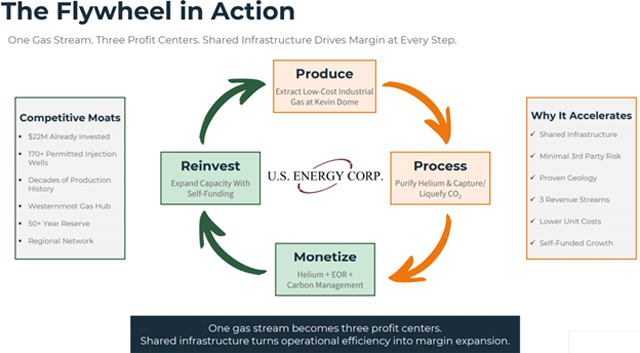
Perhaps the most compelling part of the 2026 plan is how these elements come together economically. U.S. Energy is not simply extracting gas and selling it. Instead, it is creating a closed‑loop revenue model that monetizes both helium and CO₂ through distinct, synergistic pathways.
The high‑purity helium produced at the processing facility will be sold into premium markets—semiconductors, aerospace, medical technologies—buyers who depend on long‑term, reliable supply and pay accordingly.
The CO₂, meanwhile, will follow a different path: it will flow into company‑owned oil fields for enhanced oil recovery, increasing output from assets U.S. Energy already controls 100 per cent. The same CO₂ then becomes eligible for permanent geological sequestration, supporting long‑duration carbon credits and providing optionality for additional revenue streams.
In other words, the company produces two valuable gases—but keeps the CO₂ working internally to uplift another business line, all while strengthening its position in the emerging CCUS economy.
Few emerging companies offer this level of integration, resource control, and multi‑vertical monetization.
(Source: U.S. Energy Corp. investor presentation.)
Why industrial gases are the gold of the digital age
With the 2026 plan outlined, the next chapter in this series will step back and explore the broader landscape. Why do helium and CO₂ matter so much right now? Why are industrial gases becoming essential inputs to the digital economy? And why might companies like U.S. Energy Corp. hold the key to the next era of critical‑material security?
Part 3 will examine why industrial gases are increasingly viewed as the “gold of the digital age”—and what that means for investors positioning ahead of long‑term demand.
U.S. stock futures are signaling a sharply weaker open on Tuesday, pointing to another bout of early selling after markets clawed back heavy initial losses to finish Monday on a mixed note.
Investor caution is intensifying as the conflict in the Middle East shows signs of escalating further, particularly with oil prices continuing their upward surge. Brent crude has pushed above $80 per barrel, stoking fears that higher energy costs could feed into inflation and complicate the outlook for interest rates.
The latest spike in crude follows reports that Iran has shut the Strait of Hormuz in retaliation for joint U.S. and Israeli strikes, while warning it would target any vessel attempting to transit the key shipping corridor.
Steep losses across Asian and European markets are adding to the negative tone and may weigh on U.S. equities at the open. With little major U.S. economic data due, lighter trading volumes could amplify market swings and keep volatility elevated.
“Investors across the Atlantic are also starting to become more alarmed about the situation in the Middle East,” said Dan Coatsworth, head of markets at AJ Bell. “The suspension of LNG production in Qatar is a particularly sensitive pressure point and has seen gas prices surge globally.”
He added, “The longer oil and natural gas prices remain elevated, the greater the risk of a meaningful impact on inflation which could mean higher interest rates, an event that’s typically negative for equity markets.”
On Monday, stocks initially tumbled in response to the unfolding geopolitical crisis but gradually recovered as buyers stepped in. The major indexes rebounded significantly from their intraday lows before ending the session narrowly mixed.
The Nasdaq, which had dropped as much as 1.6% earlier in the day, closed up 80.65 points, or 0.4%, at 22,748.86. The S&P 500 edged up 2.74 points to 6,881.62, while the Dow Jones Industrial Average slipped 73.14 points, or 0.2%, to 48,904.78.
The intraday turnaround reflected bargain hunting, with investors taking advantage of the sharp pullback. The Dow notably recovered after touching its lowest level in two months during the session.
The initial sell-off had followed news that U.S. and Israeli forces carried out coordinated weekend strikes that killed Iranian Supreme Leader Ayatollah Ali Khamenei.
Iran retaliated with waves of drone and missile strikes targeting several countries across the Middle East, including Kuwait, the United Arab Emirates, Bahrain, Saudi Arabia, Oman and Qatar.
Hostilities intensified further after Israel conducted airstrikes on Hezbollah positions in Beirut and elsewhere in Lebanon following projectile launches into northern Israel.
Addressing reporters at the White House, President Donald Trump said the confrontation with Iran could continue for four to five weeks but stressed that the United States has the “capability to go far longer than that.”
The escalation sent crude prices sharply higher, heightening already persistent concerns about inflation.
“Scenes in the Middle East have caused widespread nervousness across financial markets,” said Dan Coatsworth, head of markets at AJ Bell. “The U.S. attacks on Iran have caused oil prices to soar amid fears of disruptions to supplies, pushing up costs for businesses and consumers.”
He added, “If the issues persist then the market will start to worry about new inflationary pressures and that could lower expectations for near-term interest rate cuts.”
On the economic front, fresh data from the Institute for Supply Management showed U.S. manufacturing growth eased slightly in February. The ISM manufacturing PMI slipped to 52.4 from 52.6 in January, remaining in expansion territory. Economists had expected a reading of 51.8.
Sector performance was uneven. Networking stocks rallied strongly, lifting the NYSE Arca Networking Index 3.7% to a record closing high.
Energy producers also outperformed, with the NYSE Arca Oil Index climbing 3.4% as crude prices surged.
Shares of natural gas companies, software firms and brokerage houses also gained ground. In contrast, airline stocks came under heavy pressure on concerns that escalating tensions could disrupt global travel. The NYSE Arca Airline Index fell 4.1% to its lowest close in two months.
Housing-related stocks were also notably weaker, with the Philadelphia Housing Sector Index down 2.0%.
European equities tumbled on Tuesday, marking their steepest two-day decline since April, as intensifying tensions in the Middle East drove investors toward safer assets and heightened volatility across financial markets.
European Central Bank chief economist Philip Lane cautioned that a drawn-out conflict in the region, combined with sustained disruptions to oil and gas supplies, could trigger a “substantial spike” in inflation and a “sharp drop in output” across the euro area, according to an interview with the Financial Times.
Energy markets reacted sharply. European natural gas prices jumped more than 20% after operations were halted at Qatar’s largest liquefied natural gas export facility, compounding supply concerns.
The renewed surge in oil and gas prices has revived memories of the 2022 energy crisis sparked by Russia’s invasion of Ukraine — a shock that sent global energy costs soaring and hit Europe especially hard.
U.S. President Donald Trump indicated that military operations involving Iran could last four to five weeks and added that the United States has the “capability to go far longer than that,” amplifying fears that the conflict could broaden significantly.
Major European indices were firmly in negative territory. Germany’s DAX fell 3.5%, France’s CAC 40 declined 2.9%, and the U.K.’s FTSE 100 dropped 2.6%.
On the macroeconomic front, flash data showed eurozone inflation unexpectedly accelerated in February, even before the latest Middle East escalation began. The harmonized index of consumer prices rose 1.9% year-on-year, up from 1.7% in January and compared with expectations for an unchanged 1.7% reading. December had seen a 2.0% increase.
In the United Kingdom, data from the British Retail Consortium indicated that shop price inflation eased to 1.1% in February from 1.5% the previous month, largely due to declining non-food prices. Economists had anticipated a 1.4% increase.
Banking stocks extended losses from the prior session. Commerzbank (TG:CBK), Deutsche Bank (TG:DBK), BNP Paribas (EU:BNP), and Barclays (LSE:BARC) all posted sharp declines as investors reassessed risk exposure.
International Workplace (LSE:IWG) shares also retreated significantly in London, despite the flexible workspace provider reporting largely stable 2025 earnings and a slight rise in revenue.
Engineering group Smiths Group (LSE:SMIN) fell after announcing a £164 million acquisition of DRC Heat Transfer (DRC), a deal that appeared to weigh on investor sentiment.
Construction firm Kier Group (LSE:KIE) moved lower as well, even though it delivered solid half-year results.
French aerospace and technology company Thales (EU:HO) also slipped, despite posting fourth-quarter figures that exceeded market expectations.
Crude prices climbed again on Tuesday, building on the previous session’s sharp rally as intensifying Middle East tensions and mounting threats to shipping through the Strait of Hormuz reinforced concerns about potential supply disruptions.
At 03:25 ET (08:25 GMT), May Brent futures gained 3.7% to $80.58 per barrel, while U.S. West Texas Intermediate (WTI) crude rose 3.5% to $73.72 per barrel.
Both benchmarks had already finished Monday more than 7% higher after surging as much as 13% to reach their highest levels in a year.
Hormuz closure threats keep oil bid
The Middle East has entered one of its most turbulent periods in recent years following the coordinated U.S.-Israeli strike over the weekend that killed Iran’s Supreme Leader Ayatollah Ali Khamenei.
Market nerves intensified after Tehran warned it could shut down the Strait of Hormuz entirely — a strategic corridor responsible for roughly one-fifth of global seaborne oil flows.
Iranian officials said they would strike any vessel attempting to pass through the strait, raising the likelihood of disruptions to exports from key Gulf producers such as Saudi Arabia, Iraq and the United Arab Emirates.
The latest leg higher in oil prices reflects fears that an extended standoff between the U.S., Israel and Iran could destabilize the wider Gulf region and potentially involve additional parties, threatening both output and export routes.
“While there are concerns about oil flows through the Strait of Hormuz, a greater risk to the market would be Iran targeting additional energy infrastructure in the region. This could lead to more prolonged outages,” ING analysts wrote in a research note.
“While a full, long-term closure of the Strait remains an extreme scenario, even partial disruption to tanker traffic tightens market balances and could push crude prices materially higher if sustained,” said Laurence Booth, Global Head of Markets, CMC Markets. “Continued military escalation and elevated risk premia in energy markets are likely to dominate price action until there is clearer evidence of de-escalation or alternative supply routes emerge.”
Brent seen above $100 in worst-case outcome – OCBC
In a severe scenario involving a sustained blockade of the Strait of Hormuz, Brent could climb past $100 per barrel, analysts at OCBC Bank said Tuesday, as mounting Middle East tensions unsettle energy markets.
Brent briefly traded near $82 per barrel on Monday amid reported shipping disruptions.
OCBC cautioned that a prolonged shutdown of the strait could drive prices into triple-digit territory. However, its central scenario does not foresee an extended blockade, pointing to OPEC’s spare capacity as a cushion that could help offset lasting supply losses.
U.S. signals steps to curb energy cost pressures
Despite the sharp price swings, traders appear to have already factored in a sizeable geopolitical risk premium ahead of the strikes and are currently pricing in only temporary interruptions to flows through Hormuz — disruptions that the anticipated global supply surplus this year may be able to absorb.
U.S. Secretary of State Marco Rubio said Washington would unveil measures on Tuesday aimed at easing elevated energy costs, suggesting efforts to blunt the economic impact.
Even so, oil markets remain highly sensitive to further developments, and volatility is expected to remain elevated as investors continue to assess shifting geopolitical risks.