Author: Fiona Craig

  • Dow Jones, S&P, Nasdaq, Wall Street Futures, U.S. Stocks Poised To Open Higher As Nvidia and Tech Gains Boost Sentiment

    Dow Jones, S&P, Nasdaq, Wall Street Futures, U.S. Stocks Poised To Open Higher As Nvidia and Tech Gains Boost Sentiment

    U.S. equity futures pointed to a higher open on Monday, suggesting that Wall Street could extend last week’s gains amid renewed strength in technology shares, particularly Nvidia (NASDAQ:NVDA).

    The chipmaker’s stock jumped 2.2% in pre-market trading after Microsoft (NASDAQ:MSFT) confirmed it had received export licenses from the Trump administration allowing it to ship Nvidia chips to the United Arab Emirates. The move boosted investor confidence across the AI and semiconductor sectors, setting a positive tone for the session.

    Still, analysts expect overall trading volumes to be relatively muted as investors await key economic updates later in the week. The spotlight will be on ADP’s private payrolls report on Wednesday, which could offer valuable insight into the labor market’s strength amid uncertainty surrounding the outlook for U.S. interest rates.

    Several major government reports remain delayed due to the ongoing federal shutdown, heightening the importance of private-sector data.

    Friday’s session saw considerable volatility, with stocks rallying early before trimming gains, then rebounding again—only to pull back slightly into the close. Even so, the major averages all finished higher: the Nasdaq rose 143.81 points (0.6%) to 23,724.96, the S&P 500 gained 17.86 points (0.3%) to 6,840.20, and the Dow added 40.75 points (0.1%) to 47,562.87.

    For the week, the Nasdaq led the way with a 2.2% gain, while the Dow and S&P 500 climbed 0.8% and 0.7%, respectively.

    The previous week’s rally was fueled largely by strong corporate earnings, led by Amazon (NASDAQ:AMZN), whose shares soared 9.6% to a new all-time high after the company posted better-than-expected third-quarter results and a surge in cloud computing revenue.

    “The e-commerce division may have by far the bigger public profile but it’s the cloud services AWS division which is the real engine of Amazon’s growth and, it’s this which sparked the share price into life,” said AJ Bell investment director Russ Mould.

    He added, “Demand for computing power linked to AI is showing no signs of letting up and that is driving significant growth for AWS, with third-quarter numbers helping to ease fears that this business was losing ground to rival operators.”

    Netflix (NASDAQ:NFLX) also gained after announcing its board of directors approved a ten-for-one stock split, while Apple (NASDAQ:AAPL) slipped even after beating expectations for its fiscal fourth quarter and offering upbeat guidance for the current quarter.

    Interest rate uncertainty continued to weigh on sentiment after Federal Reserve Chair Jerome Powell reiterated a cautious stance.

    While the Fed lowered rates by 25 basis points last week as anticipated, Powell said another cut in December is “not a foregone conclusion,” emphasizing that Fed officials had “strongly differing views about how to proceed” heading into their final meeting of the year.

    Retail stocks rallied strongly alongside Amazon, with the Dow Jones U.S. Retail Index jumping 4.0%, its highest close in over a month. Airline stocks also outperformed, with the NYSE Arca Airline Index surging 2.7% from a two-month low.

    Elsewhere, biotechnology, computer hardware, and brokerage stocks posted notable gains, while gold miners retreated as precious metal prices slipped.

  • DAX, CAC, FTSE100, European Markets Edge Higher as Investors Regain Confidence

    DAX, CAC, FTSE100, European Markets Edge Higher as Investors Regain Confidence

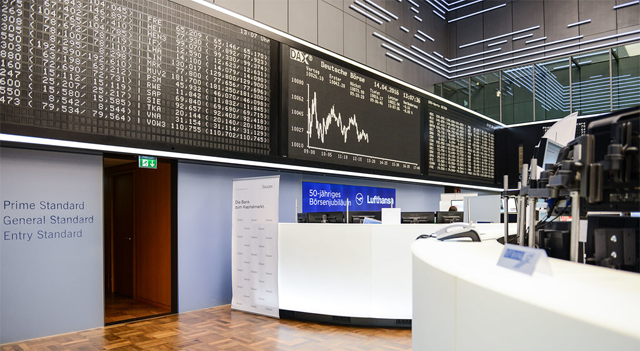
    European stocks traded mostly higher on Monday, rebounding after several sessions of weakness as investors looked for direction amid mixed corporate updates and steady economic data.

    The pan-European Stoxx 600 index rose 0.3%, recovering part of Friday’s 0.5% decline, which had marked its fourth consecutive day of losses. Germany’s DAX gained 0.8%, while the UK’s FTSE 100 hovered near the flatline, and France’s CAC 40 slipped 0.1%.

    Fresh data confirmed that eurozone manufacturing activity stagnated in October, as indicated by the final S&P Global Purchasing Managers’ Index, which came in at 50.0, matching the preliminary estimate and signaling no change in operating conditions. In September, the index had registered 49.8, reflecting a marginal contraction.

    In corporate news, BP Plc (LSE:BP.) advanced after agreeing to sell its stakes in U.S. shale assets to Sixth Street in a $1.5 billion deal. Meanwhile, Renault (EU:RNO) surged following the announcement that it will sell a 26.4% stake in its Brazilian subsidiary, Renault do Brasil, to China’s Geely Automobile.

    On the downside, Ryanair Holdings (LSE:0A2U) dropped sharply despite posting a 42% jump in first-half profits, as the airline warned of mounting fare pressure and external risks in the months ahead.

  • Five Key Market Themes to Watch This Week

    Five Key Market Themes to Watch This Week

    A busy trading week unfolds against the backdrop of a prolonged U.S. government shutdown, which continues to block major economic releases, including the nonfarm payrolls report. Meanwhile, the U.S. Supreme Court will take up a case examining the legality of Donald Trump’s tariff powers, while investors gear up for quarterly earnings from Advanced Micro Devices (NASDAQ:AMD) and Palantir Technologies (NASDAQ:PLTR). In the UK, attention centers on the Bank of England’s next policy decision, which remains too close to call.

    1. U.S. economic blackout deepens

    The federal government shutdown—now approaching historic length—continues to cloud the economic outlook. With key data delayed, investors and policymakers alike are flying blind. The September inflation report has already been published, but crucial employment figures, including the nonfarm payrolls and JOLTS job openings data, remain stuck in limbo.

    This data drought complicates the Federal Reserve’s ability to adjust policy. After a 25-basis point rate cut last week, Fed Chair Jerome Powell hinted that officials could move more cautiously going forward if the shutdown persists and essential indicators remain unavailable.

    Analysts at Vital Knowledge said the situation has created confusion, noting that “in some ways, people are feeling even more confused than before.” The lack of visibility has left markets uneasy despite last week’s major developments, including central bank decisions, blockbuster tech earnings, and renewed U.S.-China trade talks.

    Although The Wall Street Journal reported modest progress toward ending the shutdown, President Donald Trump’s push for Republicans to sidestep Democrats has complicated negotiations.

    2. Supreme Court revisits Trump’s tariff authority

    Trade policy returns to the spotlight this week as the U.S. Supreme Court hears arguments over the legality of Trump’s broad tariff powers. Lower courts have ruled that the former president exceeded his authority when he invoked emergency measures to impose higher tariffs on several nations.

    The justices will consider whether Trump’s use of the 1977 International Emergency Economic Powers Act (IEEPA) was constitutional. While the 6-3 conservative majority has often supported Trump’s policies, the outcome remains uncertain. Trump, the first president to rely on IEEPA for trade measures, justified his actions by citing the $1.2 trillion U.S. trade deficit and deaths linked to fentanyl.

    If the Court strikes down the tariffs, it could remove one of Trump’s key tools for leveraging trade negotiations during his second term.

    3. AMD earnings take center stage

    Chipmaker Advanced Micro Devices will report quarterly results on Tuesday, becoming the next major player in the AI semiconductor race to disclose performance. The company recently entered a $1 billion partnership with the U.S. Department of Energy to build two supercomputers for advanced research in cancer treatment and national security.

    AMD has also partnered with OpenAI to supply AI chips in a deal that could generate billions in annual revenue while giving the ChatGPT-maker a 10% equity stake. Executives described the partnership as “certainly transformative,” emphasizing its potential to accelerate AI adoption across industries.

    Despite the optimism, some analysts have drawn parallels to the dot-com bubble, warning that the flood of AI-related alliances could fuel speculative excess. Still, AMD’s stock has surged over 112% year-to-date, reflecting investor confidence in its growth trajectory.

    4. Palantir earnings in focus

    Palantir Technologies will also be in the earnings spotlight, with results due Monday after the market close. The data analytics and AI software firm—known for its deep ties to the U.S. defense sector—has been one of the year’s top-performing tech stocks.

    In August, Palantir raised its full-year revenue guidance for the second time in 2025, citing strong demand from both corporate clients and government agencies. The company has benefited from the Trump administration’s renewed focus on national security and the Pentagon’s shift toward commercial and “non-traditional” technology suppliers.

    Palantir is projected to post $1.09 billion in revenue and $255.6 million in operating profit, according to Bloomberg consensus. Shares have more than doubled this year as investors bet on its leadership in the AI software space.

    5. Bank of England decision approaches

    After last week’s expected moves by the Federal Reserve, European Central Bank, and Bank of Japan, investors now turn their attention to the Bank of England (BoE).

    Markets are leaning toward a pause in rate cuts, though there remains a 30% chance of a 25-basis point reduction. Holding rates steady would mark a break from the BoE’s year-long cycle of monetary easing. However, recent declines in inflation and wage growth—though still high—could strengthen the case for another cut.

    BoE Governor Andrew Bailey cautioned in September that the policy path ahead is “more uncertain,” reflecting challenges in balancing persistent inflation with slowing economic growth.

    As the week unfolds, investors will navigate a landscape shaped by missing U.S. data, shifting monetary signals, and the latest developments in the fast-evolving world of artificial intelligence.

  • Renault Sells 26.4% Stake in Brazilian Subsidiary to Geely

    Renault Sells 26.4% Stake in Brazilian Subsidiary to Geely

    Renault Group (EU:RNO) has finalized an agreement to sell a 26.4% stake in its Brazilian subsidiary to China’s Geely Holding Group, deepening the partnership between the two automakers in one of Latin America’s key markets.

    Under the deal, Geely Holding Group and Geely Automobile Holdings will gain access to Renault’s industrial resources in Brazil and begin producing Geely Auto–branded vehicles alongside Renault models at the Ayrton Senna plant.

    For Renault, the partnership provides an opportunity to integrate Geely’s vehicle platform—which supports electric and hybrid powertrains—into its production lines, enabling the French automaker to expand its range of low- and zero-emission vehicles for the Brazilian market.

    As part of the agreement, Renault do Brasil will also handle the distribution of Geely Auto’s electrified lineup, including sales, financing, and aftersales services, opening new growth channels for both brands.

    The Geely EX5 electric SUV is already available to Brazilian consumers through dealerships operated within Renault’s retail network, marking the first step in this expanded collaboration.

  • Campari Shares Plunge After €1.3 Billion Stake Seized

    Campari Shares Plunge After €1.3 Billion Stake Seized

    Campari (BIT:CPR) shares tumbled after Italian authorities seized a major stake in the company held by its controlling shareholder, Lagfin, the Luxembourg-based holding of Chairman Luca Garavoglia, as part of a tax fraud investigation. The seizure, carried out on Friday, October 31, involves shares valued at nearly €1.3 billion, representing part of Garavoglia’s 52% controlling interest in the spirits group.

    The Guardia di Finanza announced that the seizure was ordered by the preliminary investigations judge of the Monza court on charges of fraudulent declaration through other means and administrative liability of legal entities, according to a statement from the Monza Public Prosecutor’s Office. Both Garavoglia and Alberto Giovanni, Lagfin’s legal representative, have been listed as suspects.

    The probe originated from a tax inspection following the 2018 merger of Campari’s Italian subsidiary into Lagfin. Investigators allege that the group failed to declare over €5.3 billion in capital gains subject to Italy’s exit tax after the merger. Authorities believe Lagfin formally moved assets to a newly created Italian branch while keeping real financial control at its Luxembourg headquarters.

    According to the Guardia di Finanza, the seizure was executed “entirely through the placement of a lien on the ordinary shares of Campari,” corresponding to the amount of unpaid tax tied to the company’s transfer abroad.

    The news triggered an immediate market reaction: Campari’s stock dropped 4% in early trading on the Milan Stock Exchange, hitting €5.67, making it the worst performer on the FTSE MIB, which was up 0.7% at the time.

    The company swiftly issued two clarifications. In the first statement, Campari confirmed that “the dispute does not concern Davide Campari-Milano NV nor the Campari group,” adding that “there are no consequences” for the company or its operations.

    In a second release quoting Lagfin, the holding company emphasized that the issue “concerns a tax dispute that has been ongoing for approximately two years and which has never involved the Campari group in any way.”

    Lagfin further stated it “is certain that it has always operated in full compliance with all regulations, including Italian tax regulations, and will vigorously defend itself with calm rigor in all appropriate venues.”

    The company also reassured investors that “since Lagfin holds more than 80% of Campari’s voting rights, the measure is absolutely not capable of affecting Lagfin’s controlling stake in Campari.”

    Analysts, however, warned that the development could weigh on sentiment. JP Morgan said that “although the Campari group is not involved, the news could put pressure on the shares, with uncertainty lingering until the tax dispute is resolved.”

    Market strategists estimate the seized shares represent around 16% of Campari’s total market capitalization — a level they describe as “significant” if authorities were to sell them to recover unpaid taxes.

    Analysts at WebSim Intermonte noted that the tax dispute between Lagfin and Italian authorities “was already well known” and reiterated that “the measure does not affect Lagfin’s controlling stake in Campari.”

  • Dow Jones, S&P, Nasdaq, Wall Street Futures, Palantir Earnings in Focus; Trump Signals Tighter Rules on Nvidia Chips — What’s Moving Markets

    Dow Jones, S&P, Nasdaq, Wall Street Futures, Palantir Earnings in Focus; Trump Signals Tighter Rules on Nvidia Chips — What’s Moving Markets

    U.S. stock futures traded slightly higher on Monday as Wall Street looked ahead to another week of corporate earnings and a possible slowdown in key economic data releases amid the ongoing government shutdown. The extended closure — now lasting more than a month — threatens to delay another crucial reading on U.S. employment. Meanwhile, investors are watching for Palantir Technologies’ latest earnings and comments from President Donald Trump on restricting exports of Nvidia’s most advanced AI chips.

    Futures Edge Higher

    U.S. equity futures hovered near flat levels early Monday as investors weighed the market outlook following an eventful week of trading.

    By 03:08 ET, Dow futures were little changed, S&P 500 futures were up 3 points (0.1%), and Nasdaq 100 futures rose 33 points (0.1%).

    Wall Street ended last week on a positive note, with the major indexes logging gains after a flurry of tech earnings, central bank rate decisions, and direct trade talks between U.S. and Chinese leaders.

    A surge in Amazon (NASDAQ:AMZN) shares, following stronger-than-expected quarterly results, helped push U.S. markets higher, extending their longest monthly winning streak in years. Those gains offset pressure from Apple’s (NASDAQ:AAPL) warning about supply chain constraints ahead of the holiday season and cautionary comments from Federal Reserve officials that dampened hopes for more rate cuts before the end of 2025.

    Shutdown Threatens Key Labor Data

    Focus now shifts to the prolonged U.S. government shutdown, which is close to becoming the longest in the country’s history.

    The impasse has left investors and policymakers with limited visibility on the economy, as several critical data reports have been delayed. While inflation data for September was released last month, major employment indicators have yet to be published.

    The situation could persist this week, potentially delaying the nonfarm payrolls report, a key measure of the U.S. labor market usually released on the first Friday of each month. The Job Openings and Labor Turnover Survey (JOLTS) is also expected to be postponed.

    According to analysts at Vital Knowledge, “in some ways, people are feeling even more confused than before,” noting that the shutdown has partially deprived markets of a clear guide for the final stretch of the year.

    The Wall Street Journal reported late last week that lawmakers in Washington were making progress toward a deal to reopen the government, though President Donald Trump’s insistence that Republican senators bypass Democrats has cast uncertainty over negotiations.

    Palantir to Report After the Bell

    All eyes are on Palantir Technologies (NASDAQ:PLTR), which is set to announce quarterly results after markets close Monday.

    In August, the data analytics and defense software firm raised its full-year revenue outlook for the second time in 2025, citing robust demand for its AI-driven services from both corporate and government clients.

    A renewed focus by the Trump administration on strengthening national security, along with the Pentagon’s shift toward “non-traditional” and commercial suppliers, has further supported Palantir’s growth prospects.

    The company’s shares have more than doubled this year as investors bet it will remain a key player in the artificial intelligence wave and a beneficiary of higher U.S. defense tech spending.

    According to Bloomberg consensus forecasts, Palantir is expected to post a third-quarter operating profit of $255.6 million on revenue of $1.09 billion.

    Trump Comments on Nvidia Chip Exports

    Elsewhere, President Donald Trump said that Nvidia’s most advanced artificial intelligence processors would be restricted to U.S. buyers only, excluding customers in China and other countries.

    Speaking in an interview with CBS’ 60 Minutes and during remarks aboard Air Force One, Trump stated that Nvidia’s powerful Blackwell chips should remain in American hands:
    “We don’t give the Blackwell to other people,” he said.

    His comments came after noting that he and Chinese President Xi Jinping did not discuss chip access during their high-profile meeting in South Korea last week — despite Trump previously suggesting the topic might arise.

    The president’s latest stance indicates a potential move toward even tighter export controls on high-end U.S.-made AI technology.

    Oil Prices Extend Gains After OPEC+ Decision

    Crude prices climbed Monday after OPEC+ confirmed it will pause production increases during the first quarter of next year, helping ease fears of an oversupplied market.

    Brent futures rose 0.7% to $65.20 per barrel, while West Texas Intermediate (WTI) gained 0.7% to $61.41.

    The group of oil producers — which includes OPEC and its allies — agreed Sunday to raise output by 137,000 barrels per day in December, consistent with previous months. However, it will pause additional increases through the first quarter of 2026, citing concerns over a potential glut and softer demand during the winter.

    OPEC+ noted that January through March typically represents the weakest period for global oil consumption.

  • DAX, CAC, FTSE100, European Stocks Steady as Investors Await Manufacturing Data

    DAX, CAC, FTSE100, European Stocks Steady as Investors Await Manufacturing Data

    European markets opened the week on a cautious note Monday, with traders awaiting fresh regional manufacturing data for insight into the sector’s health.

    By 08:02 GMT, Germany’s DAX edged up 0.1%, the U.K.’s FTSE 100 rose 0.2%, while France’s CAC 40 slipped 0.1%.

    Manufacturing Data in Focus

    Market sentiment was slightly dented early Monday after private sector figures showed China’s manufacturing sector expanded at a slower pace than expected in October, reflecting cooling prices and a weaker economic outlook in the world’s second-largest economy.

    Still, the reading pointed to modest growth in contrast with last week’s official government PMI, which indicated a contraction.

    Investors now await similar purchasing managers’ index (PMI) data from major European economies — including Germany, France, and the eurozone as a whole — later in the session, followed by comparable reports from the United States.

    The European Central Bank left interest rates unchanged last week for a third consecutive meeting, with policymakers saying policy was in a “good place.” The ECB’s next and final meeting of the year is set for December, and economists broadly expect the bank to keep rates steady well into 2026.

    Sweden’s Riksbank will announce its rate decision on Wednesday, followed by the Bank of England on Thursday.

    European Markets Outperformed in October

    European equities outpaced U.S. markets last month, led by gains in the U.K., France, and Spain, according to Barclays in a note published Monday.

    The bank said solid third-quarter earnings and renewed investor appetite lifted regional markets despite continued global uncertainty.

    Globally, equities “continued to climb the wall of worries making new highs again in October,” Barclays noted, adding that concerns about “rising credit defaults in the U.S. and renewed U.S.-China trade spat pushed X-asset volatility higher,” though the effect was short-lived.

    The rally, the bank said, was driven by “resilient Q3 earnings” and “AI tailwinds,” which “boosted them to the highs.”

    Corporate Updates: Ryanair, PostNL, and Heineken

    Earnings activity was relatively light on Monday, though several key reports are expected later this week.

    Ryanair (NASDAQ:RYAAY) reported a 42% jump in first-half profit but cautioned that tougher year-over-year fare comparisons and geopolitical risks could weigh on results in the second half.

    PostNL (EU:PNL) posted a wider operating loss for the third quarter as higher costs and falling mail volumes offset modest parcel growth, keeping pressure on margins despite a small increase in revenue.

    Heineken (EU:HEIA) unveiled a new roadmap to 2030, pledging stronger sales and cost savings of up to €500 million annually by focusing on 17 key markets and a select group of global brands.

    Oil Prices Climb as OPEC+ Pauses Output Increases

    Crude prices advanced Monday after OPEC+ confirmed it will hold off on production hikes in the first quarter of next year, easing market fears of a potential supply glut.

    Brent futures rose 0.7% to $65.20 a barrel, while U.S. West Texas Intermediate (WTI) crude gained 0.7% to $61.41.

    The oil producers’ alliance — which includes the Organization of the Petroleum Exporting Countries and its partners — agreed Sunday to raise output by 137,000 barrels per day in December, consistent with the pace set for October and November.

    While the move was widely expected, the group also confirmed it will pause output increases through the first quarter of 2026, citing worries about a supply surplus and weaker demand during the typically slower winter months.

    OPEC+ noted that January through March tends to be the weakest period for global oil consumption.

  • Dollar Edges Higher Ahead of Key U.S. Private Sector Data

    Dollar Edges Higher Ahead of Key U.S. Private Sector Data

    The U.S. dollar moved slightly higher on Monday, hovering near a three-month peak as investors awaited fresh data to assess the strength of the U.S. economy.

    At 04:15 ET (09:15 GMT), the Dollar Index — which measures the greenback’s performance against six major currencies — was up 0.1% at 99.732, close to its strongest level since August.

    Focus Turns to Private Sector Indicators

    The dollar found support after last week’s Federal Reserve meeting, where policymakers cut interest rates by 25 basis points, as widely anticipated, but cast doubt on the likelihood of another reduction before year-end.

    As a result, markets have scaled back expectations for a December rate cut, now pricing in about a 68% chance of another move.

    With the ongoing U.S. government shutdown expected to delay the release of key labor data — including Friday’s nonfarm payrolls report and job openings earlier in the week — investors are turning their attention to privately sourced economic indicators.

    “Today sees the ISM manufacturing release for November, which contains the employment component,” said analysts at ING, in a note. “It’s not clear if we will see the JOLTS job opening data tomorrow, but on Wednesday, the monthly ADP jobs release will be a big market mover – and probably the biggest chance of the week for the dollar bear trend to restart.”

    Euro Near Three-Month Low

    In Europe, the euro weakened, with EUR/USD down 0.2% to 1.1511, hovering near a three-month low. Data showed that Germany’s manufacturing sector continued to struggle in October, while France’s output also remained subdued in the early part of the fourth quarter.

    The European Central Bank kept interest rates steady at 2% for the third consecutive meeting last week, signaling that policy was in a “good place” as downside risks to growth appear to ease.

    “We do get a heavy slate of European Central Bank speakers,” said ING. “ECB rhetoric looks unlikely to help EUR/USD, however. The debate leans more towards whether eurozone inflation undershoots and the ECB requires another rate cut.”

    Meanwhile, GBP/USD slipped 0.2% to 1.3123 ahead of this week’s Bank of England policy meeting, where rates are widely expected to remain unchanged. The pound also faced pressure from political uncertainty surrounding Finance Minister Rachel Reeves, who is set to deliver the government’s budget later this month.

    Asia: Yen and Aussie in Focus

    In Asia, USD/JPY edged up 0.1% to 154.20, keeping the yen near its weakest level since early February. The Bank of Japan left interest rates unchanged last week, as expected, though Governor Kazuo Ueda suggested that a rate hike could be on the table depending on future wage growth trends.

    The USD/CNY pair traded slightly higher at 7.1192 after touching a one-year low last week. Private purchasing managers index data showed China’s manufacturing sector expanded more slowly than forecast in October, although it remained in growth territory — a contrast to the government’s PMI data released earlier, which indicated contraction.

    Meanwhile, the AUD/USD pair rose 0.1% to 0.6552, with attention turning to the Reserve Bank of Australia’s meeting on Tuesday. The RBA is expected to keep rates unchanged but may strike a more hawkish tone following hotter-than-expected inflation data in the third quarter.

  • Oil Extends Gains as OPEC+ Pauses First-Quarter Production Increases

    Oil Extends Gains as OPEC+ Pauses First-Quarter Production Increases

    Oil prices rose on Monday after OPEC+ announced it would suspend planned output hikes during the first quarter of next year, easing market concerns over a potential supply surplus. Gains, however, were limited by weaker-than-expected manufacturing data across Asia.

    By 07:22 GMT, Brent crude futures were up 28 cents, or 0.43%, at $65.05 a barrel, while U.S. West Texas Intermediate (WTI) crude gained 25 cents, or 0.41%, to $61.23 a barrel.

    The Organization of the Petroleum Exporting Countries and its allies, collectively known as OPEC+, confirmed on Sunday that it will increase production by 137,000 barrels per day in December — consistent with levels set for October and November.

    “Beyond December, due to seasonality, the eight countries also decided to pause the production increments in January, February, and March 2026,” the group said in a statement.

    According to Warren Patterson, Head of Commodities Research at ING, the decision signals OPEC+’s recognition of “the large surplus that the market faces, particularly through early next year.” He added, “Obviously, still plenty of uncertainty over the scale of the surplus, which will be dependent on how disruptive U.S. sanctions will be to Russian oil flows.”

    Helima Croft, Head of Commodities Strategy at RBC Capital, also pointed to Russia as “a key supply wild card” following U.S. sanctions on major producers Rosneft and Lukoil, and amid ongoing attacks on the country’s energy infrastructure related to the war in Ukraine. “There is ample ground for a cautious approach given the uncertainty over the Q1 supply picture and the anticipated demand softness,” she said.

    Over the weekend, a Ukrainian drone strike hit the Tuapse oil terminal, one of Russia’s main Black Sea export hubs, sparking a fire and damaging at least one vessel.

    Both Brent and WTI posted losses of more than 2% in October, marking their third straight monthly decline. Prices hit a five-month low on October 20 amid concerns about oversupply and the potential economic drag from U.S. tariffs.

    A Reuters poll showed analysts keeping oil price forecasts largely steady, as increased OPEC+ output and subdued demand continue to offset geopolitical supply risks. Estimates for market oversupply ranged widely, from 190,000 barrels per day to as much as 3 million bpd.

    Meanwhile, the U.S. Energy Information Administration reported on Friday that American crude output rose by 86,000 barrels per day in August, reaching a record 13.8 million bpd.

    Asian economies — the world’s largest consumers of oil — continued to struggle in October, with business surveys pointing to soft demand and U.S. tariffs under President Donald Trump weighing on factory activity across the region.

    On Friday, Trump denied reports that he was considering military strikes inside OPEC member Venezuela amid speculation that Washington might broaden its operations targeting drug trafficking in the country.

  • Gold Edges Higher but Faces Pressure from Fed Uncertainty and Improved Trade Sentiment

    Gold Edges Higher but Faces Pressure from Fed Uncertainty and Improved Trade Sentiment

    Gold prices ticked up slightly in Asian trading on Monday, though the precious metal remained under pressure following two straight weeks of losses. Uncertainty over the U.S. Federal Reserve’s rate outlook and easing global trade tensions have both weighed on investor demand for safe-haven assets.

    Spot gold rose 0.4% to $4,017.13 an ounce by 01:19 ET (06:19 GMT), while U.S. gold futures gained 0.8% to $4,027.55. Despite the modest rebound, gold fell more than 2% last week—its second consecutive weekly decline—though it still posted a 4% gain for October overall.

    Fed Caution and Trade Optimism Pressure Bullion

    The metal’s softness comes despite the Fed’s recent 25-basis-point rate cut, a move that typically supports non-yielding assets like gold. However, Fed Chair Jerome Powell said additional rate cuts were “not a foregone conclusion,” dampening investor optimism. His remarks, echoed by other central bank officials, have led markets to scale back expectations for another cut in December, boosting the U.S. dollar and exerting downward pressure on bullion.

    The U.S. Dollar Index hovered near three-month highs early Monday, making gold more expensive for non-U.S. buyers.

    Meanwhile, easing geopolitical tensions also limited demand for safe-haven assets. A meeting between U.S. President Donald Trump and Chinese President Xi Jinping in Busan last week ended with both leaders agreeing to reduce trade barriers. The discussions reportedly included a preliminary framework for U.S. tariff reductions and Chinese commitments to increase imports of American goods.

    While the talks stopped short of a full trade deal, the detente helped calm markets after months of escalating friction between the world’s two largest economies, further curbing gold’s appeal.

    Other Precious Metals Advance; Copper Slips on Weak China Data

    Elsewhere in the metals market, silver futures rose 1.1% to $48.705 per ounce, and platinum futures jumped 1.8% to $1,603.60 per ounce. Industrial metals were mixed, with benchmark copper futures on the London Metal Exchange steady at $10,903.20 a ton, while U.S. copper futures edged down 0.1% to $5.11 a pound.

    A private survey released Monday showed that China’s manufacturing sector expanded at a slower-than-expected pace in October, as weaker prices and a softening economic outlook continued to weigh on factory activity.